Portuguese
  Spanish


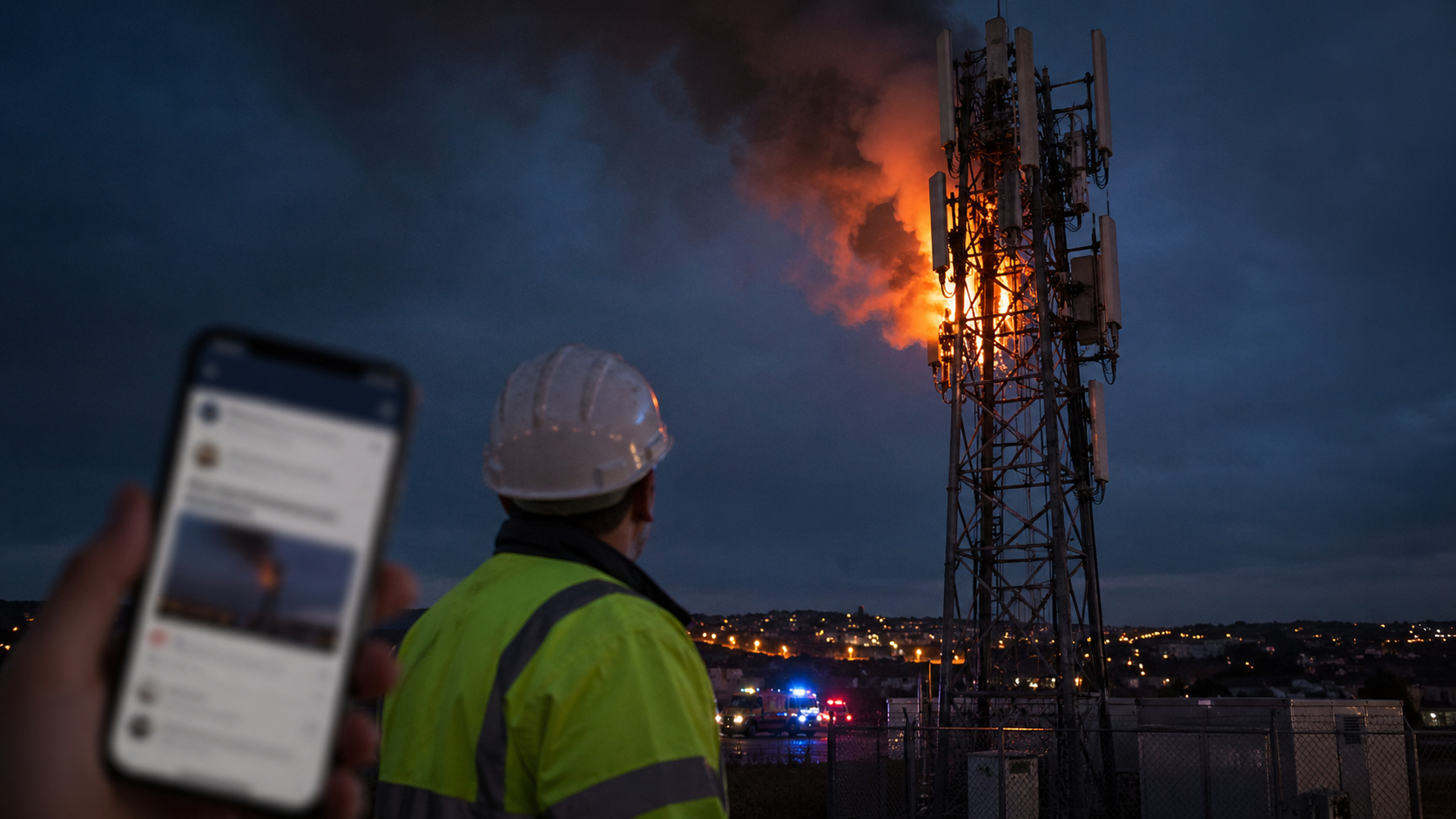

Rumor about 5G antennas left social media, turned into physical attacks against cell towers, affected networks used during the pandemic, and showed how fake news can cause real damage outside the internet
The fake news about 5G and biological virus left social media and turned into attacks against cell towers. The investigation was published by ABC News, an international news site, and showed that fires against telecommunications structures alarmed authorities and experts in the United Kingdom.
The rumor claimed that 5G antennas could spread a viral disease or weaken the human body’s defense system. The theory had no scientific basis but gained traction during a time of collective fear, when the population relied even more on phones, the internet, and stable connections.
The case became a warning because the lie affected essential infrastructure. Hospitals, ambulances, families and telecommunications technicians depended on these networks to keep services running during the health crisis.
-
Spain Launches World’s Largest Floating Dry Dock: 56-Meter Giant Produces Massive Concrete Structures in A Coruña Using Technology Proven in Brazil

-
AI-powered toys that talk, recognize faces, and collect data face scrutiny from Brazilian government over children’s privacy concerns

-
4,000-Year-Old Child’s Skull Unveils Ancient Burial in 7,500-Year-Old Norwegian Rock Shelter, Impressing Archaeologists

-
Norway Defeats Brazil in World Cup but Invests Billions to Preserve the Amazon, Strengthens Amazon Fund, and Joins Brazil in Leading Global Effort Against Tropical Deforestation



How a lie about 5G turned into fires against cell towers
The conspiracy theory grew because it combined two difficult topics for many people: a new technology and a disease that frightened the world. The narrative seemed simple to those looking for a quick explanation. The problem was that it was false.
The idea that an antenna could transmit a biological virus completely confused the functioning of the mobile network. 5G is a communication technology. It uses radio waves to carry signals, not disease particles.


Even so, the rumor spread on social media and influenced attacks against towers. Some structures hit weren’t even 5G but were treated as symbols of an imaginary threat.
Scientists explained that antennas do not transmit biological viruses
The scientific explanation is straightforward: biological viruses do not travel via cell signal. Antennas transmit communication through radio waves, while a viral disease depends on biological agents.
Microbiologist Simon Clarke from the University of Reading responded to the supposed link between 5G and viral disease with a short phrase: “Absolutely none.” The statement was recorded by ABC News, an international news site, detailing experts’ reactions to the rumor.
Eric Van Rongen from the International Commission on Non-Ionizing Radiation Protection also emphasized that electromagnetic fields carry energy but do not carry particles. In simple terms, the antenna transmits a signal, not a disease.
The fake news put essential services at risk during the health crisis
The biggest problem was not just the lie itself. The damage appeared when misinformation turned into physical action. By hitting cell towers, the attacks threatened the communication used by those who most needed help.
Families depended on phones to talk to relatives. Health professionals needed connections to work. Emergency services also relied on mobile networks to maintain quick contact and service.
Therefore, the case shows that fake news is not just a wrong opinion when it leads someone to destroy public infrastructure. The consequence can reach those who had nothing to do with the rumor.
Telecommunications technicians also became targets of collective fear
In addition to the burned towers, workers in the sector began to face hostility. Technicians responsible for installing, repairing, and maintaining networks were associated with the false theory circulating on the internet.
These professionals had an essential role at that time. They kept communication active during a period when isolation, hospitals, and public services depended even more on the connection.
The intimidation against workers shows another serious effect of misinformation. When a lie gains strength, ordinary people can be treated as guilty for something that does not exist.
The case became an example of disinformation that leaves the screen and impacts real life
The story of the burned towers became known as an example of a digital fire. The expression helps to understand how an online lie can spread quickly, gain emotion, and result in material damage.
The chain was clear. First came the viral post. Then, influential profiles amplified the fear. Subsequently, people began to believe that an antenna was a threat. Finally, the theory turned into fire against cell towers.
This path shows the risk of sharing content without checking. A false message might seem like just another social media post, but it can push other people towards dangerous actions.
Why the 5G rumor convinced so many people
The power of this fake news came from fear. In a health crisis, many people look for simple answers to complex problems. The antenna became a visible target, easy to blame and easy to attack.
Another important point is that 5G technology was still poorly understood by a large part of the population. When clear explanations are lacking, rumors fill the void and begin to seem true to those who are already scared.
The case thus shows the importance of simple language in science and technology. Explaining well is not a detail. In crisis situations, clear information can prevent panic, damage, and violence.
The warning left by attacks against cell towers
The false link between 5G and viral disease showed how a lie can cross the internet and cause real physical harm. The attack against cell towers hit a structure that helps keep hospitals, ambulances, families, and workers connected.
The episode also left an important lesson. Before sharing an alarming report, it is necessary to check the origin, understand who published it, and be suspicious of explanations that are too easy for complex problems.
Do you think social media should act faster when fake news starts to put essential services at risk? Leave your opinion in the comments and share this post with anyone who needs to understand how an online lie can turn into real-life damage.