






 Portuguese
  Spanish
  6 min of reading
  0 comments


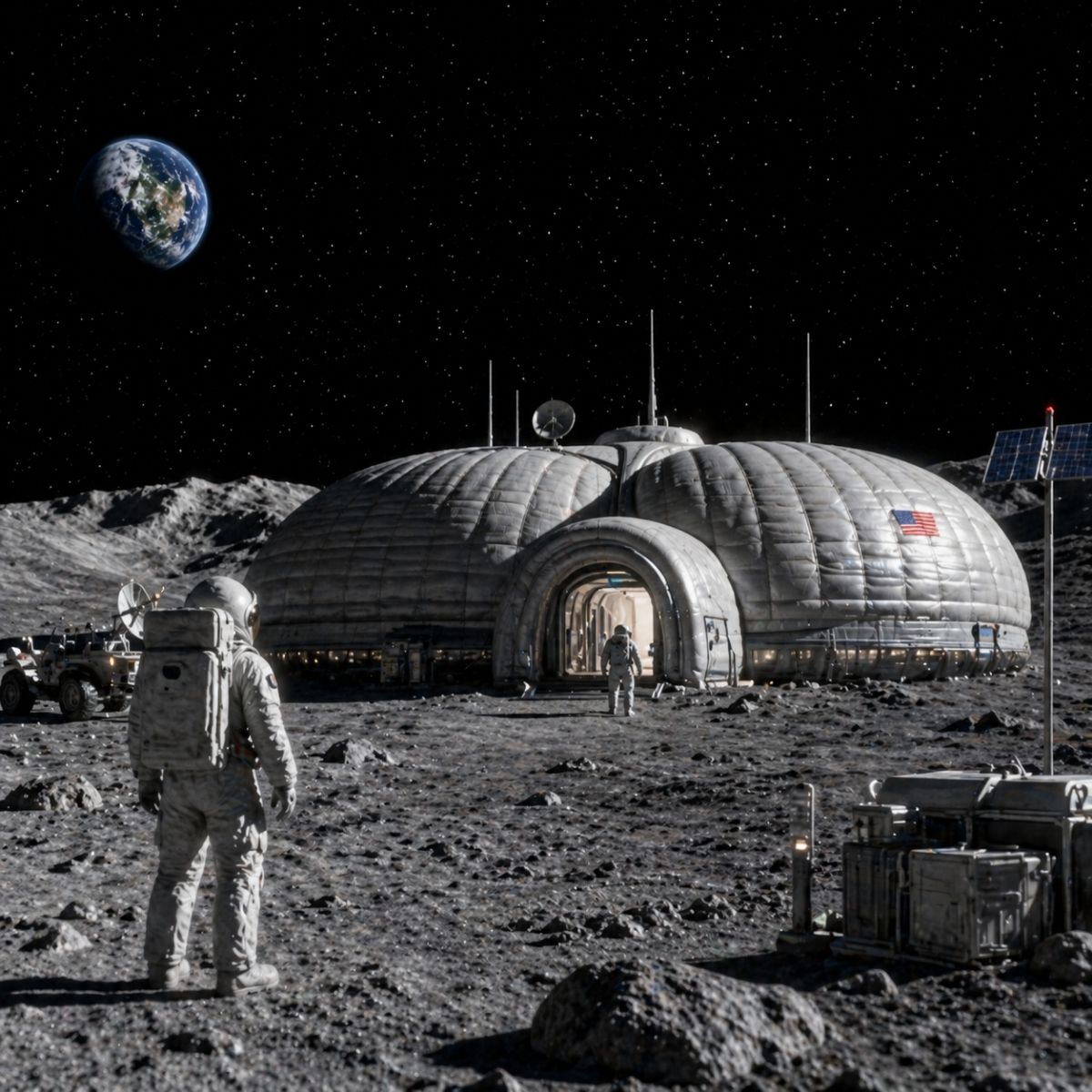
Dylan Taylor, CEO of Voyager Technologies, predicts humans living on the Moon by 2032 in a base with an inflatable habitat, while NASA has redesigned the Artemis program and projects mission 4 for the first human landing on the lunar south pole in 2028, more than 50 years after Apollo 17.
The CEO of space technology company Voyager Technologies believes the Moon will have permanent residents before the end of this decade. Dylan Taylor stated in an interview with CNBC that people will be living and working on Earth’s natural satellite around 2030 or 2032, a prediction that gains context after the success of the Artemis 2 mission, which raised global expectations for new crewed missions to the Moon and placed the human return to the lunar surface as a concrete goal and no longer a distant aspiration. For Taylor, the race for the Moon is just beginning, and the base that will allow prolonged habitation will likely be an inflatable habitat equipped with life support systems capable of sustaining humans in an environment where there is no atmosphere, liquid water, or natural radiation protection.
The CEO’s prediction coincides with a moment of reorganization in NASA’s plans. The Artemis 3 mission, which was originally intended to take astronauts back to the Moon’s surface, has been redefined as a crewed test flight in Earth orbit scheduled for mid-2027, and the program’s first human landing has been moved to Artemis 4, now projected for 2028 with a focus on the lunar south pole. The postponement reflects technical challenges that a recent NASA audit identified, but it does not alter the overall trajectory: humanity is moving towards returning to the Moon more than 50 years after the last footprint left by Apollo 17 in 1972, and this time the intention is to stay.
What Dylan Taylor predicts as a base for humans to live on the Moon

The Voyager Technologies CEO’s vision for lunar habitation involves inflatable structures, a technology that takes up little space during transport and expands upon reaching its destination, creating internal environments with sufficient volume to accommodate crews for extended periods. Inflatable habitats are considered one of the most viable solutions for the Moon because they can be launched compacted inside rockets and then pressurized on the surface, generating habitable spaces without the need to build rigid structures with materials brought from Earth, a process that would be exponentially more expensive and complex. Life support within these bases would include air and water recycling systems, protection against cosmic radiation, and thermal regulation to cope with temperature variations on the Moon, which fluctuate between 127°C during the day and minus 173°C at night.
-
New Realme phones have a giant battery of up to 7,500 mAh, military-grade durability, Android 16, and an affordable price; meet the P4x and P4 Lite.

-
For the first time, researchers find the fuel of the first stars in galaxies formed only 700 million years after the Big Bang.
-
Silent invasion in the Amazon raises alarm: 82 exotic animals and 59 plants threaten native species, crops, and the forest’s balance, while authorities rush to prevent something worse caused by invasive species.

-
Scientists have created a material six times lighter than air, 75 times lighter than styrofoam, and that becomes stronger the more it is compressed: aerographite seems impossible, but it can reinforce structures, batteries, and satellites.



The most probable location for this base is the Moon’s south pole, a region that attracts scientific interest for harboring permanently shadowed craters where water ice exists. This ice could be extracted and processed to provide potable water, breathable oxygen, and even hydrogen for fuel, resources that would make the base partially self-sufficient and reduce dependence on supplies sent from Earth. Taylor did not specify whether Voyager Technologies will directly participate in the construction of these bases, but the company already operates in the sector with the Starlab project, a commercial space station that is scheduled to replace the International Space Station when it is retired in 2030.
Why NASA postponed the Moon landing and what this changes in the plans

The Artemis program’s timeline has undergone revisions that directly affect the timeframe for humans to return to the Moon. Artemis 3, previously planned as a landing mission, has been downgraded to a crewed test flight in Earth orbit scheduled for mid-2027, a decision that transferred the first human contact with the lunar surface to Artemis 4, now estimated for 2028. A NASA audit indicated that the landing could be delayed by up to three years beyond the original plan, a scenario that would place Taylor’s goal of Moon residents by 2032 within a tight but not impossible window.
The success of Artemis 2, which took astronauts around the Moon without landing, demonstrated that the program’s fundamental systems work. The SLS rocket and the Orion capsule completed the crewed mission that was a prerequisite for all subsequent stages, validating NASA’s ability to safely send people to the lunar vicinity. The remaining question is not whether humans will return to the Moon, but when the landing system will be ready to take them to the surface and, subsequently, when the infrastructure will allow them to remain there for periods that justify the classification of “living” rather than just “visiting”.
What Voyager Technologies has to do with the future of the Moon
Voyager Technologies went public last June and positions itself as a space infrastructure company with projects extending beyond Earth’s orbit. Starlab, the company’s main initiative, is the commercial space station designed to take over the functions of the ISS after its retirement in 2030, and the experience accumulated in this project gives the company technical knowledge about life support systems in a space environment that could be transferred to lunar habitats. Dylan Taylor also predicts that operational data centers in space will be up and running within five years, a vision that indicates the breadth of the company’s ambitions.
The CEO acknowledges that significant technical challenges remain. Keeping humans alive on the Moon for extended periods requires solutions to problems that the ISS faces on a smaller scale in Earth’s orbit: radiation, microgravity (on the Moon it’s one-sixth of Earth’s), abrasive lunar dust that damages equipment and lungs, and the psychological isolation of living 384,000 kilometers from the nearest civilization. Each of these obstacles has a theoretical solution, but none has been tested in practice for periods longer than a few days, and the interval between 2028 and 2032 is short to solve everything simultaneously.
What it means for humanity to return to the Moon after more than 50 years
The last time a human set foot on the Moon was in December 1972, when the Apollo 17 astronauts left the satellite after three days of exploration. Since then, more than half a century has passed without any nation sending crews back, an interval that transformed the lunar landing from a routine conquest into a historic feat that an entire generation knows only through photographs and videos. The return planned by the Artemis program and Taylor’s prediction of permanent residents by the beginning of the next decade represent not only technological advancement but a paradigm shift: the Moon would cease to be a destination for brief expeditions and become a place of continuous work and research.
For Taylor, the race for the Moon is just beginning. If his prediction is confirmed and humans are living in inflatable habitats on the lunar surface by around 2032, the 2030s will be remembered as the period when humanity ceased to be an exclusively terrestrial species and took the first concrete step towards becoming a multi-planetary civilization. The Moon is the most accessible laboratory we have to learn to live off Earth, and each base built there will be a rehearsal for the much greater challenge that comes next: Mars.
And you, do you believe humans will live on the Moon this decade or do you think the timelines are too optimistic? Leave your opinion in the comments.






Be the first to react!