Portuguese
  Spanish


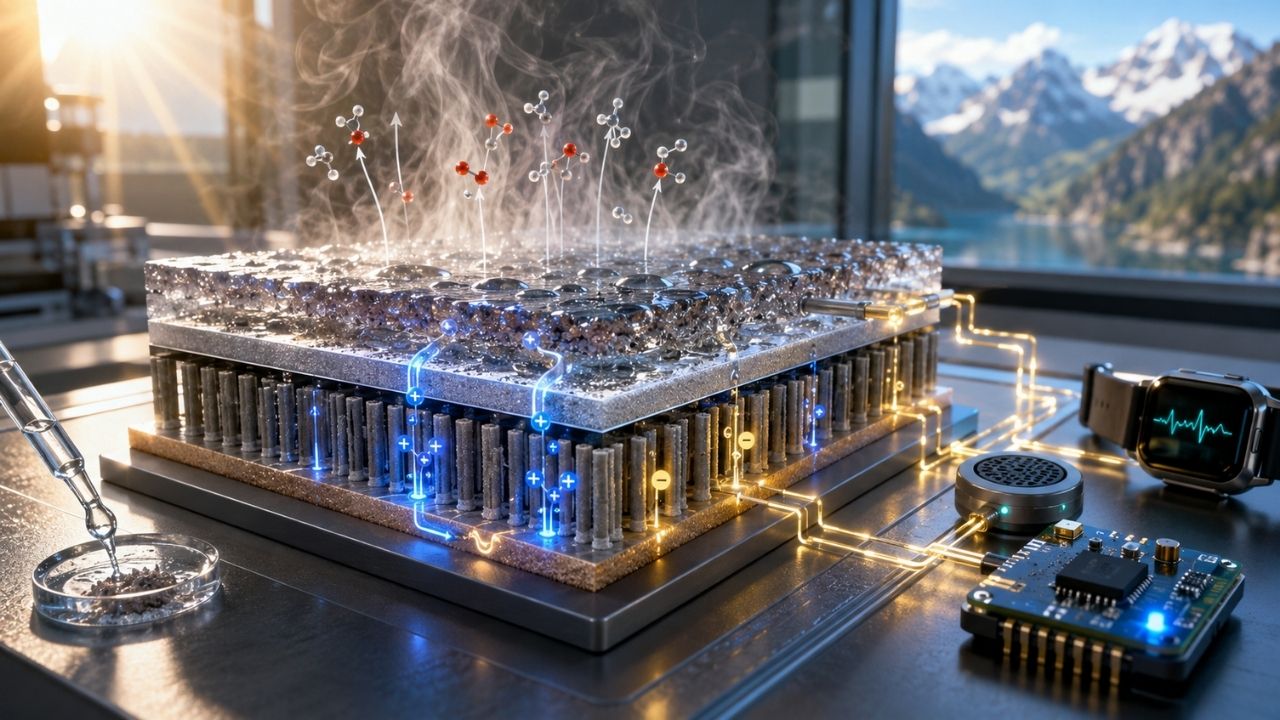

With evaporating saltwater, EPFL researchers have developed a three-layer hydrovoltaic nanodevice that uses heat and light to control ions and electrons. The technology reached one volt and 0.25W/m², targeting environmental sensors, wearables, and the Internet of Things where water, heat, and sunlight are available without an external battery.
Saltwater has become the basis for a nanodevice capable of producing continuous electricity from evaporation, in research by the Swiss Federal Institute of Technology Lausanne, EPFL, in Switzerland. The study, published in Nature Communications, involves researchers from the Laboratory of Nanoscience for Energy Technology, led by Giulia Tagliabue.
According to EPFL, the current work develops a platform presented in 2024 to study the hydrovoltaic effect, a phenomenon where the passage of a fluid over a charged surface can generate electricity. Now, the team has demonstrated a system that combines evaporation, heat, sunlight, ions, and electrons in a structure designed for autonomous low-power applications.
Evaporation of saltwater starts to generate stable current

The device’s principle starts from a common situation: evaporation. When saltwater evaporates over the nanodevice’s structure, the ions present in the fluid move, creating separations between positive and negative charges at the liquid-solid interface.
-
Brazilian Startup Converts Tucumã Seeds into Bioplastic for Bicycle Pedals, Cups, and Construction Materials

-
NASA Captures Rare Encounter of South Korean “Surfboard” Spacecraft Crossing Lunar Orbit at Over 11,000 km/h

-
Germany Opens World’s Largest Smart Power Semiconductor Factory with €5 Billion Investment, Creating 1,000 Jobs and Doubling Capacity for AI and Energy Needs

-
Kazakhstan’s Torysh Valley Holds Thousands of Giant Stone Spheres, Intriguing Scientists with Ancient Oceanic “Cannonballs”



This charge separation forms an electric field capable of driving electrons through a connected circuit. The difference is that EPFL’s system does not use heat and light just to accelerate evaporation, but to control the movement of ions in the water and the flow of electrons in the silicon material.
Three layers separate evaporation, ions, and electrical collection

The nanodevice was designed with three distinct layers. One is linked to evaporation, another to ion transport, and the third to electrical charge collection. This separation allows for better observation of each stage of the process and more precise adjustment of the system’s performance.
The structure includes silicon nanopillars arranged to create channels for the evaporation of saltwater. These pillars are coated with an oxide layer, designed to protect the material against undesirable chemical reactions and maintain stability under heat and light.
Heat and sunlight enhance energy production
In many studies on evaporation, heat and light are mainly seen as accelerators of the process. In EPFL’s research, these factors gain another function: they help intensify the electrical effects within the nanodevice.
Since silicon is a semiconductor, photons from sunlight excite electrons in the material. At the same time, heat increases negative charges on the surface, while the evaporation of saltwater moves ions. According to Giulia Tagliabue, the combination of light and solar heat can increase energy production by up to five times.
Power is small, but it can serve autonomous devices
The system achieved a voltage of 1 V and a power density of 0.25 W/m². These numbers do not indicate large-scale electricity generation, like a power plant, but are relevant for small and distributed applications, especially when the goal is to power battery-free sensors.
The proposal makes sense in scenarios where saltwater, heat, and sunlight are available. The focus is on low-power devices, such as environmental sensors, wearable equipment, and internet of things applications, which need autonomous, stable, and localized sources.
Stability in a saline environment is an important point


Working with saltwater presents a technical challenge: materials can degrade over time in corrosive environments. The EPFL team highlights that oxide-coated nanopillars help protect the device and prevent chemical reactions that could compromise performance.
This point differentiates the proposal from high-voltage systems that can suffer degradation when exposed to heat, light, and salinity. Stability is crucial for any practical application because autonomous sensors need to operate for long periods without constant maintenance.
Research targets sensors, wearables, and the internet of things
The researchers believe the advancement can accelerate the development of hydrovoltaic devices. The idea is to create small energy sources for sensor networks in places where battery replacement is expensive, difficult, or impractical.
Among the cited applications are environmental monitoring, wearable devices, and the internet of things. In all these cases, saltwater in evaporation could function as part of a local energy source, taking advantage of natural conditions of heat and light to keep systems operating.
The EPFL nanodevice shows how saltwater can cease to be just an evaporating fluid and become part of an experimental platform for electricity generation. The proposal combines nanotechnology, silicon, solar heat, light, and ion movement into a system aimed at continuous and autonomous electricity.
There is still a gap between laboratory and widespread use, but the concept raises an interesting question: can small energy sources spread throughout the environment reduce the dependence on batteries in sensors and connected devices? Do you believe that technologies like this can change the internet of things, or do they still seem too limited? Leave your opinion in the comments.