






 Portuguese
  Spanish


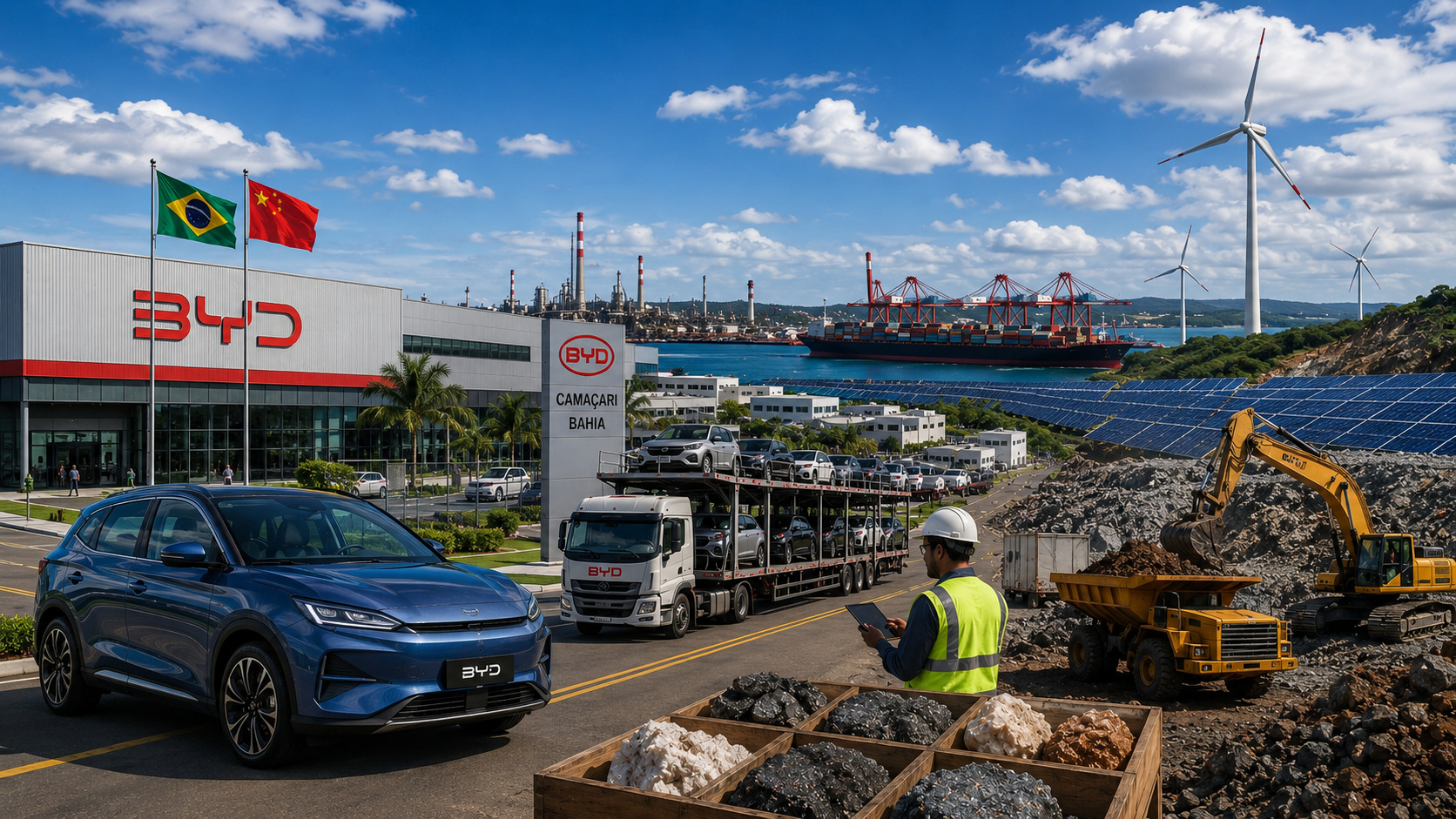

With 24 Chinese projects between 2007 and 2025, Bahia consolidates itself as the most attractive state in the Northeast and gains strength in a new investment route connecting the automotive industry, BYD electric vehicles, mining, critical minerals, electricity, clean energy, low-carbon technology, and the productive resumption of Camaçari in the Brazilian economic scenario
Bahia has come to occupy a strategic place on the map of Chinese investments in Brazil, after gathering 24 projects between 2007 and 2025 and taking the lead in the Northeast for this type of investment.
According to a survey by the Brazil-China Business Council (CEBC), the state ranked 4th nationally, behind only São Paulo, Minas Gerais, and Goiás.
This advancement occurs at a decisive moment. In 2025, Brazil was the country that received the most Chinese investments in the world, with 10.9% of the global value applied by China.
-
Brazil’s 2026 Tax Refund: Record 9.58 Million Filers in Largest Payout Ever, But a Key Detail on Priority Recipients Draws Nationwide Attention

-
Itaú Alters Hybrid Work Model, Increasing Office Days from 2028, Prompting Employees to Adjust to New Routine
-
Facing Labor Shortage, Japan Plans to Invest $34 Million to Attract Foreign Workers in Construction, Healthcare, Industry, and Commerce

-
Brazilian City Makes Remarkable Leap, Becomes 4th Wealthiest in the Country with GDP of R$ 134.1 Billion




In the same period, Chinese investments in the country reached US$ 6.1 billion, the highest value since 2017 and an increase of 45% compared to 2024.
Why Bahia entered China’s radar
Bahia gained strength because it brings together sectors considered strategic for China. These include critical minerals, clean energy, manufacturing industry, tourism, and high technology.
At the same time, in 2025, seven of the nine states in the Northeast received Chinese investments. These contributions were mainly directed to electricity, mining, and manufacturing industry.
In this scenario, Bahia received two Chinese projects in 2025, the same number registered by Paraíba, Maranhão, and Ceará.
With this, the state reinforced its position as one of China’s main entry points into the Brazilian Northeast.

BYD reignites Camaçari’s automotive hub
The automotive sector played a central role in this turnaround. In 2025, the inauguration of BYD’s factories in Bahia marked a new phase for Camaçari.
The arrival of the Chinese automaker helped fill part of the gap left by the closure of the Ford factory in 2021.
In addition to this industrial movement, the expansion occurs at a time of growth for electrified vehicles in Brazil. Therefore, Bahia has become part of a chain directly linked to the energy transition.
According to the Federation of Industries of the State of Bahia (FIEB), the Bahian economy is expected to grow by 1.4% in 2026. This advance should be driven by the Camaçari automotive hub and the expansion of services in Salvador.
Meanwhile, employment growth in Camaçari shows the resumption of the regional productive chain. Therefore, the trend is for new demands for Bahian industry.
Mining expands Bahia’s strategic weight
In addition to the automotive sector, mining also strengthens the relationship between Bahia and China.
In the first quarter of 2026, according to the Brazilian Mining Institute (IBRAM), Bahia recorded the 3rd highest mineral revenue in Brazil, with a share of 6%.
The state was behind only Minas Gerais, with 38%, and Pará, with 35%.
Similarly, Bahia appears among the main destinations for mineral investments planned for 2026 to 2030, with US$ 11.687 billion and a 15.2% share of the sector’s total.
In 2025, the Chinese company CMOC made one of the largest mining acquisitions among Chinese companies. The company bought gold mines from the Canadian Equinox Gold, including assets in Bahia and other states, in a transaction of approximately US$ 1 billion.

Energy, mining, and electric vehicles form the new chain
Chinese investments in Brazil show a clear change in direction. In 2025, the electricity sector led the investments, with 29.5% of the total and US$ 1.79 billion.
Immediately after, mining received US$ 1.76 billion, more than triple the amount recorded in 2024.
Meanwhile, the automotive sector came in third, with US$ 965 million and a 15.8% share.
Thus, Bahia became relevant because it connects three strategic fronts: critical minerals, electrified vehicles, and clean energy.
This integration can strengthen national production chains and open space for innovation, industrial diversification, and low-carbon technologies.
What this turning point represents for Bahia
Bahia has ceased to be merely a regional investment destination and has begun to compete for space in more sophisticated global chains.
In addition, the Chinese presence in sectors such as mining, electricity, and electric vehicles reinforces the state’s role in the energy transition.
However, this progress also brings challenges. The main one will be to prepare the local workforce to meet the demands of new industrial and automotive technologies.
If this qualification advances, Camaçari could consolidate itself as a technological and resilient automotive hub in the Northeast.
Meanwhile, Bahia’s mining sector can expand its connection with the low-carbon industry and electrified vehicles.
Given this scenario, Bahia enters a phase of strategic competition for investments, jobs, and technology. Will the state be able to transform this Chinese interest into lasting industrial development?









