






 Portuguese
  Spanish


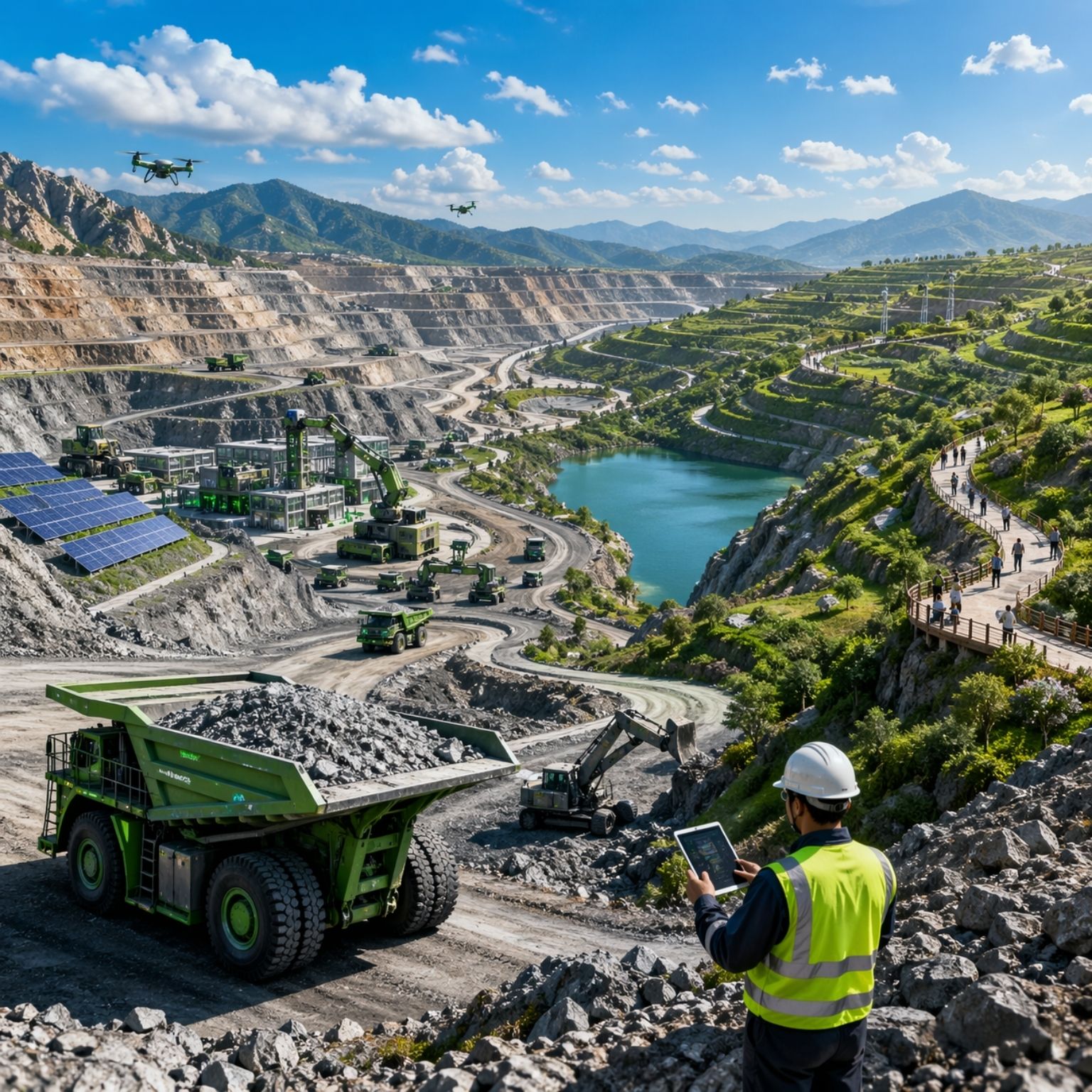

With mining as an environmental and economic priority, the country consolidates the model of “green mines” into law, adopts intelligent operation, and showcases cases in Gansu, Hunan, and Inner Mongolia that combine restoration, photovoltaic energy, and industrial tourism
China has announced that it has already built more than 5,500 green mines at the provincial level or above, a milestone that indicates concrete progress towards more sustainable and environmentally friendly mining. This information was presented by natural resources authorities at a press conference in Beijing, on the eve of Earth Day, highlighting that green mining has ceased to be an exception and has become a standard to be pursued.
The movement draws attention due to its scale and the package of measures that accompanies the number. In addition to goals and project selection, China claims to have incorporated green mining requirements into the Mineral Resources Law and the Ecological Environment Code, strengthening the legal framework, and has been expanding solutions such as solar plants, electric trucks, and intelligent operations, while accelerating environmental recovery and attempting to requalify old mined areas as tourist attractions.
Green mining becomes state policy and gains legal support
According to Dong Qingji, deputy director-general of the mineral resources protection and supervision department of the Ministry of Natural Resources, the construction of green mines has become a consensus among local governments, regulatory bodies, mining companies, and the public. The central message is that sustainable mining does not depend solely on a one-off project, but on a system.
-
China Develops Custom 140-Ton Electric Mining Truck with 770 kWh Swappable Battery, Deploys 290 Units in Xinjiang’s Largest Zinc Mine

-
Meta to Launch Arena, a New Prediction App Targeting 3.56 Billion Users, Competing with Polymarket and Kalshi

-
Scientist Challenges Famous Human Evolution Theory, Argues Homo Sapiens Evolved Gradually Over Thousands of Years
-
15-Year-Old American Builds Ocean Generator with PVC Pipe and 3D-Printed Propeller for $12, Wins National Prize, Presents at White House, and Makes Forbes 30 Under 30 List




This system, described as already widely implemented, combines government guidance, inter-departmental coordination, business leadership, and public supervision. In practice, this means that green mining is required from planning to operation, with demands incorporated into national legal milestones.
The numbers that explain the turnaround: more than 5,500 green mines and a new national selection
The most direct data is the volume: more than 5,500 green mines recognized at the provincial level or above. This number is presented as evidence of “substantial” progress in the transition to a more sustainable mining model.
In addition to what has already been done, the Ministry of Natural Resources reported that it is conducting a new round of selection for sustainable mines at the national level. The declared intention is to accelerate the high-quality development of the mining industry and contribute to the construction of a “more beautiful China,” connecting production, efficiency, and environmental recovery.
How it works in practice: mining with environmental recovery in stages and zones
A repeated point by authorities is the principle of “mining with environmental recovery.” In the official description, mining areas implement ecological restoration plans in a phased and zoned manner, with governance and environmental rehabilitation occurring over time, and not just at the end of the exploration.
The promise is to tackle a historical problem in the sector: the “industrial scars” left by extensive mining in the past. In some locations, these marks have reportedly been revitalized and transformed into tourist attractions, reshaping the image of mining companies and creating new functions for previously degraded areas.
Guojiagou: underground mining, filling with tailings, and the mine that became a tourist attraction
An example presented as a model is the Guojiagou lead-zinc mine in Longnan, Gansu province. There, according to reports, mining operations are hidden from view, while landscapes dominate the scene, functioning as a showcase for modern green mining.
The mine uses an innovative underground mining method and adopts tailings filling technology to backfill excavated areas, reducing soil damage, such as surface subsidence and tailings discharge. Above ground, the proposal combines industrial development, ecological preservation, and landscape enhancement, with the plant transformed into a park and the mine converted into a tourist attraction. The site is described as a national 4A-level tourist site and a national demonstration base for industrial tourism.
Yimin: closed belt of 32.8 km, photovoltaic energy, and smart operation with electric trucks

Another cited case is further north, in the Hulunbuir prairie, in the Inner Mongolia autonomous region. The Yimin open-pit mine operates in a fragile ecological environment, which, according to the report, requires strict standards for green and low-carbon development.
The highlighted solution involves logistics, energy, and automation. Raw coal is transported directly to a nearby thermal power plant via a fully enclosed conveyor belt corridor measuring 32.8 kilometers, presented as a way to allow clean transport, without exposure to pollution. The electricity generated by the plant, along with energy from photovoltaic facilities, is supplied to the grid and used in mining operations. Additionally, the mine has implemented a digital intelligent operation platform to enhance unmanned production processes, focusing on safety and efficiency, including unmanned electric trucks.
Shizhuyuan: science and technology to extract value from complex and low-quality ores
Advancements are seen not only in operations but also in the utilization of mineral resources. The text highlights techniques for mining low-quality ore, which can extend the lifespan of a mine, and digital and intelligent systems to enhance overall mining efficiency.
As an example, the polymetallic deposit of Shizhuyuan in Hunan province is described as “the world museum of non-ferrous metals” and includes 143 mineral species, including tungsten, tin, molybdenum, and fluorite. Given the complexity of associated and low-quality ores, the mine sought collaboration between industry, academia, and research, making viable a large amount of resources that were previously considered uneconomical.
What this means outside China: global showcase and the “first green mine” in Serbia
The Chinese experience in building green mines is presented as a “Chinese solution” for the sustainable development of the global mining industry, highlighting participating countries in the Belt and Road Initiative.
An international case cited is the Cukaru Peki copper and gold mine in Serbia, built and put into operation by Zijin Mining Group. According to Dong, Serbian President Aleksandar Vucic praised the project as “the first green mine in Serbia,” stating that it meets the highest environmental standards in the country.
The next steps: the 2026-2030 plan and the attempt to transform mined areas into tourism and efficiency poles
The 15th Five-Year Plan (2026-2030) reinforces the priority of enhancing the comprehensive utilization of mineral resources and promoting the exploration and construction of sustainable mines. In practice, this signals the continuation of the green mining model, with national selection and pressure for simultaneous gains in efficiency, technology, and environmental recovery.
The stated goal goes beyond producing with less impact: it involves restoring degraded areas, reorganizing landscapes, and, in some cases, converting former mining zones into industrial tourism and ecological enhancement poles, attempting to change the way the sector is perceived both domestically and internationally.
In your view, does this mining strategy with environmental recovery and industrial tourism really manage to compensate for the historical impacts of mining, or is it still too early to call this a definitive turnaround?





