






 Portuguese
  Spanish


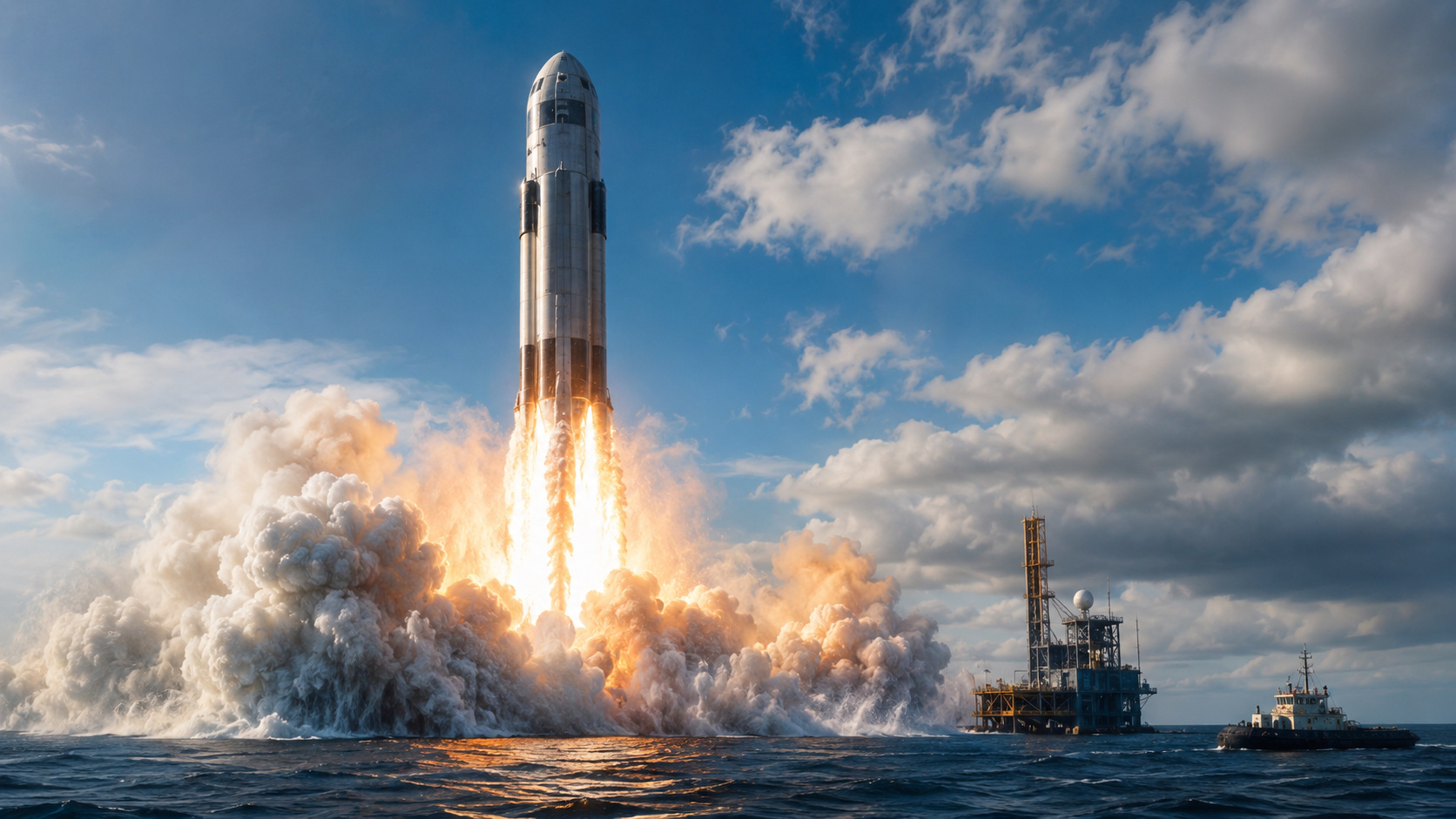

Sea Dragon was an oceanic rocket of 150 meters and 550 tons of payload that promised to drastically reduce space costs and surpass the Saturn V.
When NASA was still preparing to take astronauts to the Moon, some engineers were already thinking of something much bigger. Instead of creating increasingly sophisticated and expensive rockets, they advocated a radical idea: to build a gigantic launcher using simple materials, shipyard techniques, and dimensions never seen before in the history of space exploration. This is how the Sea Dragon was born, a concept presented in 1962 by engineer Robert Truax of Aerojet. Had it come to fruition, it would have been the largest rocket ever built by humanity, surpassing any space vehicle launched to date and completely transforming the economics of space flights.
A 150-meter-tall rocket that would make the Saturn V look small
The numbers of the Sea Dragon remain impressive even more than six decades later. The project envisioned a vehicle approximately 150 meters tall, 23 meters in diameter, and a mass exceeding 18 thousand tons when fueled.
For comparison, the Saturn V that took the Apollo astronauts to the Moon was about 111 meters tall and 10 meters in diameter. The Sea Dragon simply eclipsed it in practically all dimensions.
-
OnePlus N6 Smartphone to Launch in India with 8,000mAh Battery and 45W SuperVOOC Charging, Lasting Up to Three Days

-
Scientists Plan to Release Air Bubbles Underwater to Protect Antarctica’s “Doomsday Glacier” from Melting

-
Chinese R6000 Drone Combines Airplane and Helicopter Features, Carries Up to 12 People for Multiple Missions
-
In the World’s Most Densely Populated Desert, Families Dig Funnel-Shaped Underground Cisterns to Capture Rare Rainfall and Store Drinking Water for Up to Eight Months





Its size was so extreme that it would not be assembled on a conventional platform. The proposal was to build it in a shipyard, tow it to the ocean, and launch it directly from the sea.
The rocket would not launch from Cape Canaveral: it would take off partially submerged in the ocean
One of the most curious features of the project was the launch method. After being constructed, the Sea Dragon would be towed horizontally to the mission site.
At sea, ballast tanks would be flooded to position it vertically. When ready for launch, only the upper part would remain above the waterline.
According to Aerojet’s studies, this concept would eliminate the need for gigantic launch bases, reduce infrastructure costs, and avoid problems related to the enormous noise produced by the engines.
Capacity of 550 tons in orbit would make it one of the most powerful launchers ever conceived
The true differentiator of the Sea Dragon was not just its size. Studies indicated the capability to transport up to 550 tons to low Earth orbit (LEO) in a single launch. This is more than the total mass of the current International Space Station, which weighs about 450 tons.
In practice, a single mission of the Sea Dragon could place entire structures into orbit that would normally need to be divided into dozens of smaller launches.

The proposal was part of the philosophy advocated by Truax known as “Big Dumb Booster”, based on the idea that a huge and relatively simple rocket could be much cheaper than smaller and extremely sophisticated vehicles.
The cost per kilogram promised to break down one of the biggest barriers to space exploration
Another point that caught NASA’s attention was the potential savings. Studies conducted in the 1960s estimated costs between $59 and $600 per kilogram placed in orbit, extraordinarily low values for the time.

The concept was so aggressive that independent reviews conducted by the Space Technology Laboratories concluded that the projections were plausible within the assumptions adopted by the project.
The logic was simple: build rockets like ships, using common steel, robust components, and industrial processes already mastered by shipyards.
NASA did not cancel the Sea Dragon because it was impossible
Contrary to what many imagine, the Sea Dragon was not abandoned because the engineering was unfeasible.
The concept received positive technical evaluations and sparked interest within NASA. The problem was another: during the 1960s, the agency was focused on the Apollo Program and did not have missions capable of justifying such a gigantic launcher.

Studies showed that the vehicle made sense for large lunar bases, gigantic space stations, or manned missions to Mars.
None of these programs received political approval at that time. Without a payload requiring 550 tons per launch, the project lost priority.
The forgotten giant has regained attention in the era of mega-rockets
For decades, the Sea Dragon remained a historical curiosity. However, the emergence of new super-heavy rockets rekindled interest in the concept.
Many experts began revisiting Truax’s studies to understand if a gigantic vehicle, built in shipyards and launched from the ocean, could make sense in an era of commercial space stations, space mining, and future manned missions to Mars.
More than 60 years later, no rocket has exactly achieved the combination of simplicity, size, and capacity proposed by the Sea Dragon.
And perhaps that’s the most surprising part of the story: the largest rocket ever conceived didn’t disappear because it failed, but because humanity hadn’t yet decided what to do with a machine capable of taking an entire small space station in a single launch.


