






 Portuguese
  Spanish


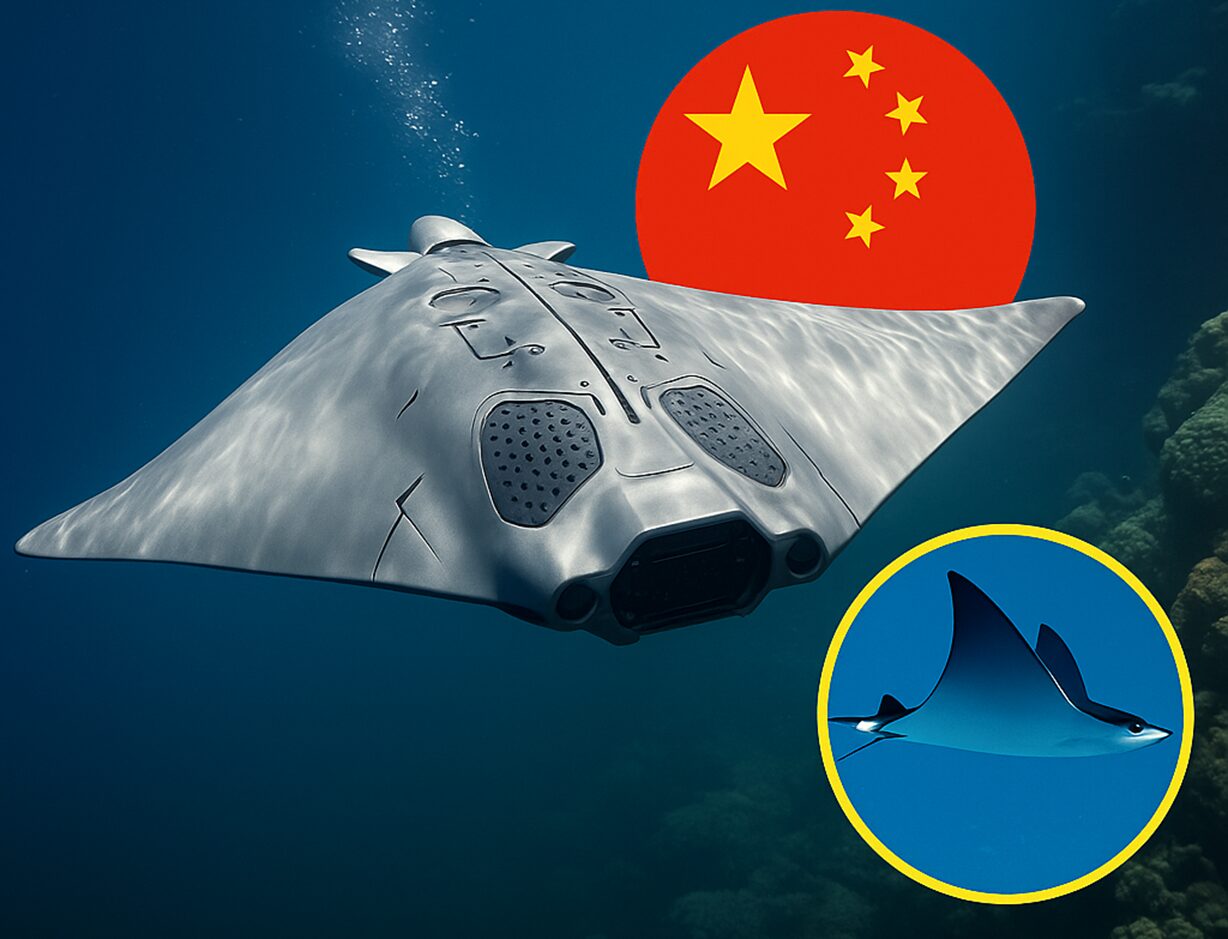

Underwater Drones That Imitate Manta Rays Are Being Tested by China for Scientific and Military Missions in the South China Sea.
Chinese researchers are developing swarms of underwater drones with more efficient movement, based on the swimming of manta rays.
The aim is to create systems that mimic the natural behavior of these animals to form coordinated formations, reducing energy expenditure and increasing mission performance.
ARTICLE CONTINUES BELOWSee also
Midea Unveils Portable PortaSplit Air Conditioner: 12,000 BTUs, Quiet Mode, Heating, Dehumidification, App Control, and AI Efficiency Without Professional Installation

Singapore Turns Incinerated Waste Ash into Construction “Sand” in Ambitious Project to Revolutionize Megacity Waste Management
High School Teen Develops AI to Detect Autism and ADHD Signs from Retinal Patterns with 89% Accuracy

Abandoned Building in Brazil to Become Biotechnology Unit with $10 Million Investment, Bridging Science, Industry, and Public Health



Nature as a Model of Innovation
Flight formations of birds and schools of fish have already inspired technological projects in the past. Now, manta rays are gaining prominence.
With wide fins and streamlined bodies, these animals glide through the water with ease and low resistance.
According to the researchers, their shape and swimming style provide a valuable model for designing new underwater propulsion systems.
“Underwater operation tasks are becoming more complex. They often require vehicles working together,” said Pengcheng Gao, the study’s author. “The shape and performance of manta rays are of great value for biomimicry.”
Experiments with Formations of Three Rays
The study was conducted by scientists from Northwestern Polytechnic University and Ningbo Institute, both in China.
They analyzed the behavior of groups of manta rays and created simulations based on real photographs.
The focus was on groups of three individuals, testing three formations: a straight line (linear tandem), a V-shaped triangle, and an inverted triangle.
The results showed that the line formation particularly benefits the ray in the middle.
It receives a thrust from the water generated by the ray in front, which enhances its propulsion. The triangular formations did not show the same gains. Despite this, they remain common in nature.
“The tandem and triangular formations are the most observed in rays during group swimming,” explained Gao. “These observations indicate that three individuals form a basic unit of collective swimming.”
Limitations and Next Steps
Even with lower efficiency, triangular formations are still used by the rays. This may indicate that there are other reasons for their choice, such as communication or orientation among the animals.
The research acknowledges that social behavior can also influence formation decisions.
As rays form from pairs to large groups of thousands of individuals, understanding how three interact is already an important step. This foundation can help develop larger systems with collective intelligence.
The study concludes by highlighting the importance of simulating other factors in the next phases. “It is necessary to study how performance changes with different formations, spacings, and movements, as well as to apply deep learning algorithms to control the parameters of each drone in the group,” stated Gao.
A Physics of Fluids devotes itself to publishing original theoretical, computational, and experimental contributions to the dynamics of gases, liquids, and complex fluids. Click to see the original study https://pubs.aip.org/aip/pof.


No Seriado ” Viagem ao Fundo do Mar” havia um parecido.
Parece cópia do Subvoador do Seaview.
A China fez o Subvoador!