





 Portuguese
  English
  Spanish
  3 min of reading
  0 comments


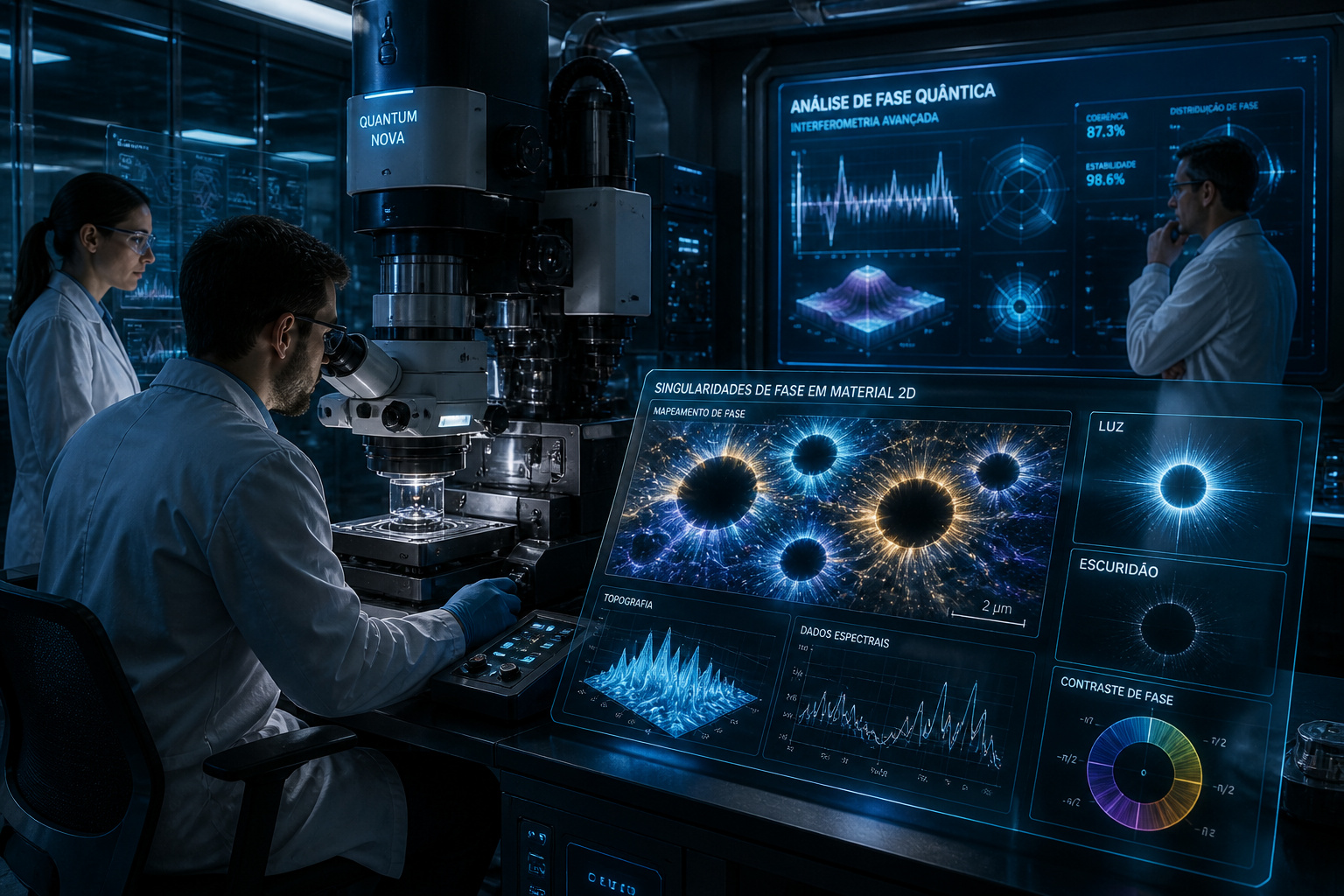
Scientific discovery shows how dark patterns within light can move faster without violating laws of the universe, opening new possibilities for technology and understanding of nature
The idea that nothing can exceed the speed of light has always been considered one of the pillars of modern physics. However, a recent discovery is drawing attention from the scientific community and raising new discussions about the limits of the universe. Researchers have identified that certain patterns of darkness can, under specific conditions, move faster than light itself — something that, at first glance, seems impossible.
The information was released by “R7.com”, based on a study published in the renowned scientific journal Nature, conducted by physicists from the Technion-Israel Institute of Technology. According to the scientists, the phenomenon involves structures known as “optical vortices”, also called “phase singularities”.
These dark spots emerge within a light wave when its oscillations cancel each other out in certain regions. That is, while light travels and behaves like a wave that twists and moves, there are internal points where this oscillation simply disappears — creating small regions of darkness.
-
Japan wants to bury a 500 km “cargo conveyor” between Tokyo and Osaka to replace up to 25,000 trucks per day, move goods through tunnels and automated driverless corridors, and avoid a logistical collapse in an increasingly aging country.

-
Vietnam dumps sand in the South China Sea and transforms disputed reefs into artificial islands with an area equivalent to more than 1,500 football fields, builds 15 ports in the Spratly Islands, and expands bases in the ocean while challenging Chinese pressure in one of the most tense maritime regions on the planet.

-
Is Rosie from the Jetsons becoming a reality? China tests “robot cleaners” with artificial intelligence inside homes for R$ 114, capable of collecting trash, folding clothes, and mapping apartments, turning domestic cleaning into a living laboratory for companies that want to teach machines to act like humans.
-
Lunar meteorite found in the desert bears marks of 3 impacts and reveals a colossal asteroid collision that melted part of the Moon 3.5 billion years ago, at the same time life was beginning to emerge on Earth.





How darkness can exceed the speed of light without breaking the laws of physics
As researchers deepened their analysis, they realized something even more surprising: these phase singularities can move at speeds greater than that of light. However, this does not mean that the laws of physics have been broken.
This happens because these dark spots do not carry mass, energy, or information. Thus, they do not violate the Theory of Relativity, proposed by Albert Einstein, which states that no information can travel faster than light.
According to physicist Ido Kaminer, who led the research, this discovery confirms theoretical predictions that have existed since the 1970s. Furthermore, it reveals that this behavior is not exclusive to light, but can be present in different types of waves, such as sound waves, fluid flows, and even complex systems like superconductors.
To reach this conclusion, scientists developed a system of extremely advanced microscopy, capable of observing these singularities in specific materials, such as hexagonal boron nitride — a two-dimensional structure used to generate quasi-particles known as polaritons.
These polaritons have an interesting characteristic: they move about 100 times slower than the speed of light, which facilitates the observation of ultrafast phenomena on a microscopic scale.
The impact of the discovery on technology, science, and the future of information
With this technology, researchers were able to observe how singularities with opposite charges approach, accelerate, and reach superluminal speeds before annihilating each other. This behavior may seem abstract, but its implications are extremely practical.
Firstly, this discovery could revolutionize how we understand ultrafast phenomena in various fields. For example, in chemistry and biology, where reactions occur on extremely small and rapid scales, this technology could enable more precise analyses.
Furthermore, it paves the way for new forms of light manipulation and the development of quantum information encoding systems. In other words, we are talking about possible advancements in quantum computing and telecommunications, areas that are already at the forefront of current technological innovations.
Another important point is that this discovery reinforces the idea that the universe still holds many mysteries. Even concepts considered “closed,” such as the speed of light, may have nuances that we do not yet fully understand.
Therefore, although the headline might suggest that something “surpassed light,” what is actually happening is even more fascinating: we are discovering new behaviors within nature’s own laws, without necessarily breaking them.
And, in this scenario, science continues to show that questioning the obvious is, often, the path to the greatest discoveries.
And you, do you believe there are still phenomena in the universe capable of changing everything we know about reality?





Be the first to react!