






 Portuguese
  Spanish


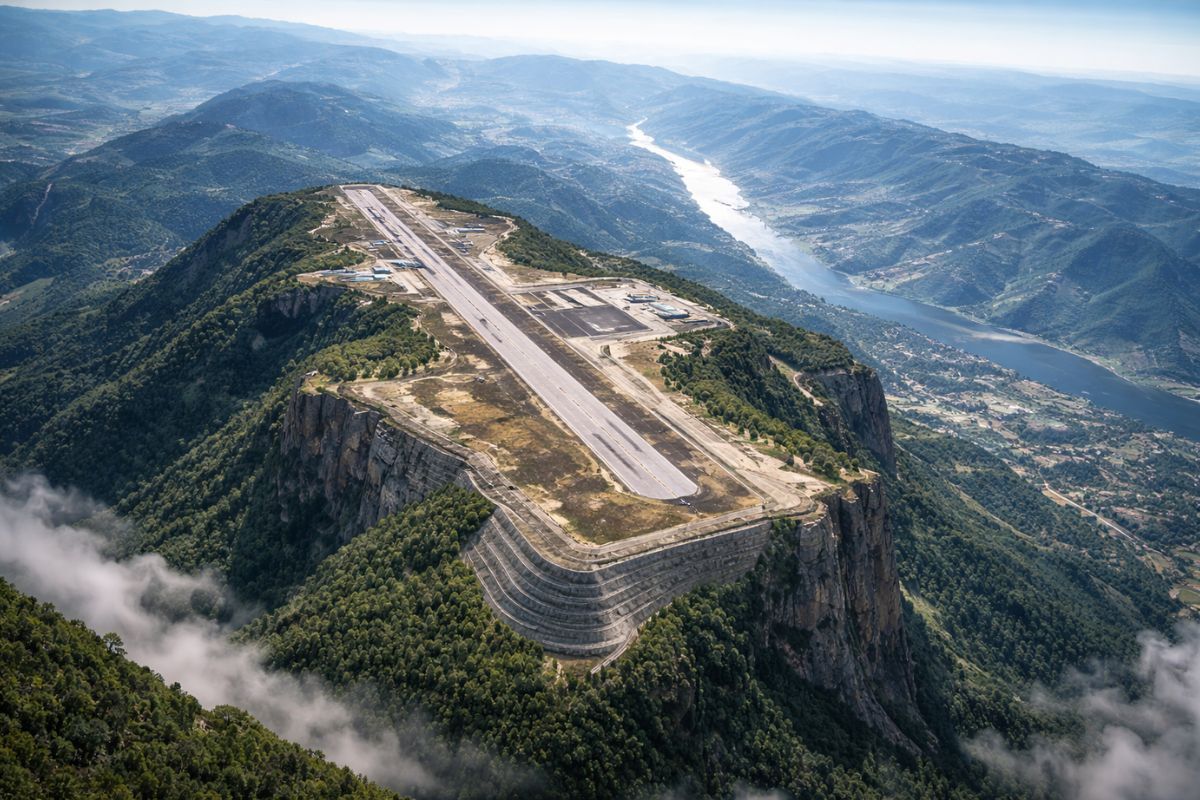


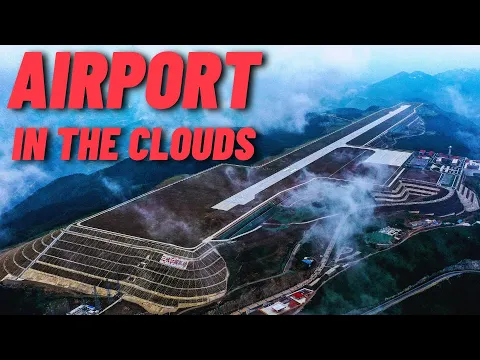
In China, the construction of an airport on the top of a mountain required large-scale explosions, continuous cut and fill, six years of work, and extreme precision to stabilize soil, runway, and navigation, connecting an isolated area of the Three Gorges with regular air operations at high altitude until today.
China implemented an engineering intervention that completely changed the relief of a mountainous area: instead of seeking a valley for takeoffs and landings, the work leveled a rocky top to create a 2.6 km runway at high altitude. The central objective was to break regional isolation and connect cities that relied on longer and more complex access.
The project, associated with the Chongqing Wushan Airport, spanned six years of execution, starting in 2015 and inaugurated in 2019. During this period, the operation combined controlled detonations, massive earth movement, technical compaction, and implementation of complete airport systems. The scale is impressive, but the most relevant data is the logic of the project: transforming a geographical limit into functional infrastructure.
From Irregular Peak to High Altitude Construction Site

In the mountainous heart of China, above the Three Gorges area, the work started from an extreme condition: a peak at an elevation of 1,800 meters, with unevenness incompatible with commercial aviation.
-
$80 Million Bridge in Brazil Cuts Travel Time from 30 Minutes to 1 Minute, but Audit Reveals Major Flaws

-
Man Builds Stone Bed with Granite Rocks and Hand-Sawn Cedar Beams, Home Extension Garners Over 437,000 Views on Bonus Bolts Channel

-
Brazilian Researcher Develops Color-Changing Roof Tile to Reduce Air Conditioning Use by Up to 15%
-
21-Year-Old Moves Back to Parents’ Home in Arizona, Finds New Private Apartment in Converted Garage as Families Tackle U.S. Housing Pressures




The proposal was straightforward yet risky: removing material from elevated areas and using that same volume to fill around depressions, forming a large technical plateau. There was no adaptation of terrain; there was reconfiguration of terrain.
The initial mobilization showed the scale of the intervention: about 800 machines and 2,000 workers in continuous shifts.
With hard rock and difficult access, explosives were needed to open the work front. From there, a heavy cycle of excavation, transport, unloading, and leveling began, with trucks operating on narrow edges in a permanently risky environment.
It was precision engineering applied in a rough construction scenario.
How Engineering Converted Unevenness into Operational Runway

The cut and fill strategy needed to be controlled millimetrically because an airport at high altitude cannot tolerate significant structural variation in the subgrade.
The filled terrain was subjected to dynamic compaction to increase density and reduce the risk of settlement.
In simple terms: it was not enough to fill; it was necessary to consolidate the mass so that it would behave like a reliable base over time. Geotechnical stability became a prerequisite for operational survival.
Another critical factor was the weather. Heavy rains turned work fronts into mudslides, delaying schedules and compromising equipment circulation.
The response came with emergency drainage, opening of channels, and continuous adjustments of the execution sequence. When the weather improved, teams recovered pace to not miss the execution window. In practice, the schedule was negotiated daily between technical and meteorological considerations.

In parallel, quality control and topography worked with reduced tolerances. Each applied layer, each leveled segment, and each final elevation needed to meet strict standards to ensure the behavior of the runway and the safety of future operations.
This stage, less visible to the public, is often what separates monumental work from reliable work. A major project is not just about volume; it is technical consistency repeated without failure.
Runway of 2.6 km: Layers, Materials, and Operational Safety
With the plateau ready, China entered the paving phase of the 2,600-meter runway. First came the sub-base with layers of gravel, compacted in sequence to create mechanical resistance.
Then, the hot asphalt was applied with control of temperature and compaction window, a crucial step at altitude due to more severe thermal variations. Each layer had a structural function and was not just for superficial finish.
Patio areas received thick concrete, chosen for durability under static load and traffic of parked aircraft.
The project standard indicated in the work considered support for airplanes weighing up to 70 tons, which requires the correct combination of base, coating, and deformation control. At the same time, runway markings, such as the designation 06-24, were executed within international aviation parameters. Here, visual detail means real safety during approach and takeoff.
The supporting infrastructure also advanced at the same pace: runway lights, buried cables, navigation aids, weather stations, and FOD (Foreign Object Debris) removal protocols.
At a mountain airport, especially with fog and variable winds, these systems cease to be complementary and become part of the core operation. Without this “nervous system,” the runway physically exists, but does not operate reliably.
Terminal, Cargo, and Regional Integration

The next stage consolidated the logistical and passenger function. The terminal, with about 3,500 m², received a metal and glass structure to enhance natural lighting and visibility of the mountainous landscape.
While the architecture sought local identity, the technical installations connected energy, data, and security to support the airport routine. Aesthetics came after functionality, but both were integrated into the same design.
In the cargo area, conveyor belts and operational areas were configured to move up to 1,200 tons, expanding the airport’s role beyond passenger transport.
This matters because isolated regions often rely on reliable logistics to reduce circulation time of inputs, equipment, and higher value-added products. Air connectivity, in this context, is not a luxury: it is infrastructure for economic circulation.
With access roads and support areas established, the airport began serving the Three Gorges region and brought closer poles that were previously conditioned by the relief. The practical effect is to shorten functional distances between localities, even when the geographical distance remains the same. The mountain does not disappear; what changes is the capacity to cross it efficiently.
What This Project Reveals About Infrastructure Planning in China
The timeline of the project from April 2015 to the opening on August 16, 2019, shows that China treated the work as a long-term mission, with clear technical stages and execution discipline.
The number of equipment, mobilized workforce, and topographical complexity indicate continuous multisector coordination, from heavy earthmoving to flight system calibration. It was not a common construction site; it was an altitude engineering ecosystem.
At the same time, projects of this scale always raise legitimate debates about cost, territorial impact, and public investment priorities. The reported value of US$ 123 million and the scale of intervention help gauge the commitment.
The justification lies in connecting an isolated region to the rest of the country, but a complete assessment also involves maintenance, operational demand, and long-term benefits for residents and local chains. A historic work is one that continues to make sense after inauguration.
The inauguration of the first commercial flight, already operated by the airport team, marked the symbolic transition from construction to service.
After six years of dust, detonations, concreting, signaling, and testing, the top of the mountain became an entry and exit point. Where there was only rock, there is now logistics, time saved, and a new relationship with the territory.
China transformed an extreme geographical barrier into permanent air infrastructure by combining controlled explosions, massive earthmoving, geotechnical engineering, and operational aviation standardization. The result does not eliminate cost and maintenance challenges, but demonstrates how consistent technical planning can convert isolation into actual connectivity.





A gente vê pelos comentários em todas as matérias, a falta que faz uma boa educação para os brasileiros. O nível intelectual é de dar medo. Esse é o maior atraso de nosso país
MAS SAO ****.COMEM CRIANCINHAS como diziam no passado .ou não comem mais? parece que pra extrema direita ainda comem.e para os evangélicos.
Os chineses não são desse mundo porque o que eles fazem é um espetáculo