Portuguese
  Spanish


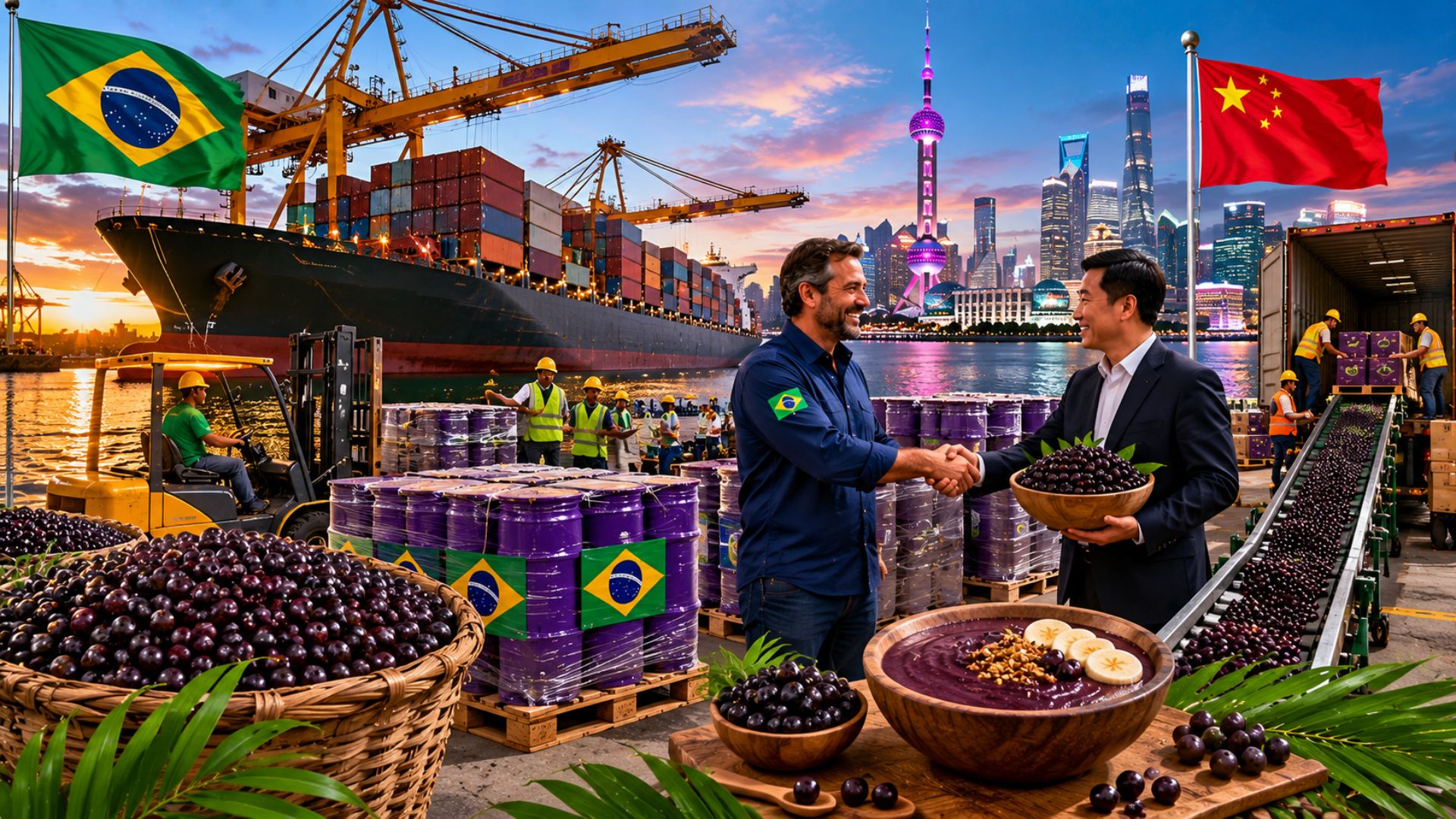

The second largest food distribution network in China has closed the purchase of 15 thousand tons of açaí from Amapá for the next five years. The historic agreement, brokered by the Amazonbai cooperative at the largest food fair in Asia, takes the fruit from the mouth of the Amazon directly to the promising Chinese market.
Between May 18 and 20, 2026, during Sial China, the largest food fair in Asia, held in Shanghai, the Amazonbai cooperative from Amapá closed a historic agreement with the second largest food distribution network in China for the supply of 15 thousand tons of açaí over the next five years. The deal, announced on May 22, stipulates that the cooperative of extractive producers will allocate its entire fruit harvest to the Asian giant, taking the açaí from the mouth of the Amazon River directly to the Chinese consumer market.
The agreement represents a milestone for family farming and extractivism in the Amazon. China, Brazil’s largest trading partner, opens its doors to a product that is a symbol of Amazonian biodiversity, and Amazonbai, based in Amapá, now has a guaranteed buyer for all its production for five years. For the president of the cooperative, Amiraldo Picanço, the international partnership is the gateway for açaí from Amapá and from other Brazilian cooperatives to reach a market he describes as extremely promising.
How açaí from Amapá reached the Chinese market

The negotiation took place during Sial China, considered the largest food and beverage fair in Asia and one of the largest on the planet, which brings together more than 5 thousand exhibitors from dozens of countries and receives about 180 thousand professional visitors. The 2026 edition, held in Shanghai, had a record participation from Brazil, with 82 exporting companies, a number that surpassed the 54 from the previous edition, according to the Brazilian Trade and Investment Promotion Agency, ApexBrasil.
-
Major Appliance Manufacturer Closes Factory in Argentina, Shifts Production to Brazil, and Restructures in Latin America with Mexico Closure, Investing Up to $165 Million

-
China to Revive $3.6 Billion Mega-Dam Project in Myanmar, Stalled Since 2011, Promising 6 GW Capacity and Completion in Eight Years

-
Foreign Company Wins Auction for Brazil’s First Immersed Tunnel, a $1.3 Billion Project with $14 Million Contract Under Federal Investigation

-
China’s Century Megaproject Wows the World: Massive Water Transfer Network Moves Water from Wet South to Arid North, with Ambitious Plans in the Tibetan Plateau Involving Giant Tunnels at Altitudes up to 4,000 Meters



The presence of Amazonbai at the event was made possible by the National Integration Routes strategy of the Ministry of Integration and Regional Development, specifically through the Açaí Route, which seeks to strengthen local productive systems and promote sustainable regional development. The cooperative’s participation included an investment of around 207 thousand reais, a sum that enabled the producers to attend the main food business stage in Asia, where direct contact with China was possible.
Who is Amazonbai, the cooperative at the mouth of the Amazon

Amazonbai is a cooperative of açaí extractive producers based in Amapá, in the region at the mouth of the Amazon River, recognized as a pioneer in traceability and certification of the açaí supply chain worldwide. The organization has been growing rapidly in recent years, and in 2024 it managed to triple its revenue compared to the previous year, reaching an income of over 2 million reais, driven by the first direct exports of freeze-dried açaí, or in powder form, to the United States and Europe.
Besides its economic weight, the cooperative stands out for its social leadership. In recent years, female participation in Amazonbai has tripled, and in January 2025, for the first time, women were elected to management positions. Now, by securing the sale of its entire harvest to China, the cooperative consolidates a model that combines income generation, preservation of the standing forest, and appreciation of the work of traditional Amazonian communities, transforming extractivism into a sustainable business with global reach.
The importance of the Chinese market for Brazilian products
The entry of açaí into the Chinese market is not an isolated movement but part of a larger Brazilian offensive to expand its exports to the Asian country. At Sial China 2026, ApexBrasil’s expectation was to generate around 3.3 billion dollars in immediate and future business, with a record presence of Brazilian companies distributed across five national pavilions. The pavilion dedicated to family farming brought together cooperatives from various regions, presenting the Chinese public with products such as specialty coffees, nuts, honey, wines, fruit pulps, and items from Brazilian socio-biodiversity.
This effort relies on programs like Cooperate to Export, developed by ApexBrasil in partnership with Sebrae, which offers training and support for cooperatives to participate in international fairs. For China, importing products like açaí means access to high-value-added foods with wellness appeal, in a gigantic consumer market increasingly open to new tropical biodiversity offerings, which opens a significant window of opportunity for Brazil.
The potential and challenges of exporting açaí to China
The 15,000-ton agreement is promising, but exporting açaí on a large scale to China involves significant logistical and production challenges. Açaí is a highly perishable fruit that needs to be processed quickly after harvest, and the distance between the mouth of the Amazon and China requires solutions such as freeze-drying and freezing to preserve the product’s quality on the long journey to the other side of the world.
There is also the challenge of scaling production sustainably, without excessively pressuring native açaí groves or compromising the supply to the Brazilian domestic market, where açaí is an essential food, especially in the North of the country. Ensuring that the growth of exports to China truly benefits the extractive communities, and not just intermediaries, will be crucial for this historic agreement to translate into real and lasting development for the Amazon region.
The sale of 15,000 tons of açaí from Amapá to China is an achievement that symbolizes the potential of the Amazon bioeconomy when connected to global markets. The agreement brokered by Amazonbai at Sial China shows that products from standing forests, produced by family farming cooperatives, can reach the world’s largest markets, generating income and valuing Brazilian socio-biodiversity. The challenge now is to transform this opportunity into a sustainable and lasting model for the Amazon.
Did you imagine that açaí from the mouth of the Amazon could conquer the Chinese market in a five-year agreement? Do you believe that exporting products from standing forests is the best way to reconcile the economy and preservation of the Amazon? Leave your comment, tell us if you are a fan of açaí, and share the article with those interested in agribusiness, exports, and the future of the Brazilian bioeconomy.