






 Portuguese
  Spanish
  5 min of reading
  0 comments


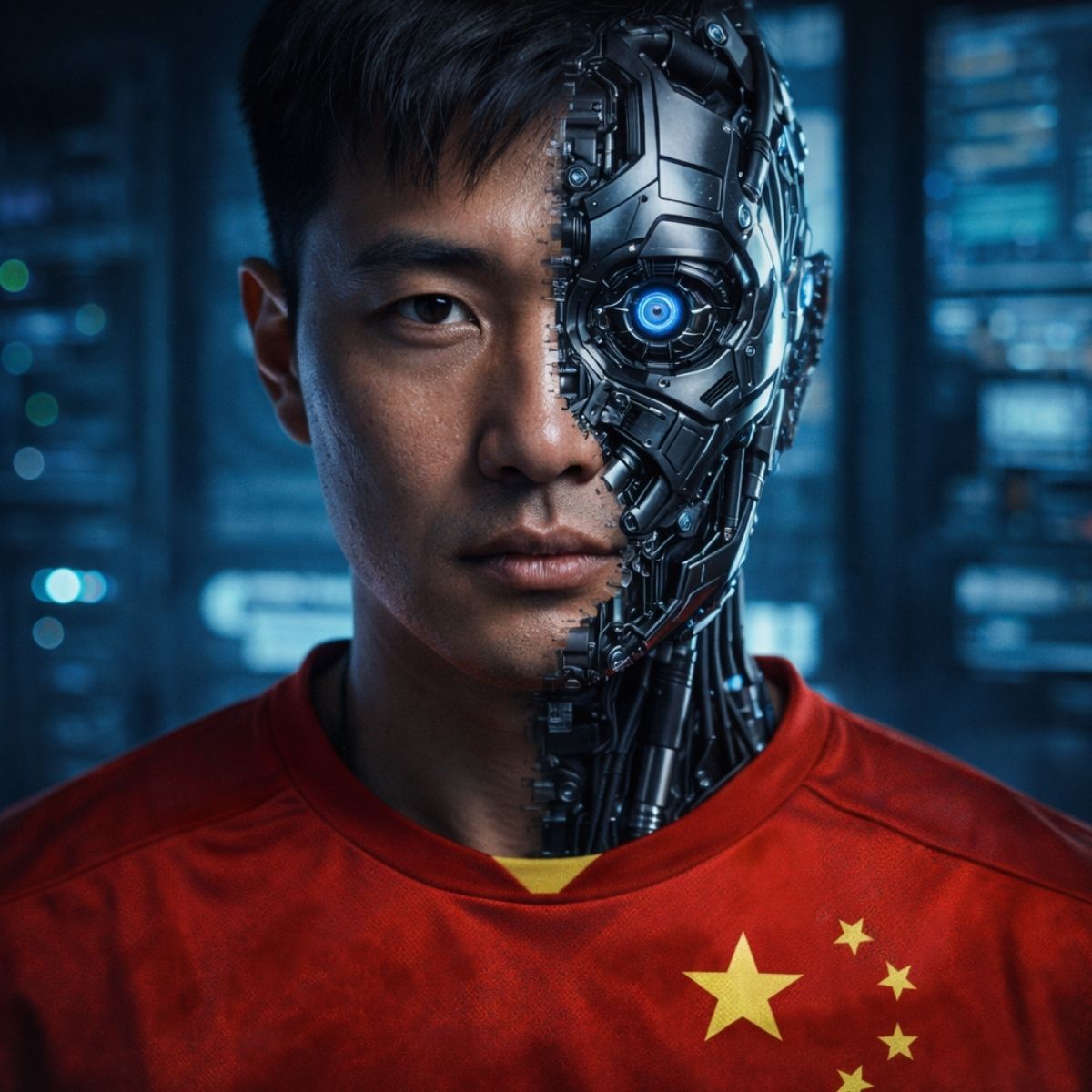
Chinese researchers developed the AI ASI-Evolve, an artificial intelligence system that improves itself in continuous cycles and in tests outperformed humans by almost threefold margin, a model that Shanghai positions as a collaborative tool and not as a replacement for professionals.
Researchers from the Chinese university Jiao Tong, based in Shanghai, presented an AI capable of self-improvement through automatic cycles in which the system generates variations of itself, alters training methods, and adjusts input data without external intervention in each round. The model, called ASI-Evolve and published in the arXiv repository with code available on the university’s GitHub, operates in a process that mimics how human researchers would test artificial intelligence technologies, but executing the iterations at a speed that no team of scientists could keep up with. According to the authors, this is the first unified system to demonstrate AI-driven discoveries in three fundamental pillars of artificial intelligence: datasets, network structures, and learning methods.
The performance in the tests made the numbers clear. In controlled experiments, the AI managed to improve its attention mechanism by 0.97 points on a standard benchmark, while human researchers achieved 0.34 points on the same task. Even though the difference may seem small in absolute terms, in the realm of artificial intelligence benchmarks every tenth matters, and the almost threefold margin achieved by ASI-Evolve represents a leap that teams of scientists would normally take months or years to reach. China, which already leads the race for patents and publications in the field of AI, now adds a model that not only processes information but also improves itself.
How the Chinese AI evolves without human intervention each cycle

The ASI-Evolve operates through a closed operational loop: it conducts experiments, analyzes the results, identifies what worked, and applies the conclusions in the next round. The difference compared to other evolutionary systems lies in two internal components: a cognitive base that incorporates accumulated human experiences at the beginning of each exploratory cycle, and a dedicated analytical module that converts complex results into reusable conclusions for the next iterations. In practice, the AI does not start from scratch in each round. It inherits prior knowledge and progressively refines it.
-
Goodbye traditional laundry: Roborock launches washer and dryer with super hydrolysis, microbubbles, 99.99% sterilization, low-temperature drying, automatic detergent, app control, and cycles to remove stains, odors, mites, and bacteria from clothes.

-
It is now possible to generate energy without batteries: new flexible material transforms body heat into electricity and paves the way for more efficient, autonomous, and comfortable wearable devices, with the potential to revolutionize personal electronics in the coming years.

-
Leaving the charger plugged in without a phone consumes energy or is it a myth? Experts call the phenomenon “phantom consumption” and warn that dozens of devices on standby can add up on the bill over the year.
-
It accompanies Earth, but it is not a moon: Chinese probe reaches Kamo’oalewa and begins an unprecedented mission to investigate where the strange asteroid came from, what its internal structure is like, and whether its origin is linked to an ancient collision that launched fragments of the lunar surface into space.


Researcher Xu Weixian explained that the system does not seek an evolution without direction. According to him, the purpose of the experiments and the fundamental concepts always stem from humans, and the real value of AI lies in using its exploratory capacity to quickly traverse the path defined by researchers. China positions ASI-Evolve as a tool for scientific acceleration, not as an autonomous entity: humans stop solving problems directly and instead define which problems artificial intelligence should tackle.
The tests that proved the superiority of AI over human researchers

The benchmark used measures the system’s ability to optimize specific attention functions, a fundamental component in the architecture of modern artificial intelligence models. The score of 0.97 achieved by the AI against 0.34 from humans is not a generic comparison: it refers to a precise and controlled task in which both the system and researchers started from the same conditions. The difference of almost three times demonstrates that the iterative capacity of AI allows it to explore a volume of combinations that human teams simply cannot traverse in the same time frame.
The results were not limited to the field of artificial intelligence. When applied as a drug discovery model, the AI surpassed existing systems, indicating that the self-evolution mechanism can be transferred to other areas of knowledge. Researchers in China suggest that professionals in finance, biomedicine, climate science, and game development could use ASI-Evolve to achieve results superior to those obtained through manual exploration, expanding the reach of artificial intelligence beyond its own development.
What differentiates Chinese AI from Western artificial intelligence models
While American and European laboratories focus efforts on increasingly larger language models, trained with colossal volumes of data and proportional energy costs, China’s ASI-Evolve bets on a different logic. The system operates in a closed learning cycle, which suggests considerably lower energy consumption compared to the main models trained on massive data sets. The researchers did not disclose the exact energy costs, but the speed and efficiency of the process indicate a leaner approach.
China also links the advancement of AI to sustainability policies. New data processing centers in the country are required to use green technology, and systems like ASI-Evolve, which operate with iterative learning instead of brute training, fit this guideline. Artificial intelligence that evolves on its own can represent not only a technical leap but also a response to criticisms about the environmental impact of the sector, a topic that dominates the debate in Western countries while China advances in practice.
Will AI replace scientists or transform them into something else
Xu Weixian makes a point of distancing himself from the narrative of replacement. According to him, ASI-Evolve operates as an accelerated partnership between humans and machines, not as an artificial intelligence that dispenses with people. The change that the model proposes is one of role: instead of spending time solving technical problems and fixing failures, humans will define which questions AI should explore. Intellectual work does not disappear but migrates from execution to strategy.
This view contrasts with the alarmist tone that prevails in part of the global debate on artificial intelligence. While Western governments discuss regulations, moratoriums, and existential risks, China is deploying an AI that improves on its own and achieves measurably superior results to those of human researchers in specific tasks. ASI-Evolve still requires human oversight in its evolution and does not represent, according to its creators, a threat to jobs. But the gap between the pace of Chinese development and the regulatory pace of the West becomes more visible with each publication like this.
And you, do you think an AI that evolves on its own should be a cause for concern or excitement? Do you trust the collaborative model that China proposes or would you prefer more control before moving forward? Leave your opinion in the comments.






Be the first to react!