Portuguese
  Spanish


China is building a bridge so large it needed two decks and 16 lanes to handle the traffic — and the project has already broken 5 world records
In Guangdong province, in southern China, engineers are building something that defies imagination: the Lion Ocean Link, a double-deck suspension bridge with 16 traffic lanes crossing the Pearl River estuary between the cities of Guangzhou and Dongguan.
According to a report by CGTN, the bridge’s main towers were completed in March 2026 — a milestone that confirmed the structure as the world’s largest double-deck suspension bridge.
However, what’s most impressive isn’t its size — it’s the number of records the project has already broken even before its inauguration.
-
Two-Bedroom Home Built in a 40-Foot Shipping Container Delivered and Ready for Same-Day Living in São Paulo Countryside

-
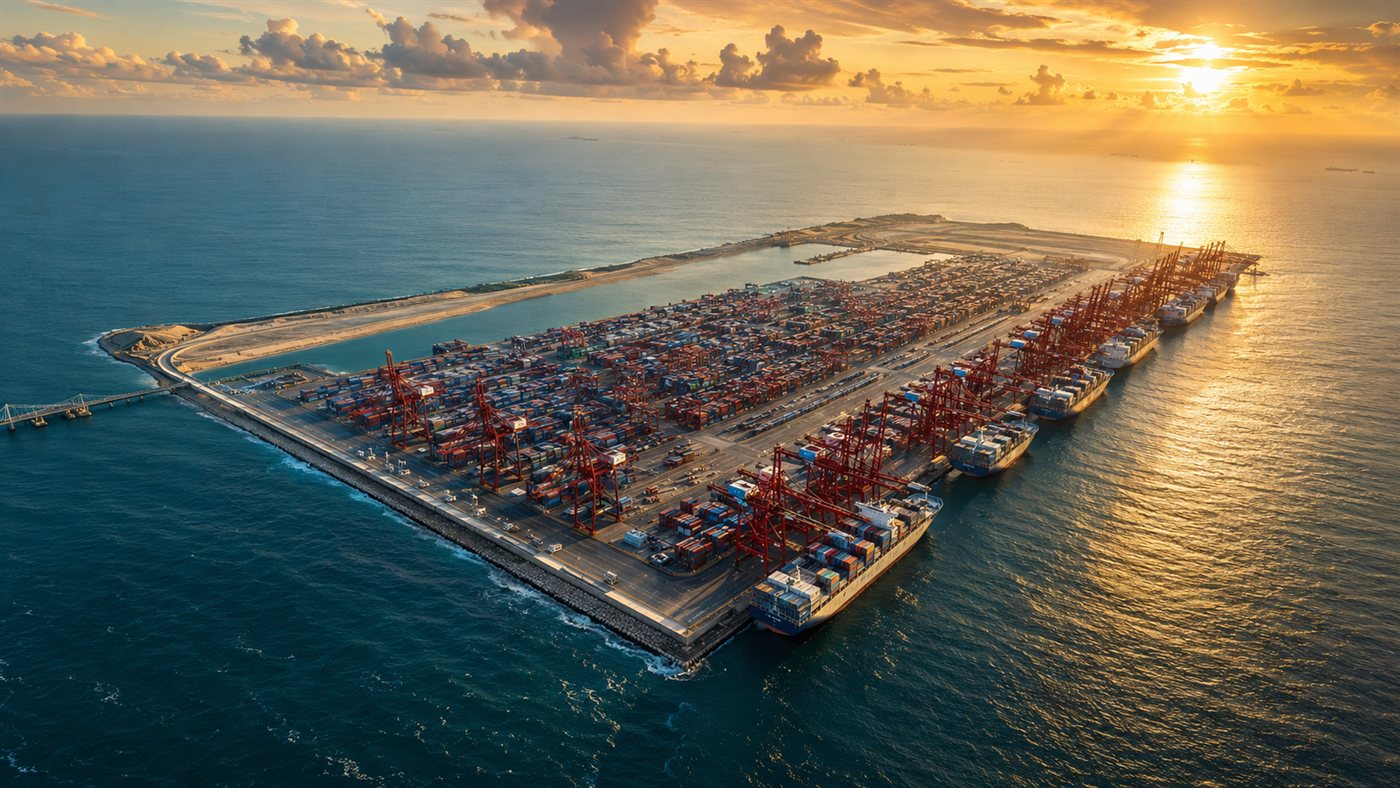
China Constructs Artificial Island 32 km Offshore for Yangshan Port, Connected to Shanghai by 32 km Bridge, Unloading 3,000 Containers in 20 Hours
-
China’s $70 Billion River Diversion Project, the World’s Largest, Moves 44.8 Billion Cubic Meters Annually, Crosses Under the Yellow River, and Displaced 330,000 People
-
Indian Driver Spends 14 Years Digging 10-Meter Tunnel Through Mountain to Connect Isolated Village to the World




Thus, the Lion Ocean Link is not just another Chinese bridge: it is an engineering demonstration that pushes the limits of what was considered possible to build over water.
Furthermore, the bridge is part of the Greater Bay Area economic corridor — a region that includes Hong Kong, Macau, Shenzhen, and Guangzhou and has a combined GDP greater than that of most countries.

The 5 world records the bridge has already broken — and it hasn’t even been inaugurated yet
According to the project’s technical documentation, the Lion Ocean Link has set five world records during its construction.
Consequently, the bridge has become a global benchmark in suspension bridge engineering, surpassing milestones that seemed unattainable just a few years ago.
Among the records are the longest span for a double-deck suspension bridge and the tallest suspension towers ever built for this type of structure.
Additionally, the bridge’s load capacity is unprecedented: with 16 lanes distributed across two levels, it is designed to support the combined traffic of two full highways.
Likewise, the Lion Ocean Link’s suspension cable system uses an amount of steel that, if stretched in a straight line, could circle the Earth more than once.
In this sense, the bridge represents the state of the art in civil engineering — and demonstrates why China dominates the construction of megastructures in the 21st century.
The bridge connects two cities with a combined GDP larger than that of many countries — and is part of a $100 billion plan
Guangzhou and Dongguan are two of the wealthiest and most industrialized cities in China — and the world.
On the other hand, the Pearl River estuary that separates them has always been a logistical obstacle, forcing trucks and vehicles to take long, congested routes to cross from one city to the other.
Therefore, the Lion Ocean Link will drastically reduce crossing time between the two metropolises, turning what once took hours into a journey of minutes.
Similarly, the bridge is a central piece of the Greater Bay Area (GBA) integration plan — the Chinese megaproject aimed at transforming the region into an economic hub capable of rivaling the San Francisco Bay Area and Tokyo.
The GBA brings together 11 cities with a combined GDP of over $1.7 trillion — higher than that of countries like South Korea or Australia.
Consequently, every infrastructure improvement that reduces travel time within the GBA has a multi-billion dollar economic impact.

How a double-deck bridge works: the challenge of stacking two highways over water
Building a conventional suspension bridge is already an engineering feat. Building one with two independent decks multiplies the complexity exponentially.
In fact, the lower deck must support not only the weight of the vehicles traveling on it but also the entire weight of the upper deck — including asphalt, barriers, lighting, and traffic.
Furthermore, the wind forces on a double-deck structure are drastically different from those acting on a conventional bridge — requiring aerodynamic wind tunnel simulations that took years to complete.
Despite this, Chinese engineers developed a steel box girder deck system that distributes loads evenly between the two levels — an innovation that could be replicated in future bridges around the world.
As a result, the Lion Ocean Link functions as if it were two complete highways stacked in the air, suspended by steel cables anchored to towers that exceed the height of 60-story buildings.
Above all, the separation into two decks allows each level to be dedicated to one direction of traffic, eliminating crossing flows and significantly increasing safety and crossing speed.
Why China dominates bridge construction: of the 100 tallest bridges in the world, 85 are in the country
The Lion Ocean Link is another example of Chinese supremacy in bridge engineering.
According to data compiled by international civil engineering organizations, of the 100 tallest bridges in the world, 85 are in China.
Furthermore, of the 10 bridges with the longest spans in the world, the majority are also Chinese — including the Huajiang Bridge, which at 625 meters high is the tallest bridge on the planet. Meanwhile, Finland inaugurated a bridge exclusively for pedestrians — showing that each country solves infrastructure in its own way.
However, this dominance is not accidental: China has invested more in transportation infrastructure in the last two decades than all other countries combined.
Likewise, the country has developed proprietary construction technologies that allow bridges to be erected at speeds that would seem impossible elsewhere — with 580-ton girder-erecting machines, as documented by BlackRidge Research, that position entire deck segments in a matter of hours.
Still, each new Chinese bridge raises questions about financial sustainability: are they all necessary, or is part of the infrastructure boom an overinvestment that will lead to underutilization?

What the Lion Ocean Link means for the future of megabridges
The completion of the Lion Ocean Link sets an important technological precedent: double-deck bridges with more than 10 lanes per level are feasible and could be the solution for regions with extreme traffic that cannot accommodate two separate bridges.
Therefore, cities like Istanbul, Mumbai, and Lagos — which face epic congestion on water crossings — may be looking at the Lion Ocean Link as a model.
Consequently, Chinese bridge engineering could become one of the country’s biggest technological exports, alongside high-speed rail and solar energy.
A bridge with 16 lanes on two decks, 5 world records, and towers taller than 60-story buildings — all built over the ocean, in the same region that 40 years ago was made up of fishing villages.
The Lion Ocean Link is living proof that when a country treats infrastructure as a state priority, the results challenge even the imagination of the most optimistic engineers.