Portuguese
  Spanish


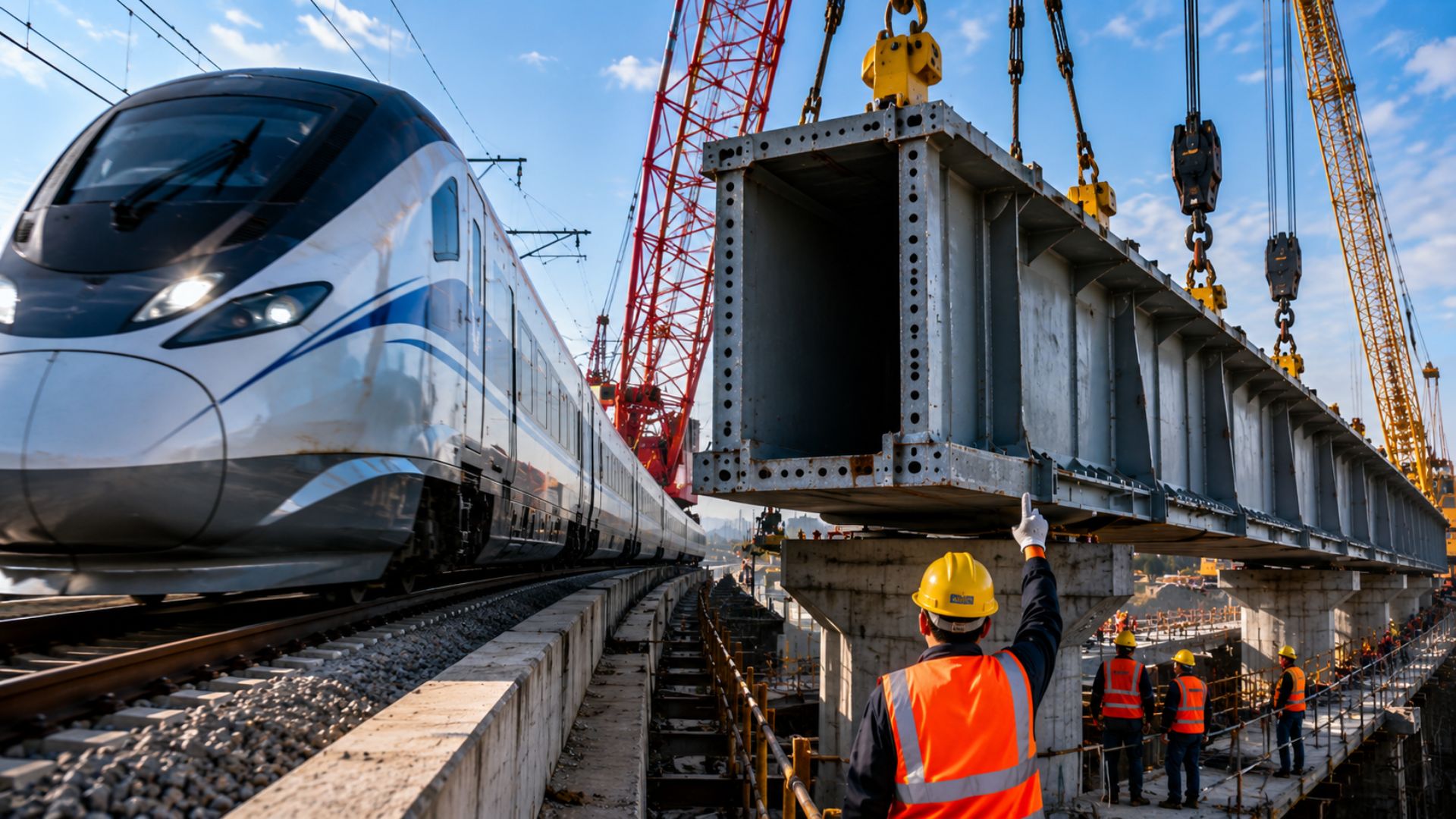

Chinese railway engineering carried out an operation in Chongqing with extreme space restriction, installing metal beams next to a high-speed line in operation, according to Xinhua. The assembly occurred while the neighboring railway maintained daily circulation of almost 160 trains.
Chinese engineers installed four large steel beams on a railway bridge in Chongqing, in southwest China, during an operation conducted next to a high-speed line that continued in operation and received almost 160 trains per day.
According to material released by the state agency Xinhua, the installation of the metal structures was completed in six days and took place in an area classified by the agency itself as having extreme space restriction.
At the point of shortest distance between the structures, the new bridge was only 16 centimeters from the railway already in operation, a measurement equivalent to 6.3 inches and cited by Xinhua as one of the central data of the intervention.
-
Seven-Year-Old Nicknamed Hulk Wins Gold in Brazilian Jiu-Jitsu After Defeating South American Competitors

-
Once Burdened by $90,000 in Debt and a Divorce, Now Leads a Beauty Group Targeting $150 Million by 2026
-
Ice Cream Shop Grows from 39 Square Meters to $19 Million Revenue with Popsicles Sold at 20 Cents in Brazil
-
Rural Worker Spotted “Flying” on a Drone in Brazil





The operation involved a stage of heavy assembly in an active railway area. In works of this type, the positioning of the pieces needs to consider the available lateral space, the passage of trains, and the safety limits defined for circulation on the neighboring line.
Railway work occurred in Chongqing
The new bridge was built next to an already existing high-speed railway in Chongqing, according to a publication by Xinhua about the operation. The agency did not inform, in the consulted material, the official name of the bridge nor the identification of the railway line in operation.
Even without these details, the disclosed data allows for sizing the intervention: the structure under construction received four large metal beams, installed in an area where the smallest separation in relation to the neighboring bridge was 16 centimeters.
This proximity reduced the available space for maneuvering equipment and positioning adjustments. Therefore, the assembly stage depended on control of the movement of the pieces, coordination between teams, and monitoring of the surroundings during installation.
Xinhua also reported that the railway next to it received almost 160 trains per day. This data indicates that the work was carried out in a corridor with frequent circulation, and not on an isolated or temporarily non-operational line.
Installation of the beams concentrated the main stage
The installation of the four beams in six days corresponds to the phase of assembling the metal parts on the new bridge. This stage is usually one of the most visible in railway works because it involves lifting, transporting heavy components, and positioning them on structural supports.
Before a beam reaches its final location, technical teams need to define the execution sequence, support points, movement method, and approach limits concerning existing structures.
In a construction site next to an active railway, these procedures also need to consider the continuity of train circulation. The assembly then depends not only on structural calculations but also on coordination with railway operations.
In the case reported by Xinhua, the six-day period refers to the installation of the beams. The agency did not detail the complete project schedule, the duration of previous stages, the exact date of assembly completion, or the company responsible for execution.
High-speed line increased the requirements
The presence of an operational high-speed line increased the operational requirements of the project. The daily circulation of almost 160 trains necessitated aligning the beam assembly with maintaining railway traffic on the neighboring structure.
During this type of intervention, the passage of trains next to the site requires attention to vibrations, lateral distance, equipment stability, and team safety. These variables need to be monitored to avoid interference with the operating track.
The 16-centimeter point between the bridges was highlighted by Xinhua because it reduces the tolerance margin concerning the positioning of the structures. Any displacement beyond the planned limits could affect the space reserved for the neighboring railway.
The operation also shows how new railway works can progress in areas already occupied by existing tracks and bridges. In regions with consolidated infrastructure, building new connections may require interventions close to structures in use.
Giant beams were installed next to the active railway
The four steel beams form the most visible part of the intervention presented by Xinhua. Pieces of this type are usually prepared outside the final assembly point and brought to the site when the structural supports are ready to receive them.
This model reduces installation time in the critical area but does not eliminate the need for planning. The transportation, lifting, and fitting of the beams must follow a sequence compatible with the available space and the conditions of the nearby railway.
In the Chongqing operation, the proximity between the new bridge and the operational railway was the main technical element disclosed by the agency. The minimum distance of 16 centimeters served as a reference to explain the space restriction faced by the teams.
The information about almost 160 daily trains also helps to contextualize the environment in which the assembly took place. The work was carried out next to an active line, which differentiates the intervention from constructions carried out in areas without railway circulation during the works.
Data released by Xinhua guides the report
The available report is based on data released by Xinhua and publications associated with the same material. The confirmed information indicates that the work took place in Chongqing, in southwest China, next to a functioning high-speed railway.
The agency also reported that the new bridge was 16 centimeters from the existing structure at the narrowest point, that the neighboring line received almost 160 trains per day, and that four steel beams were installed safely in six days.
In the sources consulted, there is no public identification of the consortium, the construction company, or the executing body of the work. Neither the name of the bridge, the name of the neighboring railway, nor the exact date when the installation stage was completed were located.
Based on the available information, the operation can be described as a railway intervention carried out in a restricted space, with the assembly of large metal beams next to an active high-speed line in Chongqing.