






 Portuguese
  Spanish


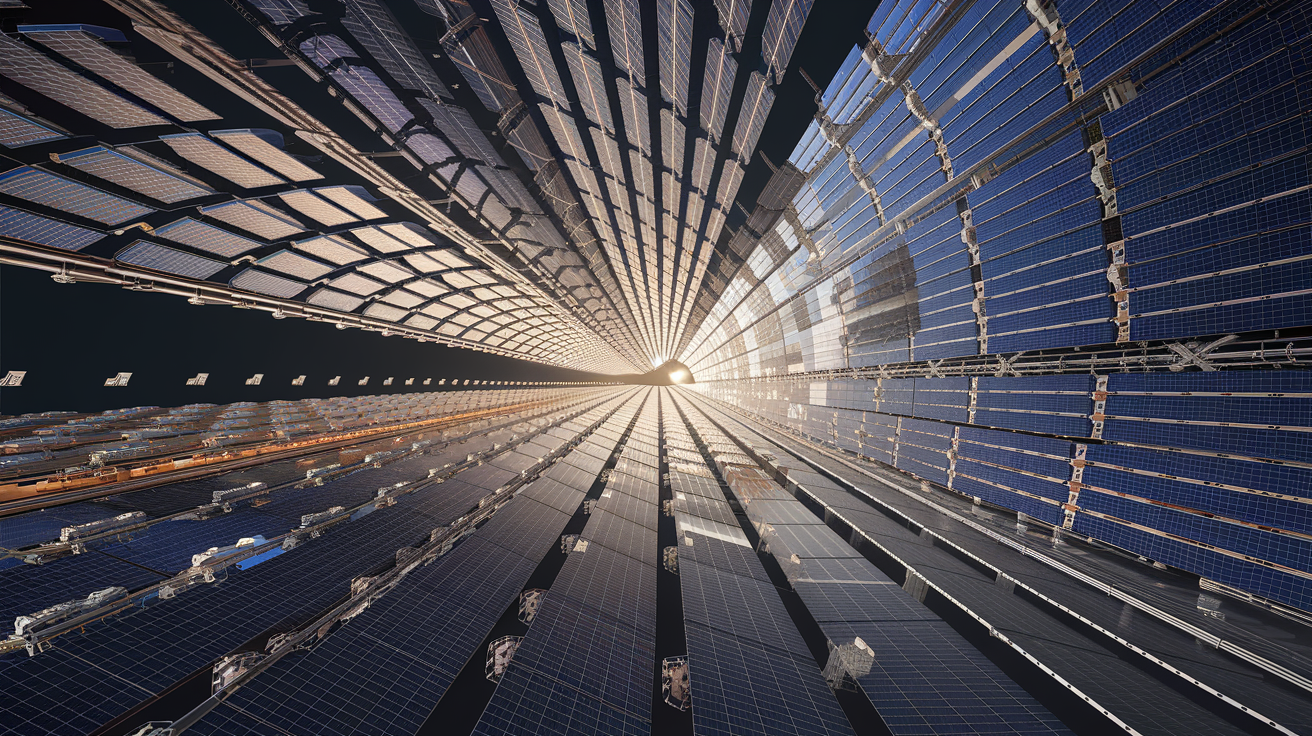


1 Km Solar Power Plant in Space Is China’s New Ambition: Asian Country Announces Initiatives to Build a Solar Power Plant in Space. Check Out the Details of the Chinese Solar Power Plant.
On January 24, 2024, China announced an ambitious project for solar energy production in space, promising to transform how electricity is generated around the world. The initiative aims to build an orbital solar power plant measuring 1 km in length. The information was disclosed by Long Lehao, chief designer of the Long March rockets and a member of the Chinese Academy of Engineering, as reported by the South China Morning Post. In this article, we explore the details of this innovative project and its impact on the energy sector.
Solar Plant in Space Will Be 36 Thousand Kilometers from the Earth’s Surface
The 1 km solar power plant project in space, which has been compared to the Three Gorges Dam due to its magnitude, aims to place a solar energy matrix in geostationary orbit at 36 thousand kilometers from the Earth’s surface.
This comparison is not unwarranted, as Three Gorges, the largest hydropower project in the world located on the Yangtze River in China, generates 100 billion kWh of energy annually, according to the website Live Science.
-
China Develops Custom 140-Ton Electric Mining Truck with 770 kWh Swappable Battery, Deploys 290 Units in Xinjiang’s Largest Zinc Mine

-
Meta to Launch Arena, a New Prediction App Targeting 3.56 Billion Users, Competing with Polymarket and Kalshi

-
Scientist Challenges Famous Human Evolution Theory, Argues Homo Sapiens Evolved Gradually Over Thousands of Years
-
15-Year-Old American Builds Ocean Generator with PVC Pipe and 3D-Printed Propeller for $12, Wins National Prize, Presents at White House, and Makes Forbes 30 Under 30 List




In the case of the Chinese solar power plant, the key word is efficiency. In space, sunlight is ten times more intense than on the planet’s surface, and there’s no need to worry about night or cloudy days.
China’s solar power panels could collect sunlight constantly and send it to Earth wirelessly through high-energy radio waves, to ground receivers.
Understand How the Solar Power Plant in Space Will Become Possible
The 1 km solar power plant project in space is so ambitious that Long Lehao mentioned at a conference of the Chinese Academy of Engineering that it is as incredible as moving the world’s largest dam to a geostationary orbit 36 thousand km above Earth. Although the solar power plant in space is not a new idea, its large-scale implementation for solar energy generation presents technical and logistical challenges.
In November 2023, researchers from Xidian University presented promising results from the Chasing the Sun Project, the first complete ground validation system for space solar power.
Challenges Faced in the Chinese Solar Power Plant Project
Although the goals for the 1 km solar power plant in space are ambitious, the path there is rife with technical challenges. The main one is the transfer of large volumes of energy through space, which remains an outstanding task.
Recent advances, such as the experiment conducted in 2023 by the California Institute of Technology (Caltech), have only managed to transmit energy wirelessly on a milliwatt scale, almost insignificant compared to what China plans to send from its future solar power plant in space.
Beijing has yet to announce an exact date for the completion of the Chinese solar power plant, but expectations are high.







Energia por micro ondas, que se transforme em realidade energia limpa.
Se a China anunciou a construção da usina é pq eles já tem alguma tecnologia promissória de transferência, mantida em segredo.