Portuguese
  Spanish


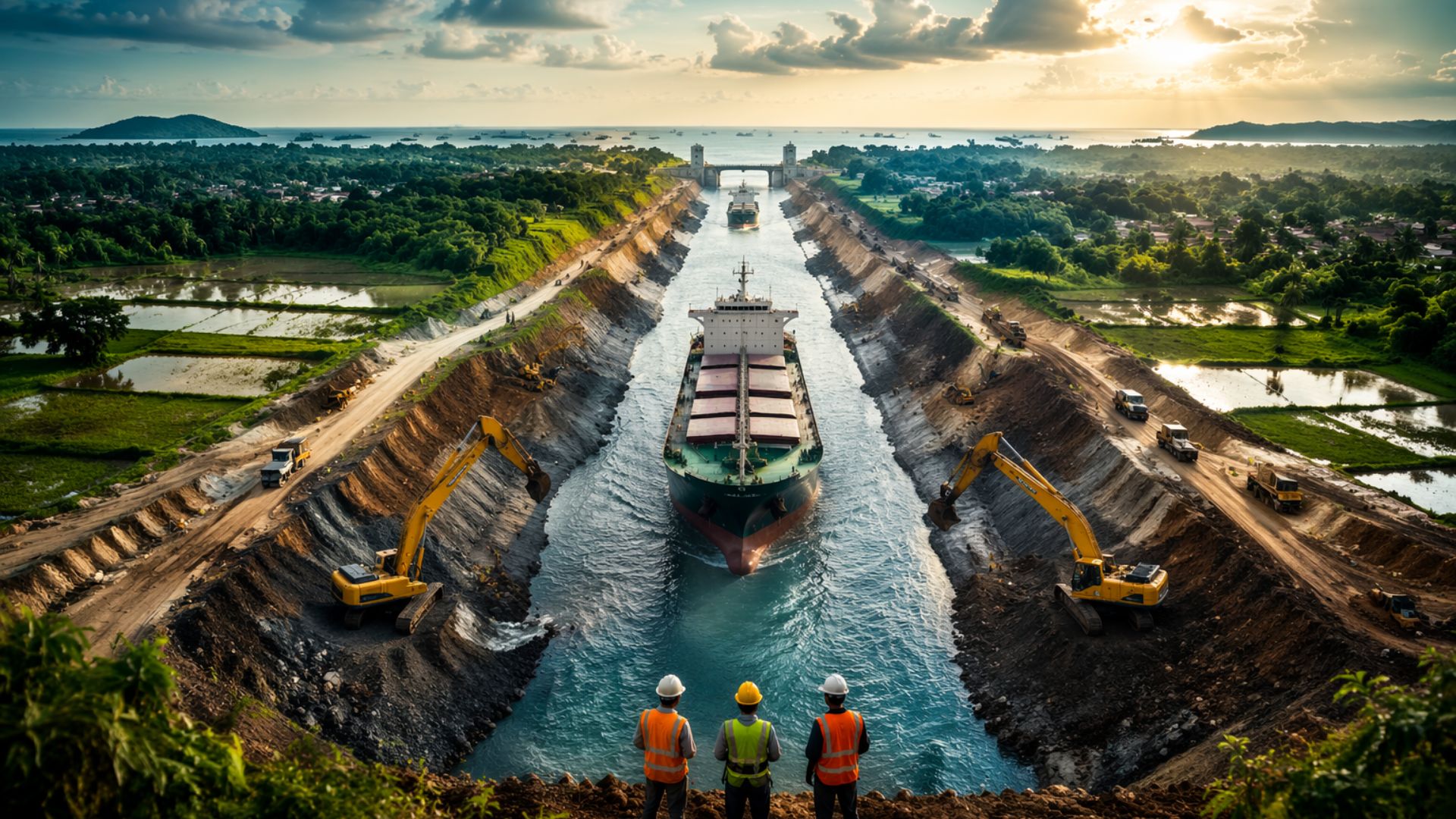


Billion-dollar agreement between China and Cambodia repositions regional logistics, expands Chinese influence, and raises environmental alerts in the Mekong by proposing a new export route independent of Vietnam and altering commercial, political, and water dynamics in one of the most strategic regions of Southeast Asia.
The signing of the US$ 1.2 billion agreement between China and Cambodia to finance the Funan Techo canal has brought back to the center of regional debate a project with the potential to transform the logistics of a country that still relies on routes via Vietnam to export a significant portion of its production.
Designed to connect a branch of the Mekong River near Phnom Penh to a direct outlet to the Gulf of Thailand, the project comes with the promise of increasing Cambodia’s commercial efficiency and reducing logistics costs, altering historically established flows in the region.
Funan Techo Canal and the new commercial route of Cambodia
More than just a simple hydraulic work, the project has been structured as a public-private partnership under the build-operate-transfer model, according to the Associated Press, ensuring 51% Cambodian participation and 49% Chinese, in a division that combines formal sovereignty and financial dependence.
-
Mother discovers she may have won £12 million in the lottery but faces an agonizing wait after the shopkeeper threw the ticket in the trash.

-
A couple bought a house in Sheffield and, when removing the carpet from the hallway, found a trapdoor leading to a secret 23 m² basement with a 2-meter ceiling height, a discovery that eliminated the need for an expensive extension and, according to them, added £70,000 to the property’s value.

-
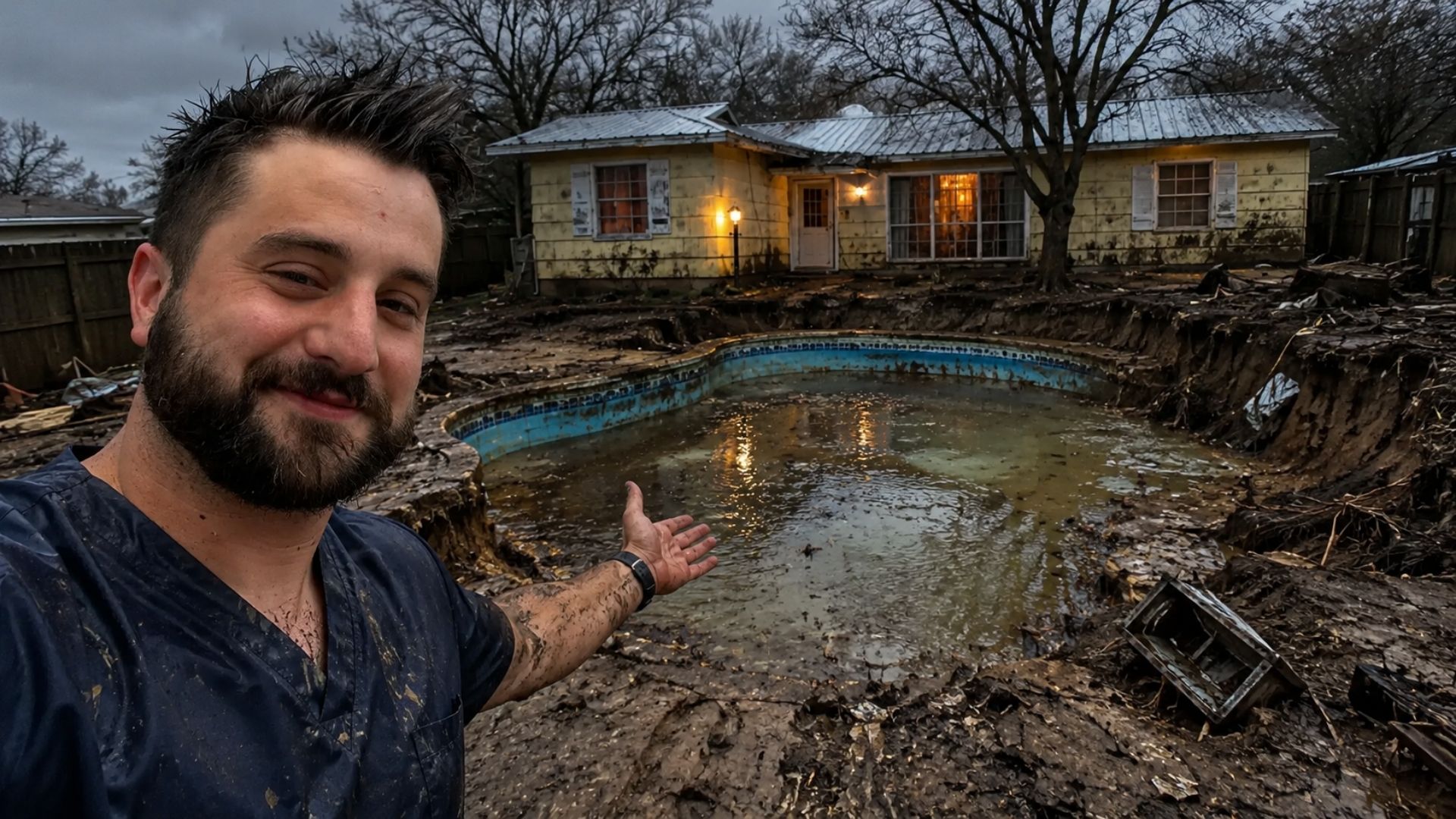
A nurse bought for 20,000 a 1955 house abandoned by a hoarder in Texas, and months later, rain revealed a buried pool in the backyard valued at $160,000, which he restored himself for about $10,000, a fraction of the cost of building a new one.
-
The United Kingdom is transforming dog feces left on trails into gas to light a streetlamp through an unlikely and surprising project that shows how even one of the most rejected wastes in cities can generate energy.



With a planned length of 151.6 kilometers, the canal is expected to connect Phnom Penh to the southern coast of the country, creating an internal logistics corridor that seeks to reduce the need to use Vietnamese ports and shorten distances for goods destined for the international market.

In this context, the proposal addresses a historical vulnerability of Cambodian geography by attempting to reorganize its trade flows through its own infrastructure, reducing bottlenecks and offering a strategic alternative for the outflow of national production.
Chinese influence and geopolitical impact in Southeast Asia
At the same time, the political dimension of the canal helps explain its international repercussions, as Cambodia maintains one of the closest diplomatic relations with China in Southeast Asia, where Chinese investments in infrastructure have been consistently expanding.
In this way, the formal entry of resources from Beijing reinforces the reading that the country seeks to consolidate its presence in strategic logistics corridors and regional supply chains, expanding influence in areas where economic and geopolitical interests often overlap.
Internally, the Cambodian government presents the project as an instrument of economic sovereignty, highlighting the expectation of reducing transportation costs to the port of Sihanoukville and increasing export capacity without relying on structures located in Vietnamese territory.
Moreover, the promise of job creation strengthens the political discourse around the project, as estimates point to up to 50,000 direct and indirect jobs, transforming the canal into a relevant asset both economically and symbolically.

Environmental impacts on the Mekong River concern the region
On the other hand, the project also raises significant environmental concerns, especially as it involves the Mekong, one of the most important river systems in Asia, responsible for sustaining millions of people in six countries and supporting essential activities such as fishing and agriculture.
Changes in the river flow, sediment transport, and water dynamics can create chain effects, impacting everything from riverside communities to large agricultural areas, especially in the Vietnamese delta, which directly depends on the stability of the system for its production.
In this scenario, Vietnam appears as the country most sensitive to the possible impacts, both due to the potential loss of logistical flow and environmental risks, leading the government to request more detailed information about the project and its consequences.
Dispute for influence and the logistical future of the region
In this context, the canal transcends the character of a national project and is treated as a regional issue, as the Mekong connects economies, territories, and productive sectors, making any intervention relevant to multiple countries at the same time.
While Cambodia defends the initiative as a step towards logistical autonomy, the project also reveals a broader shift in how the country intends to position itself on the economic map of Southeast Asia, seeking greater prominence in its trade routes.
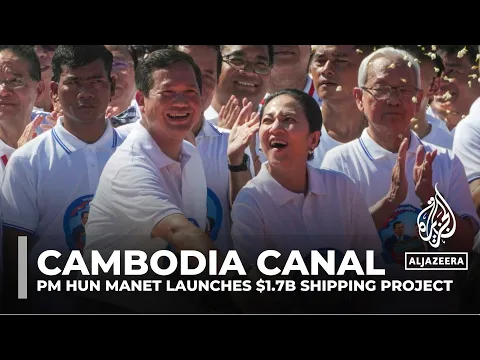

The recent history of the project is also noteworthy, as it was initiated, interrupted, and later resumed with new political momentum during the state visit of Chinese President Xi Jinping, reinforcing the strategic weight of the canal in the bilateral relationship.
The participation of the China Road and Bridge Corporation, linked to a large Chinese state conglomerate, enhances this perception by placing the Funan Techo within a broader set of infrastructure investments that are likely to redefine trade flows for decades.
In practice, the project concentrates on three simultaneous dimensions: logistics, by offering an alternative to reduce external dependence; political, by increasing Chinese presence; and environmental, by impacting a vital system for millions of people and various production chains.
Thus, by attempting to build its own access to the sea with Chinese financial support, Cambodia seeks to reduce old vulnerabilities, but at the same time, it inserts itself into a new network of dependencies related to capital, infrastructure, and the strategic influence of Beijing.