






 Portuguese
  Spanish


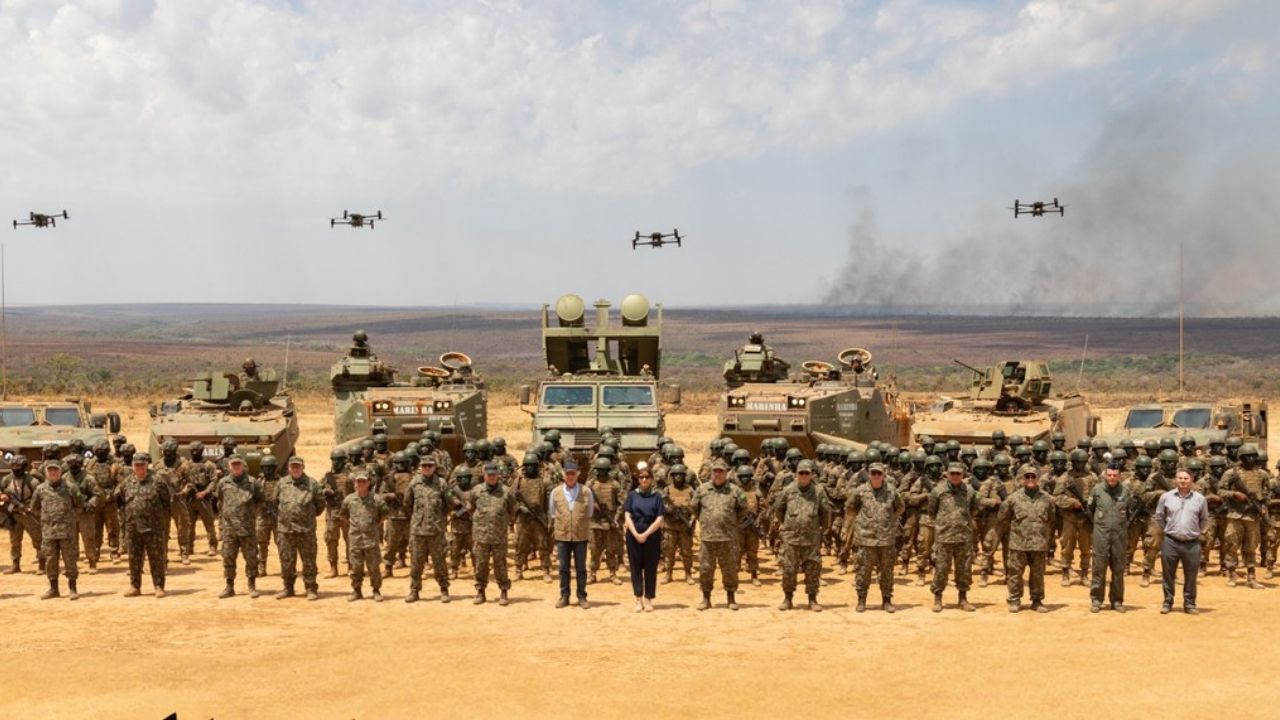

With camouflaged marines, paratroopers, vehicles, armored vehicles, helicopters, fighter jets, anti-tank missiles, and kamikaze drones, Operation Atlas brought live ammunition to the Formosa Training Field. The exercise gathered 2,500 military personnel, 180 vehicles, and aircraft from the Navy, in addition to the Air Force, in a tactical phase presented to Minister José Mucio in the Goiás Cerrado.
The naval marines participated in an operational demonstration of Operation Atlas 2025 at the Army Training Field in Formosa, Goiás, during a stage held between September 8 and 16. The activity brought together artillery systems, armored vehicles, aircraft, kamikaze drones, and troops specialized in combat.
According to the Ministry of Defense, the presentation took place on Tuesday, September 16, 2025, in front of the Minister of Defense, José Mucio Monteiro, the Navy Commander, Admiral Marcos Sampaio Olsen, generals of the Armed Forces, and the Secretary-General of the department, Cinara Wagner Fredo. The objective was to demonstrate coordinated actions in a tactical scenario in the Cerrado.
Demonstration simulated real combat actions in Formosa

The Operation Atlas brought to the Formosa Training Field a simulation with live ammunition, gunfire, explosions, and troop movements in a highly complex environment. In the scenario described by the Ministry of Defense, camouflaged marines operated in the forest, while paratroopers appeared above and military vehicles advanced across the terrain.
-
Brazilian Navy Demonstrates Strength in Naval Exercise with Over 20 Nations, Deploys Frigate Independência in Anti-Submarine and Air Defense Scenarios, and Joins Historic Formation with 26 Ships from 14 Allied Navies off the U.S. Coast

-
BAE Systems to Supply New Bofors 40Mk4 Cannons to the Brazilian Navy
-
Ukraine Bets on Swedish Gripen E Jets to Counter Russia, But 16 Fighters Won’t Arrive Until Late 2020s; Kiev to Use C/D Models for Pilot Training and Operations Amid Ongoing Missile and Drone Threats
-
End of an Era: US Navy’s C-2A Greyhound Makes Final Catapult Launch Before Retiring to Arizona Desert; Aircraft Supported Carriers in Wars and Humanitarian Missions for Nearly 60 Years


The exercise was presented as a transition from theory to practice in war scenarios. Armored vehicles, helicopters, fighter jets, anti-tank missiles, and kamikaze drones were part of the demonstration, reinforcing the proposal to test combined responses in a controlled environment, but with elements close to a real combat situation.
Navy, Army, and Air Force tested joint operations

One of the central points of the activity was the interoperability between the Navy, Army, and Air Force. The presence of marines, aircraft, armored vehicles, and artillery systems showed how different means can operate in a coordinated manner in the same tactical phase.
According to Defense, the operation aimed to reinforce the synergy between the Armed Forces. This type of exercise is important because it tests communication, movement, air support, fire employment, and command in the same operation, decisive factors in defense and readiness missions.
Tactical phase gathered 2,500 military personnel in the Cerrado

The stage held in the Central Plateau gathered 2,500 military personnel and involved 180 vehicles and aircraft from the Navy. The Air Force also participated with 10 military personnel and three planes in airspace control during the activities.
The tactical scenario was set up at the Formosa Instruction Field, an area traditionally used by the Navy for large-scale training. The location allows for the use of larger caliber weapons, such as howitzers, as well as bomb drops and machine gun fire by Navy and Air Force aircraft.
Minister highlighted readiness and territory defense

During the operational visit, José Mucio stated that the exercise is part of the Operation Atlas 2025 schedule and mobilizes personnel, equipment, and artillery systems in coordinated actions. The initiative was presented as focused on operational capability and military readiness.
The minister also highlighted that Operation Atlas brings together 10,000 men in total and had been planned since February 2024. The statement reinforces that the demonstration in Formosa was a stage within a larger operation, aimed at preparation for adversities and defense of the national territory.
Kamikaze drones and anti-tank missiles increased the weight of the demonstration

Among the mentioned equipment, the kamikaze drones and anti-tank missiles drew attention for indicating the use of technologies and armaments associated with modern conflicts. These means were employed alongside traditional systems, such as artillery, armored vehicles, and aircraft.
The presence of naval marines in this environment shows how specialized troops need to operate in conjunction with embedded technology and fire support. Modern warfare requires integration between soldiers, sensors, vehicles, aviation, and attack systems, and Operation Atlas sought to demonstrate this coordination.
Exercise in the Cerrado integrates phase of Operation Atlas 2025


The tactical phase presented in Formosa is part of Operation Atlas 2025, coordinated by the Ministry of Defense. Although the operation is linked to the tactical phase in the Amazon, the scenario of this stage was set in the Cerrado, using the Goiano instruction field to simulate combat actions in a controlled environment.
The use of a high-complexity training area allows for testing weaponry, troop movement, and coordinated responses without exposing civilians to risk. It is in this type of environment that the Armed Forces evaluate procedures before any real deployment, adjusting doctrine, command, and integration between means.
The demonstration of Operation Atlas showed marines, paratroopers, armored vehicles, helicopters, fighter jets, anti-tank missiles, and kamikaze drones in a single showcase of firepower. More than displaying equipment, the exercise aimed to test coordination between the Navy, Army, and Air Force in a complex tactical scenario.
At the same time, operations of this scale raise discussions about defense investment, military preparedness, the use of new technologies, and national priorities. Do you believe that demonstrations like Operation Atlas strengthen Brazil’s readiness or should they be accompanied by more transparency about costs, objectives, and results? Leave your opinion in the comments.


