Portuguese
  Spanish


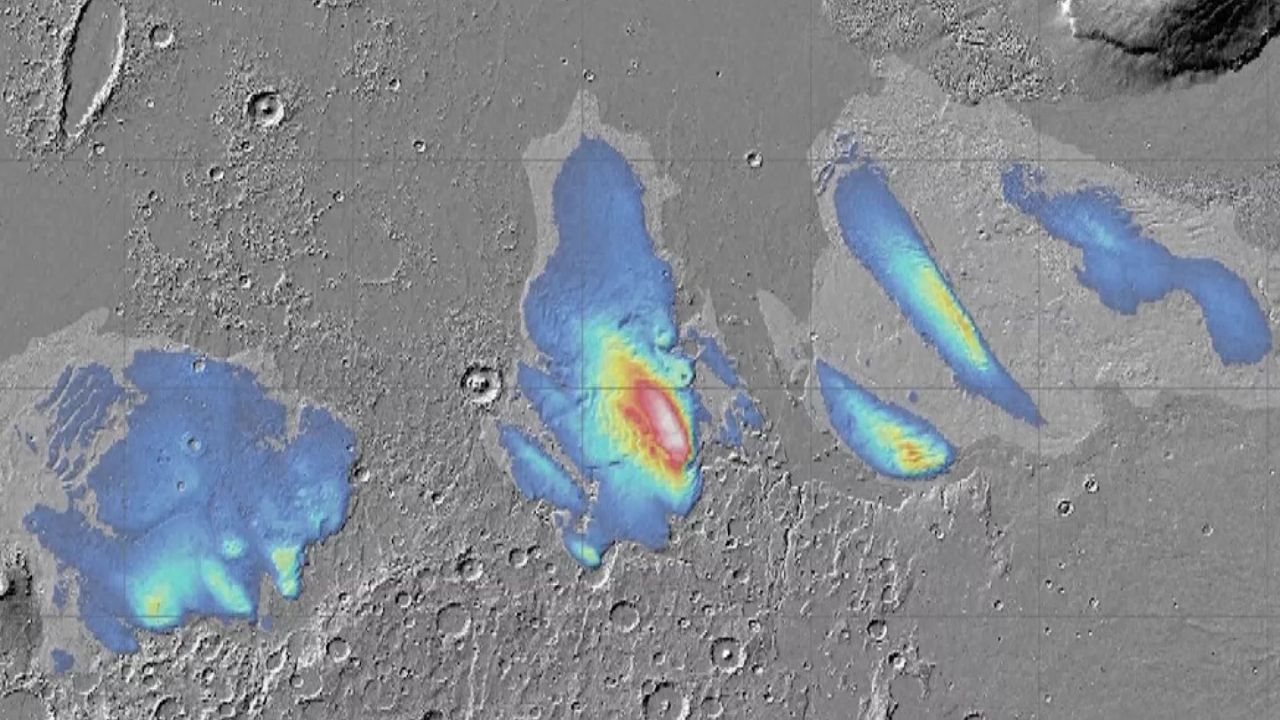

What If All the Hidden Ice on Mars Melted? Well, the Surprising Data from ESA’s Mars Express Probe Raises an Intriguing Reflection: A Potential Ocean on Mars That Would Cover the Planet with a Layer of Water Between 2.7 and 1.5 Meters Deep.
Mars has always sparked our curiosity, and now it reveals a well-kept secret: beneath its surface, a layer of ice hidden under dust could, if melted, form a true ocean. This idea not only fuels the imagination but also broadens our understanding of the history and geology of the Red Planet.
The Surprising Data from the Mars Express Probe
Scientists used data from the Mars Express radar to explore below the surface of Mars, and what they found was nothing short of impressive! The area known as Medusae Fossae (MFF) is a vast formation of wind-sculpted deposits, extending hundreds of kilometers in diameter and several kilometers in height. This area, located at the boundary between Mars’s highlands and lowlands, is considered one of the planet’s largest sources of dust, making it a perfect setting for hiding geological secrets.
The seemingly harmless layer of dust hides a treasure: thick deposits of ice, with an estimated thickness of up to 3,000 meters! Just imagine: right beneath the dust, a vast reservoir of frozen water, waiting to be revealed. This discovery leads us to think about the possibility that if this ice melted, it could transform into an ocean on Mars capable of covering the planet with a layer of water.
-
Pennsylvania Mine Creates Ice in Summer Heat and Melts in Winter, Turning a Mountain Crevice into a Reverse Natural Refrigerator

-
China Accelerates Global Expansion of Robotics: From Smart Vacuums to Industrial and Humanoid Machines, Millions Exported to Over 150 Markets
-
Polar Air Mass to Hit Brazil: Temperatures to Plummet in Nine States, Near Freezing in the South with Frost Risk Until Monday
-
Chinese “dark factories” produce electric cars 24/7 with minimal human intervention, as Zeekr assembles 800 units daily, raising concerns in Brazil.





Melting Scenarios: Depth of the Ocean on Mars
Now, let’s get to what really intrigues: what would be the depth of this ocean? Researchers presented two interesting scenarios:
Scenario 1: 300 m of Dust and 2.7 m Depth
In this first scenario, it is assumed that the layer of dry material (possibly dust or volcanic ash) covering the ice is about 300 meters thick. With this configuration, the total volume of water ice present in the MFF deposits would be approximately 400,000 km³. If all this ice melted, it would result in an ocean covering Mars with a depth of 2.7 meters. It’s like imagining a thin sheet of water, but even so, it would transform the entire landscape of the planet.
Scenario 2: 600 m of Dust and 1.5 m Depth
But what if the layer of dust is thicker, about 600 meters? In this case, the volume of ice would be reduced to 220,000 km³, and the melting would result in an ocean with only 1.5 meters of depth. Even though this is less impactful in terms of volume, this scenario still shows us how delicate and surprising Mars’s geology can be, with the potential to create an ocean on Mars that, although shallow, would be an unparalleled phenomenon.
Other Evidence of Water
And it doesn’t stop there! In the vast northern plains of Mars, scientists also found thousands of mounds and hills rich in clay minerals. These formations, which rise hundreds of meters above the terrain, are like clues left behind by the water that once flooded the region. Formed by the interaction of rocks with water over millions of years, these structures help paint a broader picture of Mars’s history and reinforce the idea that water has always played a crucial role on the Red Planet.