Portuguese
  Spanish


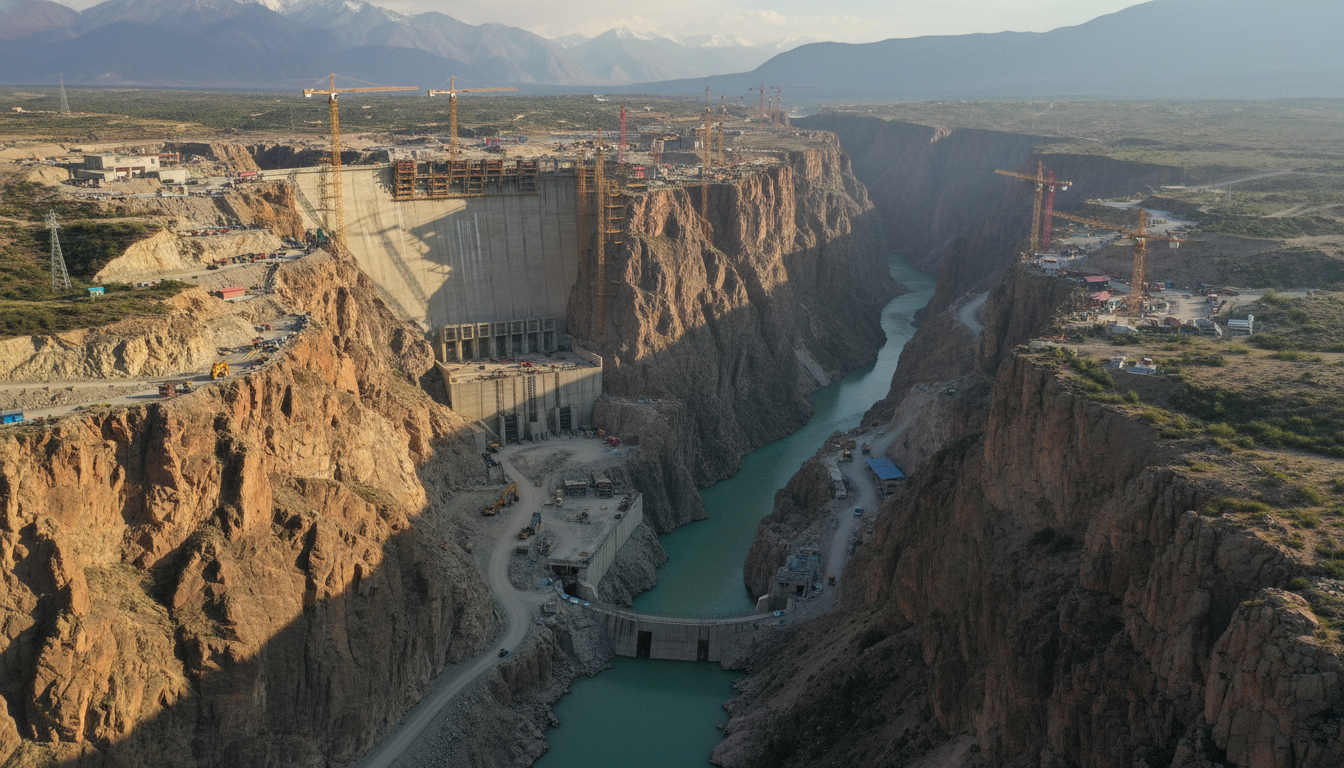

Premier Li Qiang launched in July 2025 the planet’s largest hydroelectric plant, with a capacity of 60 GW
While Belo Monte advanced at a slow pace in Brazil, China is building 5 cascade hydroelectric plants on the Yarlung Tsangpo river in Tibet. The complex was named Medog Hydropower Station.
The project will generate 300 billion kWh per year. This volume is three times greater than the current production of the Three Gorges hydroelectric plant.
Construction was officially launched on July 19, 2025, by Chinese Premier Li Qiang. The announcement took place at a ceremony in Tibet itself.
-
Facing high rent, couple transforms parents’ garage into a fully functional apartment, creating a complete home at a fraction of the market cost.

-
MIT Scientists Develop Method to Transform CO₂ into a Construction Ally, Boosting Cement Strength by 13% in 24 Hours for More Sustainable Infrastructure

-
Canadian City Builds 8 Tiny Homes in 72 Hours for Homeless Youth, Plans 40 Affordable Houses for Female-Led Families Amid Housing Crisis

-
45-year-old Brazilian mother of 9 and grandmother of 12 receives 27 m² house made from recycled plastic, built in 15 hours with interlocking blocks and a recycled roof.


As reported by The Diplomat in February 2026, the total investment reaches 1.2 trillion yuan. That’s about 137 billion dollars.
In fact, the number is larger than the entire budget of the International Space Station. The Chinese intend to complete the complex by 2033.
Therefore, Medog becomes the largest hydroelectric project in human history. Three Gorges, the current record holder, has only 22.5 GW of capacity — Medog will reach 60 GW.

How the Medog Yarlung Tsangpo hydroelectric plant works in Tibet
The complex takes advantage of a unique bend in the Yarlung Tsangpo. In the Namcha Barwa region, the river makes a U-turn around a mountain.
This section has a drop of 2,000 meters over just 50 km. According to the detailed technical record of Medog, it is the highest concentration of hydroelectric potential in the world.
Instead of a single dam, Chinese engineers planned 5 cascade stations. Each one takes advantage of part of the total drop.
According to an analysis by Yale Environment 360 magazine, the project also involves 4 tunnels, each 20 km long. These tunnels cut through the massive Namcha Barwa to divert part of the river’s flow.
Thus, Medog Yarlung Tsangpo combines hydraulic engineering with large-scale tunneling. It is the largest hydroelectric construction site in history.
For comparison, the Itaipu complex (Brazil/Paraguay) has 14 GW installed. Medog will produce 4 times Itaipu combined.

Comparison with Three Gorges and Belo Monte on a global scale
China’s Three Gorges hydroelectric plant holds the current world record. It has 22.5 GW of installed capacity and produces about 88 billion kWh per year.
The Yarlung Tsangpo will surpass Three Gorges in all metrics. 2.7× greater capacity, 3.4× greater annual production, 2× greater drop.
According to data from the China Three Gorges Corporation, current operations generate 88.2 billion kWh per year. In 2 decades, it has produced over 1.6 trillion kWh.
Therefore, Medog’s leap is historic. There is no other renewable energy project that comes close to this volume.
In parallel, Belo Monte in Brazil reaches 11.2 GW and is the fourth largest plant in the world. According to an analysis by AIDA Americas, the final cost escalated from US$ 4-5 billion to over US$ 15 billion.
Indeed, Belo Monte took 14 years to become operational (2002 planning began, 2019 final completion). Medog has a similar timeline — 8 years from announcement to operation.

Environmental risks and geopolitical tensions of Medog
The Yarlung Tsangpo does not end in Tibet. Further downstream, it becomes the Brahmaputra river in India and Bangladesh.
Therefore, over 300 million people depend on the flow of this river. India formally protested in December 2024, according to Yale Environment 360.
According to