






 Portuguese
  Spanish


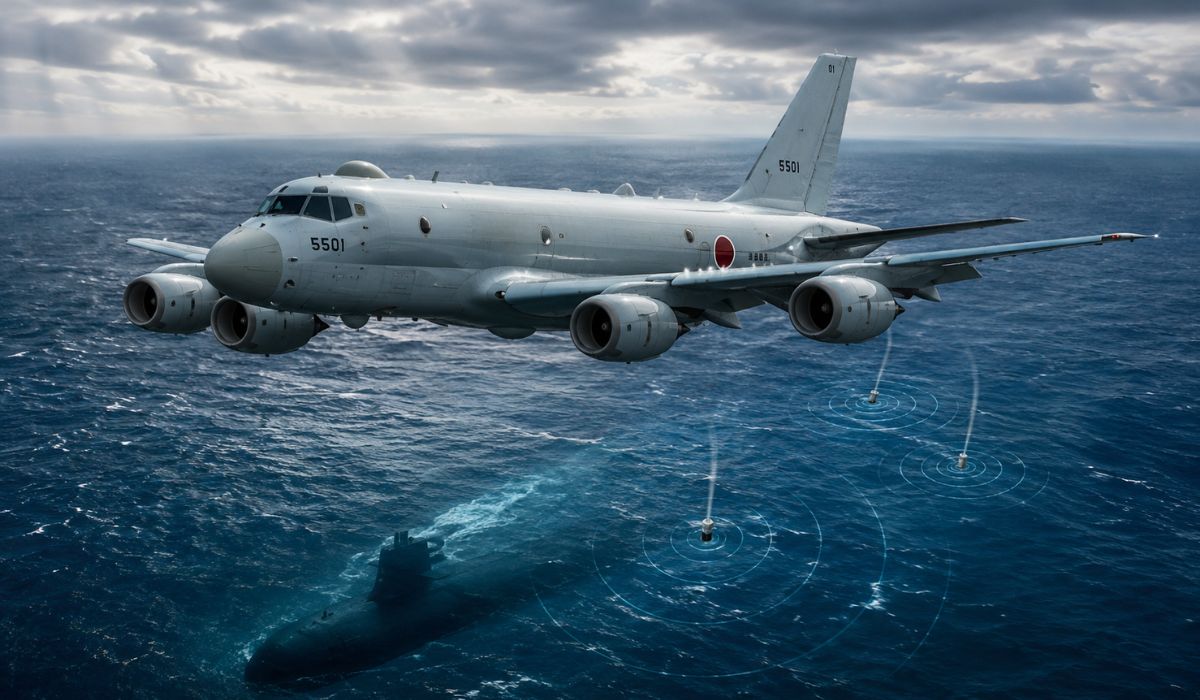


Japanese aircraft combines four engines, fiber optic control, and anti-submarine sensors in a military project designed for prolonged ocean patrols and maritime surveillance in strategic areas of the Pacific.
The Kawasaki P-1 is a maritime patrol aircraft developed in Japan to monitor large ocean areas, detect submarines, and support naval security missions.
Operated by the Japan Maritime Self-Defense Force, the model was created to gradually replace the P-3C Orion and perform prolonged missions over the sea, according to Kawasaki Heavy Industries.
Designed as a military platform from its inception, the P-1 features four IHI F7-10 turbofan engines, onboard mission systems, and a structure geared towards operations in a maritime environment.
-
China Develops Custom 140-Ton Electric Mining Truck with 770 kWh Swappable Battery, Deploys 290 Units in Xinjiang’s Largest Zinc Mine

-
Meta to Launch Arena, a New Prediction App Targeting 3.56 Billion Users, Competing with Polymarket and Kalshi

-
Scientist Challenges Famous Human Evolution Theory, Argues Homo Sapiens Evolved Gradually Over Thousands of Years
-
15-Year-Old American Builds Ocean Generator with PVC Pipe and 3D-Printed Propeller for $12, Wins National Prize, Presents at White House, and Makes Forbes 30 Under 30 List




According to the Japan Maritime Self-Defense Force, the aircraft is 38 meters long, has a wingspan of 35.4 meters, is 12.1 meters high, has a maximum takeoff weight of approximately 80 tons, and a crew of 11 people.
The combination of sensors, avionics, and low-altitude flight capability defines the model’s role in anti-submarine patrol.
During this type of mission, the aircraft can deploy acoustic buoys, cross-reference radar, infrared, and magnetometry data, in addition to maintaining communication with ships and command centers.
Kawasaki P-1 was created to patrol large maritime areas
Unlike civilian aircraft adapted for military use, the Kawasaki P-1 was developed as a maritime patrol aircraft.
Kawasaki reports that the model received its own fuselage, engines, and patrol systems, as well as improvements in speed, range, and payload capacity compared to the P-3C Orion.
The choice of four engines is related to operation over large maritime areas.
On long flights over the Pacific, far from land bases and in an environment prone to corrosion, mechanical redundancy increases the safety margin in case of an engine failure.
This arrangement is also associated with low-altitude operations, a frequent condition in search and tracking missions of contacts at sea.
Technical documents from Japan’s Ministry of Defense cite the P-1’s stability at low speed and low altitude, as well as the cockpit’s wide visibility, as characteristics linked to maritime patrol missions.
Visual observation remains present in this type of operation.
Although radars, acoustic sensors, and infrared systems play a central role, the crew can also monitor surface signs, such as debris, vessels, displacement marks, and other elements useful for identifying occurrences.
Fly-by-light system uses fiber optics in flight control
Among the most cited technical features of the Kawasaki P-1 is the fly-by-light control system, also known as fly-by-optics.
In this system, flight commands are transmitted via optical fibers, instead of traditional mechanical cables or conventional electrical wiring.
According to Kawasaki, the P-1 employs the first operational fly-by-light system applied to an aircraft of this type.
The company states that the technology offers high tolerance to electromagnetic interference, a relevant factor in a platform equipped with radars, mission equipment, and onboard electronic systems.
The adoption of optical fibers is directly related to the routine of a military patrol aircraft.
In naval operations, the environment can involve multiple radar emissions, military communications, and electronic warfare equipment.
In this context, the optical transmission of commands reduces the control system’s exposure to interference.
This feature does not only change how the pilot sends commands to the aircraft.
It also integrates a flight architecture that needs to work in conjunction with sensors, mission computers, and communication systems, especially in long operations with a large volume of data.
Kawasaki P-1 sensors aid in the search for submarines
The search for submarines requires the combination of different sensors, as submerged targets cannot be tracked by visual means alone.
Generally, maritime patrol aircraft rely on acoustic data, radars, infrared sensors, and magnetic anomaly detectors to form a broader picture of the situation.
In the case of the P-1, Kawasaki states that the aircraft can employ sonobuoys to capture underwater sounds.
These devices are launched into the sea and transmit data to the aircraft, where operators analyze acoustic patterns and try to identify possible contacts below the surface.
The magnetic anomaly detector is another resource used in anti-submarine missions.
This type of sensor looks for changes in the Earth’s magnetic field caused by the presence of large metallic masses, such as submarine hulls, and can complement information obtained by acoustic means.
In addition to sensors focused on the underwater environment, the aircraft can also use radar and infrared equipment to observe the surface.
This combination allows for tracking vessels, identifying changes in the maritime surroundings, and supporting decision-making during surveillance missions.
Range, engines, and armament of the Japanese submarine hunter
The attributed range of the Kawasaki P-1 appears in specialized databases to be around 8,000 kilometers, a value equivalent to about 4,300 nautical miles.
Kawasaki, in its public materials, states that the model has a greater range than the P-3C Orion, but does not provide the exact number in kilometers on its institutional page.
The propulsion is provided by four F7-IHI-10 turbofans.
According to the Japan Maritime Self-Defense Force, each engine has a thrust of 5,400 kg, and the set allows for a cruising speed of 450 knots, equivalent to approximately 833 km/h.
Although classified as a patrol aircraft, the P-1 was also designed to carry armaments on specific missions.
Kawasaki’s technical literature cites an internal bomb bay and external hardpoints under the wings, a configuration that allows for the use of payloads for anti-submarine and anti-ship operations.
Specialized sources describe compatibility with torpedoes, mines, depth charges, and air-launched missiles.
The configuration, however, depends on the mission, operational authorizations, and the doctrine of employment of the Japan Maritime Self-Defense Force.
Japan developed its own aircraft to replace the P-3C Orion
Japan relies on sea routes for trade, energy, and supply.
Being surrounded by busy seas in the western Pacific, the country maintains maritime patrol aircraft as part of its surface surveillance and anti-submarine warfare structure.
The P-1 is also part of an industrial development policy.
Instead of merely adopting a ready-made foreign aircraft, Japan conducted a national program to replace the P-3C, with the participation of local companies in areas such as fuselage, engines, sensors, and systems integration.
Kawasaki states that the program began after the company was chosen in 2001 as the main contractor for the development of the P-1 and the C-2 transport aircraft.
The proposal involved creating two distinct military aircraft, but with part of the development conducted in parallel.
This decision has implications for Japan’s defense production chain.
Maritime patrol aircraft require integration between sensors, computers, communications, weapons, and aerodynamic performance, which demands specialized suppliers and long-term maintenance.
Oceanic environment poses challenges to P-1 operation
The operation of the P-1 occurs in an environment of constant wear and tear for aircraft.
Salt, humidity, strong winds, and prolonged flights over the sea can affect engines, sensors, and electronic components, requiring frequent maintenance and parts replacement.
In 2025, audits in Japan pointed out operational availability problems in the P-1 fleet.
Among the factors cited were corrosion in engines, failures in electronic equipment, and difficulties in the supply chain, according to information released by specialized defense publications.
These records show that the operation of an advanced military platform depends not only on the original design but also on maintenance, logistics, and continuous updates.
In the case of an aircraft designed to patrol oceans, the maritime environment itself becomes part of the challenges faced by the fleet.
The curiosity surrounding the P-1 lies in the combination of characteristics uncommon in a patrol aircraft: four jet engines, fiber optic control, underwater search sensors, and national development aimed at a specific need.





