Portuguese
  Spanish




Alleged Discovery Beneath the Pyramid of Khafre Reignites Ancient Theories, But Archaeologists Explain Why The Data Does Not Support The Hypothesis
A controversial hypothesis regarding the existence of a secret city beneath the Pyramids of Egypt gained global attention in 2024, after two Italian researchers claimed to have identified structures up to 38,000 years old buried beneath the Giza plateau. However, although the announcement sparked curiosity, experts in archaeology and geosciences quickly challenged the conclusions, based on established data.
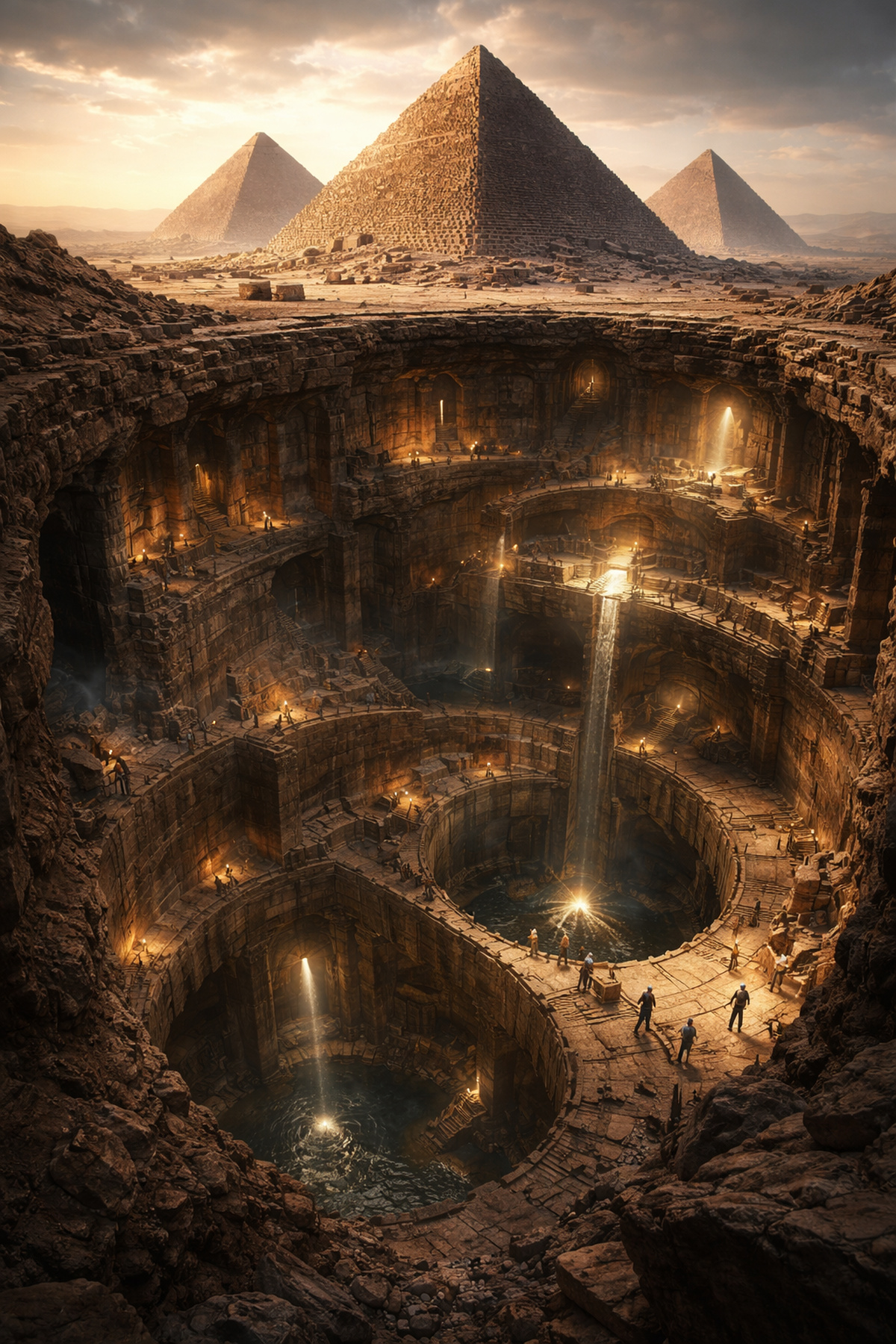
According to retired chemist Corrado Malanga and remote sensing specialist Filippo Biondi, a new method of interpreting synthetic aperture radar (SAR) data supposedly revealed wells, spiral passages, and large geometric structures beneath the Pyramid of Khafre in Giza. According to the authors, the data would indicate eight deep wells connected to two cubic structures about 90 meters in size, along with other interconnected formations.
Radar Technology Generates Controversial Interpretations
However, despite intense publicity, these claims have not undergone peer review to date. Still, visual reconstructions — many of which are generated by artificial intelligence — have begun circulating widely, linking the alleged structures to a legendary prehistoric city or even an ancient power plant.
-
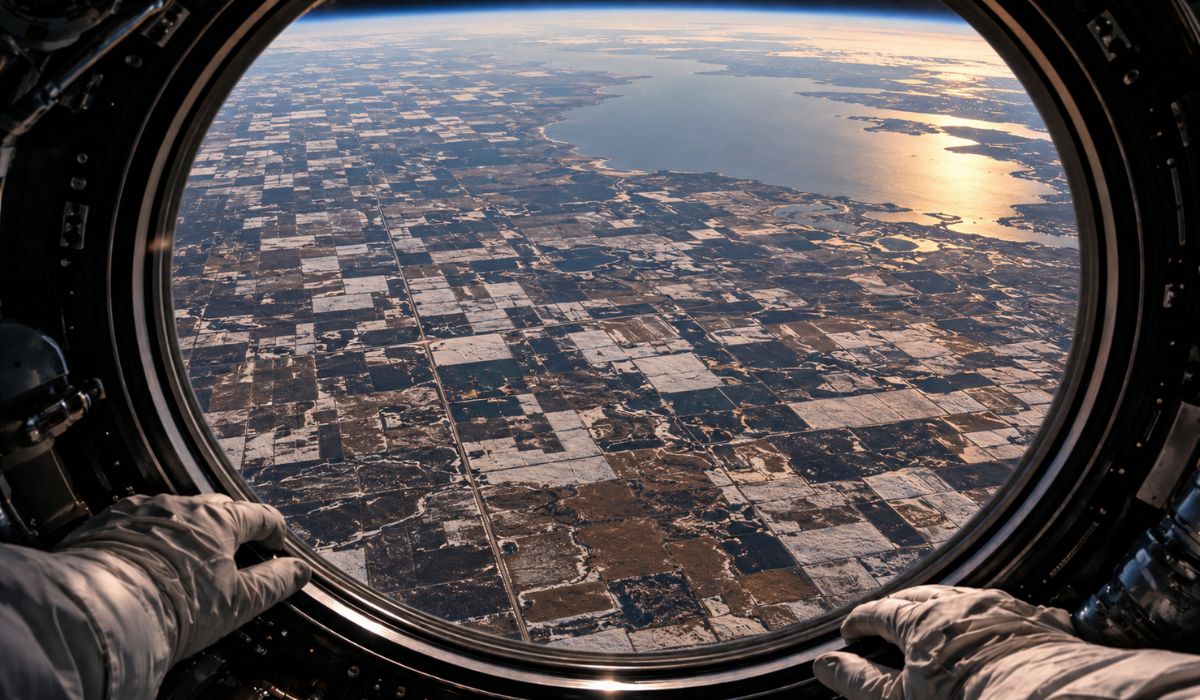
Seen from space, an astronaut captures in Canada a geometric carpet of crops drawn over the backdrop of a ghost lake that disappeared 12,000 years ago, was once larger than all the Great Lakes combined, and left a scar of fertile mud that still sustains agriculture.

-
Billionaire says the most valuable skill will help overcome job elimination caused by AI, following Bill Gates’ fears

-
A Dutchman created a ‘box’ that makes trees grow in the desert almost without water and without irrigation: the invention has already brought seedlings to dozens of countries and achieves up to 90% survival where common planting did not exceed 10%.

-
Abandoned warehouse hid a giant collection of rare computers, with over 2,000 artifacts from the 1930s to the 1980s.



These images, while visually striking, exceed the actual limitations of SAR, a technology that does not produce complete three-dimensional models nor allows for accurate visualization of structures at great depths.
Ancient Legends Return to the Center of Modern Debate

Photo by Christian Heeb, Laif, Redux
Historically, rumors about hidden structures beneath the pyramids are not new. Accounts attributed to Herodotus in the 5th century BC already mentioned underground passages. Centuries later, during the Middle Ages and the Renaissance, these narratives resurfaced in writings and philosophical debates.
By the 20th century, American medium Edgar Cayce popularized the idea of a “hall of records” hidden beneath Giza, reinforcing theories that continue to be recycled whenever new technologies emerge.
Archaeologists Question Technical Limits of the Study
In light of the repercussions, renowned archaeologists have taken a stand. In 2024, archaeologist Flint Dibble from Cardiff University explained that synthetic aperture radar does not penetrate kilometers of rock, reaching only a few meters below the surface, even under ideal conditions.
Science communicator Milo Rossi emphasized that the published reconstructions exceed the actual data, while professor Lawrence B. Conyers, a ground-penetrating radar expert at the University of Denver, classified the claims as “a major exaggeration” in interviews given the same year.
Lack of Official Authorization and Criticism in Egypt
Egyptian archaeologist Zahi Hawass, former Minister of Antiquities, stated in 2024 that the claims are unfounded, stressing that no official authorization has been granted for studies of this type on the Pyramid of Khafre, according to the norms of the Egyptian Supreme Council of Antiquities.
According to him, any research of this magnitude would require institutional validation and technical oversight, which did not occur in this case.
Water Table Contradicts Megastructure Hypothesis
Another decisive point involves the water table of the Giza plateau. A study conducted by Sharafeldin et al., published in 2019, demonstrated that groundwater is only a few dozen meters from the surface, causing continuous erosion in monuments like the Sphinx.
Thus, giant structures two kilometers deep would be permanently submerged, which completely invalidates the hypothesis presented by the Italian researchers.
Water Explains The Construction of The Pyramids, Not Extraordinary Technology
Furthermore, research by Sheisha et al., published in 2022, indicated that, between 2600 and 2500 BC, during the construction of the pyramids, a navigable arm of the Nile River reached the Giza plateau, facilitating the transport of the stones used in the constructions.
Therefore, natural processes, fluvial logistics, and human engineering explain the construction of the pyramids without the need to resort to unknown technologies or external interventions.
In light of more than two centuries of archaeological, geological, and hydrological studies, the scientific consensus remains clear: there is no reliable evidence of a secret city beneath the Pyramids of Egypt.
To what extent should fascinating narratives advance when they clash with widely verified historical data?