






 Portuguese
  Spanish
  4 min of reading
  1 comment


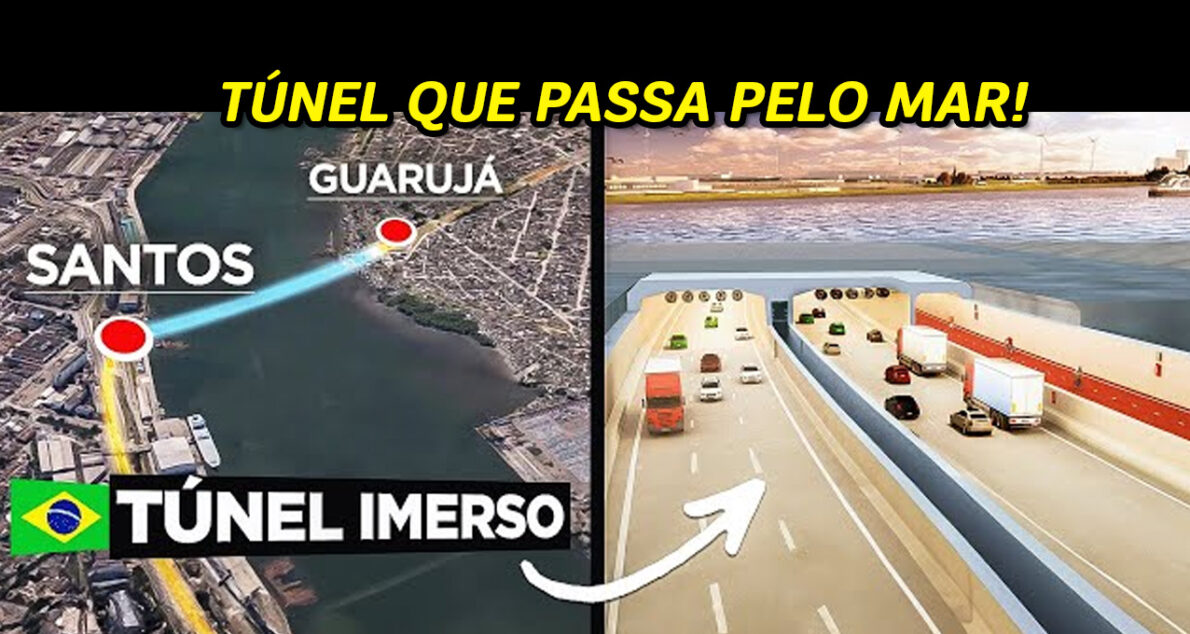


Tunnel Project Promises to Revolutionize Transportation on the Coast. With a cost of R$ 6 billion, the construction will include six lanes, a link with the Light Vehicle on Rails (VLT), and easy access for pedestrians and cyclists. Over 9,000 jobs will be created, and the crossing will take only two minutes.
A submerged tunnel, the first of its kind in all of Latin America, is about to become a reality on the coast of São Paulo, connecting the cities of Santos and Guarujá in a crossing that should last only two minutes.
The project promises to revolutionize urban mobility in the region and profoundly impact the logistics of the Port of Santos, with a structure that will cross the sea and include six traffic lanes, allowing pedestrians, cyclists, vehicles, and even the Light Vehicle on Rails (VLT) to connect the two cities quickly and safely.
A Billion-Dollar Project in Progress
-
Brazilian Joins Homeownership Consortium, Faces Decade of Dual Payments Totaling $141,000, Surpassing Traditional Mortgage

-
Land Rover to Halt Production in July, Putting 371 Jobs at Risk, as Chinese Automaker Negotiates to Convert Factory to 100,000 Vehicles Annually by 2027

-
Mexican Pest Threatens U.S. Cattle Herds at Historic Lows, Potentially Boosting Brazilian Beef Exports as Burger Prices Soar

-
Brazilian Freight Bill Progresses in Congress with $5,000 Minimum Wage, 70% Advance Payment, and Fines Up to $1 Million, as Agriculture and Industry Warn of Rising Costs and Legal Uncertainty


The Santos-Guarujá Tunnel project, estimated at R$ 6 billion, already has significant support from the São Paulo government and the Ministry of Ports and Airports, which together will cover 86% of the total cost.
The remaining amount will be financed through a partnership with private sector companies, according to information from the state government.
The auction to determine the company responsible for the construction is scheduled for the second half of 2025, and the inauguration of the work is expected in 2028.
What Will the Tunnel That Crosses the Sea Be Like?
The tunnel will be 860 meters long and located at a depth of 21 meters.
It will have six lanes, with three in each direction, and will also allow the passage of the VLT in one of the lanes.
The accesses will be made from the Outeirinhos wharf in the Macuco neighborhood in Santos and from Codesp’s Linhão in Vicente de Carvalho, in Guarujá.
Adding the access roads, the total length of the project will reach 3 kilometers, allowing a direct connection between the two cities that currently takes almost an hour by car.
Drastic Reduction in Crossing Time
Currently, the crossing between Santos and Guarujá is done by ferries and roads. With the ferry, the average time is 18 minutes but can extend due to a waiting time of up to 15 minutes.
By the Cônego Domenico Rangoni highway, which connects the cities in a 43 km route, the trip takes about an hour.
The new submerged tunnel will reduce this crossing to just two minutes, according to projections from the Port Authority of Santos (APS).
It is estimated that over 21,000 vehicles, in addition to 7,700 cyclists and 7,600 pedestrians, will use the tunnel daily.
Urban and Environmental Impact
To make the project viable, several urban adaptations have been planned.
In Santos, a “superblock” will be created in the Macuco neighborhood, in a space equivalent to four soccer fields, aimed at minimizing the impact of the work on homes.
This intervention includes the relocation of 700 families to new residential areas, ensuring the preservation of the quality of life for local residents.
In Guarujá, the tunnel’s route will be diverted from areas undergoing reurbanization, adding 1.5 km in length to the Cônego Domênico Rangoni highway, to facilitate access for heavy vehicles and public transport.
The structure will feature a bike lane and pedestrian crossings, making it a multifunctional and accessible space.
Jobs and Development for the Region
The construction of the tunnel is seen not only as a mobility solution but also as an economic opportunity for the region.
It is estimated that the work will create about 9,000 direct and indirect jobs, benefiting workers from various sectors and boosting the local economy.
Additionally, the tunnel will allow for a smoother integration with the Regional Airport of Guarujá, which is under development, and will contribute to the growth of the logistics infrastructure of the Port of Santos, one of the busiest in Latin America.
According to the Port Authority, the tunnel will not interfere with the deepening works of the port channel, ensuring that the flow of ships also remains uninterrupted.
Next Steps and Expectations
With the sanction of the law project authorizing the Public-Private Partnership (PPP) by the São Paulo Government, the contracting and development stages are progressing.
According to the São Paulo Legislative Assembly (Alesp), the project encompasses everything from construction to the operation and maintenance of the tunnel, ensuring the continuous responsibility of the winning company from the auction.
The expectation is that, with the completion of the works, mobility between Santos and Guarujá will be completely transformed, providing not only a faster and safer alternative but also encouraging sustainable urban development for the coming years.
This way, the local population and the thousands of tourists who visit the coast of São Paulo will be able to enjoy a new mobility experience while the region gains new momentum for growth and innovation.
How do you think this billion-dollar project will impact the daily lives of residents and the economy of the coast of São Paulo?





Na Argentina existe um túnel submerso nos mesmos moldes sob o Rio Paraná, já faz alguns anos