Portuguese
  Spanish


US Scientists Discover Material That Could Revolutionize The Technology Market: It Is A Semiconductor Silicone That Can Be Used In Screens, Clothes, And Solar Panels. Learn All About The Silicone That Glows
Scientists have developed a new type of semiconductor silicone that surprisingly emits light and conducts electricity — something previously considered incompatible with traditional silicone properties. The discovery, made by a team of researchers from the University of Michigan, led by Richard Laine and Zijing (Jackie) Zhang, in the United States, represents a leap in materials science and could have revolutionary applications in technologies such as foldable screens, smart clothing, and flexible solar panels.
This new silicone not only retains the flexibility and thermal resistance characteristics that make the material widely used in the industry but now also exhibits electrical and optical properties previously exclusive to rigid and fragile materials, such as crystalline silicon. The unprecedented combination of mechanical flexibility and electronic functionality promises to open new frontiers for wearable electronics and portable devices.
What Is The Glowing Semiconductor Silicone?
Silicone is traditionally a polymer known for its thermal stability, elasticity, and excellent electrical insulation. For this reason, it is widely used in medical, industrial, and electronic applications — but almost always as an insulating support and not as a conductor.
-
NASA Plans to Repurpose Mars Rover for Lunar Mission, Sending a 1-Ton Nuclear-Powered Vehicle to Explore the Moon’s South Pole Without Solar Dependence

-
Early Humans Made Beds Nearly 200,000 Years Ago in African Caves, Study Reveals

-
Japanese Smart Bike Detects Cyclist’s Intent to Turn and Potential Falls
-
METTL3 Protein Found to Play Crucial Role in Breast Cancer Metastasis, Surprising Scientists


In this study, scientists altered the molecular structure of silicone by incorporating organic semiconductor compounds and side-chain siloxanes.
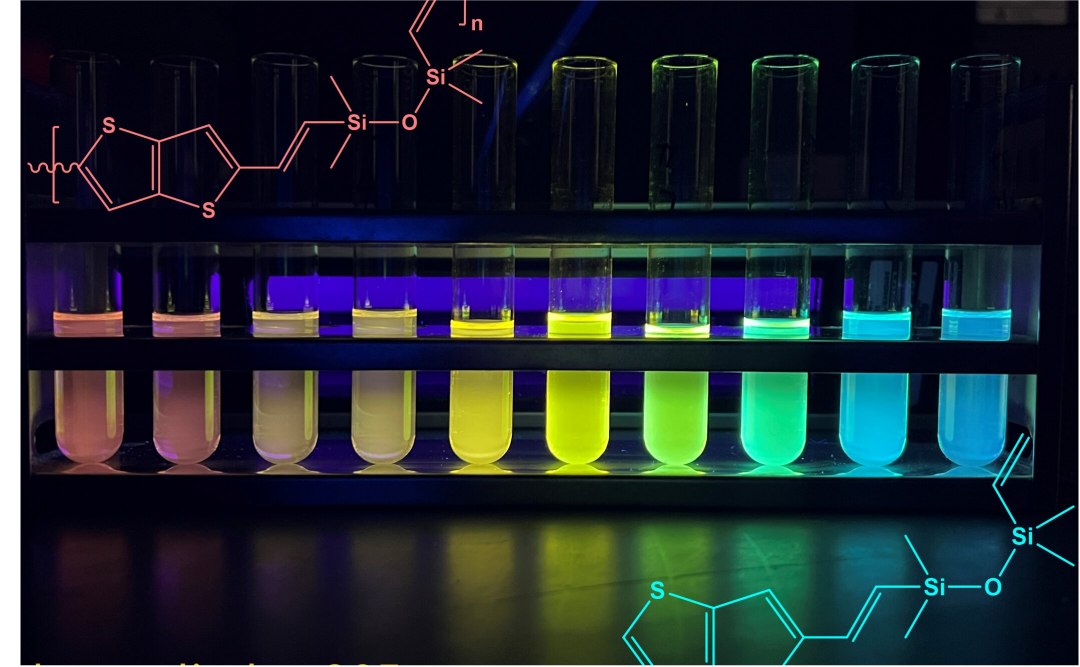
This chemical modification enabled electron conduction and, more importantly, the emission of visible light when electrically stimulated. Therefore, it is a glowing silicone with effective semiconductor properties.
Impact On Flexible And Foldable Display Technology
One of the main expected uses for the glowing semiconductor silicone is in the display industry. Flexible OLED screens, currently used in smartphones and wearables, still rely on plastic substrates and rigid electronics, which limits their durability and deformation capability.
The integration of the new silicone will enable the development of screens that truly follow the movements of the body, capable of being folded, stretched, or even rolled up without performance loss. This benefits everything from wearable electronics, such as smartwatches, to medical and industrial applications where continuous and discreet monitoring is required.
Additionally, due to being a lightweight, durable, and easy-to-manufacture material, it could reduce production costs and simplify the logistics of distributing these devices.
More Advanced And Comfortable Smart Clothing
Another promising field for this semiconductor silicone is in smart clothing — an area that has been growing with the convergence of fashion and technology. Apparel equipped with electronic sensors is already used in sports, health, and safety but suffers from comfort, durability, and washability limitations.
With the new material, it becomes possible to produce electronic fabrics that not only monitor physiological variables like heart rate and body temperature but also react to this data by emitting visual signals or altering the properties of the fabric itself. Imagine a t-shirt that changes color to indicate physical exhaustion or a jacket that lights up in risk areas with low visibility.
The flexibility and biocompatibility of silicone make it ideal for direct contact with the skin, and its conductivity allows communication with other devices via Bluetooth or NFC, integrating into IoT (Internet of Things) ecosystems.
Potential For Flexible And Portable Solar Energy
Another major benefit of the glowing semiconductor silicone is its application in flexible solar panels. Conventional solar cells, made of crystalline silicon, are efficient but fragile and heavy. Although there are flexible alternatives, such as perovskite cells or organic polymers, they struggle with stability and durability.
The new silicone presents a potential solution: it combines environmental resistance with energy conversion capability and structural flexibility. This would allow the creation of solar panels that can be folded, rolled, or applied to irregular surfaces — such as backpacks, camping tents, drones, helmets, or clothing.
This technology could benefit remote areas, military operations, space missions, and off-grid communities, contributing to the advancement of clean and decentralized energy.
Contribution To Sustainability And Reduction Of Electronic Waste
In addition to technological benefits, the new semiconductor silicone also raises discussions about sustainability. Flexible materials that conduct electricity and emit light could help reduce the use of heavy metals and rigid components that are difficult to recycle.
The manufacturing of electronic devices with this glowing silicone could generate less industrial waste and extend the product lifecycle. This is especially important in light of growing concerns about electronic waste. Therefore, the innovation not only drives technological evolution but also contributes to more environmentally and economically responsible solutions.
Technical Challenges And Next Steps
Despite the advancements, there are still obstacles to overcome before the new material can be produced on an industrial scale:
Chemical Stability: One of the biggest challenges of organic semiconductor materials is ensuring that their properties remain stable over time and under different environmental conditions like exposure to moisture, heat, and UV radiation.
Light Emission Efficiency: Although the semiconductor silicone can emit light, its efficiency is still lower than that of commercial LEDs. Chemical and structural optimizations are still necessary to make it competitive.
Integration With Traditional Electronic Components: The compatibility between the new material and existing circuits also needs to be studied, so the industrial transition can occur in a viable manner.
Semiconductor Silicone Can Open New Possibilities In The Technology Sector
The creation of a glowing semiconductor silicone that conducts electricity represents a milestone in materials science. It combines the best of both worlds: the flexibility and robustness of silicone with the functionality of active electronic materials.
With applications ranging from foldable screens and smart clothing to flexible solar panels, this advancement could transform the way we interact with technology, making it more integrated with the human body, the environment, and everyday life.
The material still faces technical challenges, but the enthusiasm among researchers is high. The research, published and highlighted by innovation centers, points to a quiet revolution — driven by a silicone that now, also, glows.