






 Portuguese
  Spanish


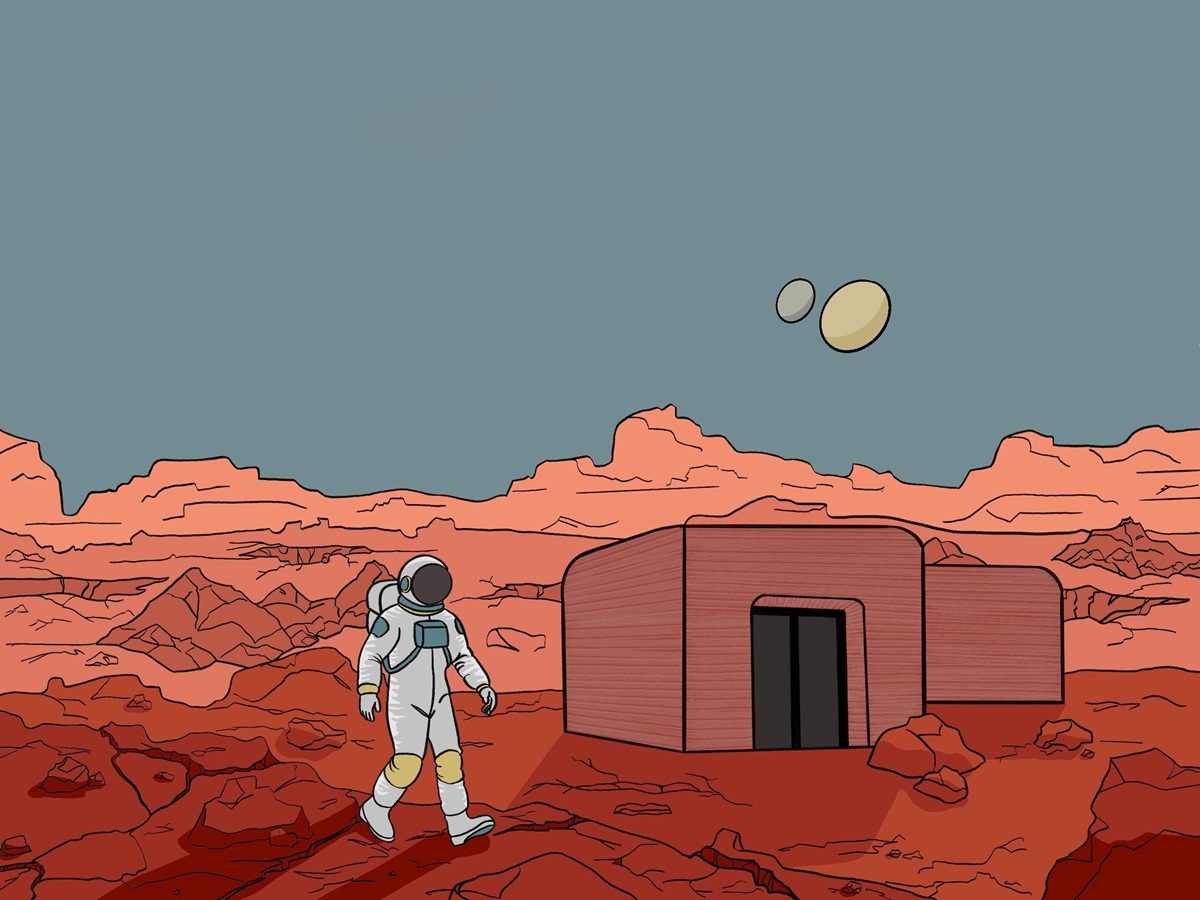


Researchers Develop Autonomous Biological System Capable of Transforming Martian Soil into Solid Structures, Eliminating the Need for Human Labor.
Inhabiting Mars was once a distant dream. But with advancements in research, the construction of autonomous structures on the red planet may be closer than ever. A team led by Dr. Congrui Grace Jin from Texas A&M University has developed a technology capable of creating living building materials, without the need for human labor.
New Solution for an Old Challenge
Transporting building materials from Earth to Mars is unfeasible. The cost and complexity of space logistics make this route impractical.
That’s why researchers have been looking for ways to utilize the planet’s own resources, such as regolith — a mixture of dust, sand, and rocks.
-
Brazilian Innovator Transforms 1962 Mercury Comet with Nissan Leaf Electric Motor, Achieving 125 km Range for Under $6,000

-
China Tests Giant 582-Ton Magnets to Contain Plasma Hotter Than the Sun’s Core, Aiming to Cut Superconductor Costs and Generate First Electricity from “Artificial Sun” by 2030
-
Seventh Grader Builds Nuclear Fusion Machine at Home, Aiming for Guinness World Record

-
Ancient Ritual Circle, Hidden for 5,000 Years, Discovered in Scotland’s Machrie Moor Using Sensors, Revealing a “Phantom Stonehenge”



It was with this goal that Jin’s team developed a synthetic lichen system.
This biological structure combines different organisms to form materials that mold and consolidate without any external intervention.
Synthetic Lichens Based on Fungi and Cyanobacteria
The advancement consists of a synthetic community that unites two main species: heterotrophic filamentous fungi and photoautotrophic nitrogen-fixing cyanobacteria. Together, they create a fully autonomous self-cultivation system.
The cyanobacteria fix carbon dioxide and nitrogen from the atmosphere, converting them into oxygen and nutrients.
These elements nourish the fungi, which, in turn, bind metal ions to their cell walls and produce biominerals.
The result of this process is a cohesive material created from the interaction between these two organisms and Martian regolith particles.
Additionally, the two components release biopolymers that help keep the structure together.
Advantage Over Other Methods
Other approaches to creating materials on Mars have already been studied. There are techniques that use magnesium, sulfur, and geopolymers.
However, all of them require direct human action. This is a significant obstacle, as any operation on Mars will face a shortage of personnel and resources.
NASA has also investigated the application of microorganisms in self-cultivation systems. Fungal mycelium and ureolytic bacteria were considered for creating bricks and masonry.
But, even in those cases, the limitation of the species used and the constant need for external nutrients compromised autonomy.
Jin’s team’s proposal overcomes these obstacles by combining organisms that mutually sustain themselves and eliminate the need for continuous supply of inputs.
3D Printing at the Center of the Next Phase
With the technology working in the lab, the next step is to develop a special ink based on regolith. This ink will be used in 3D printers with direct ink writing techniques.
The expectation is to autonomously manufacture houses, buildings, and even furniture on Mars.
The ability to form complex structures using only simulated regolith, light, air, and an inorganic liquid medium represents a remarkable advancement.
The proposed solution does not rely on energy-intensive processes or supply missions.
Researchers Behind the Project
The initiative is led by Dr. Congrui Grace Jin, assistant professor in the Department of Engineering Technology and Industrial Distribution at Texas A&M University.
The co-authors of the study, published in the Journal of Manufacturing Science and Engineering, are Dr. Richard Wilson, Nisha Rokaya, and Erin Carr from the University of Nebraska-Lincoln.
According to Jin, the potential of this technology is enormous for making long-term extraterrestrial colonization possible.
The proposal combines scientific innovation, engineering, and sustainability in one of the most promising projects in space exploration.
The team is now focused on creating bio-ink and the actual application of 3D printing for space structures.
If successful, this technique could enable future colonists on Mars to have access to solid constructions made from the Martian soil itself — without the need to carry a single brick from Earth.


Faça igual aos nossos ancestrais, levem ferramentas e cavem uma caverna!