Portuguese
  Spanish


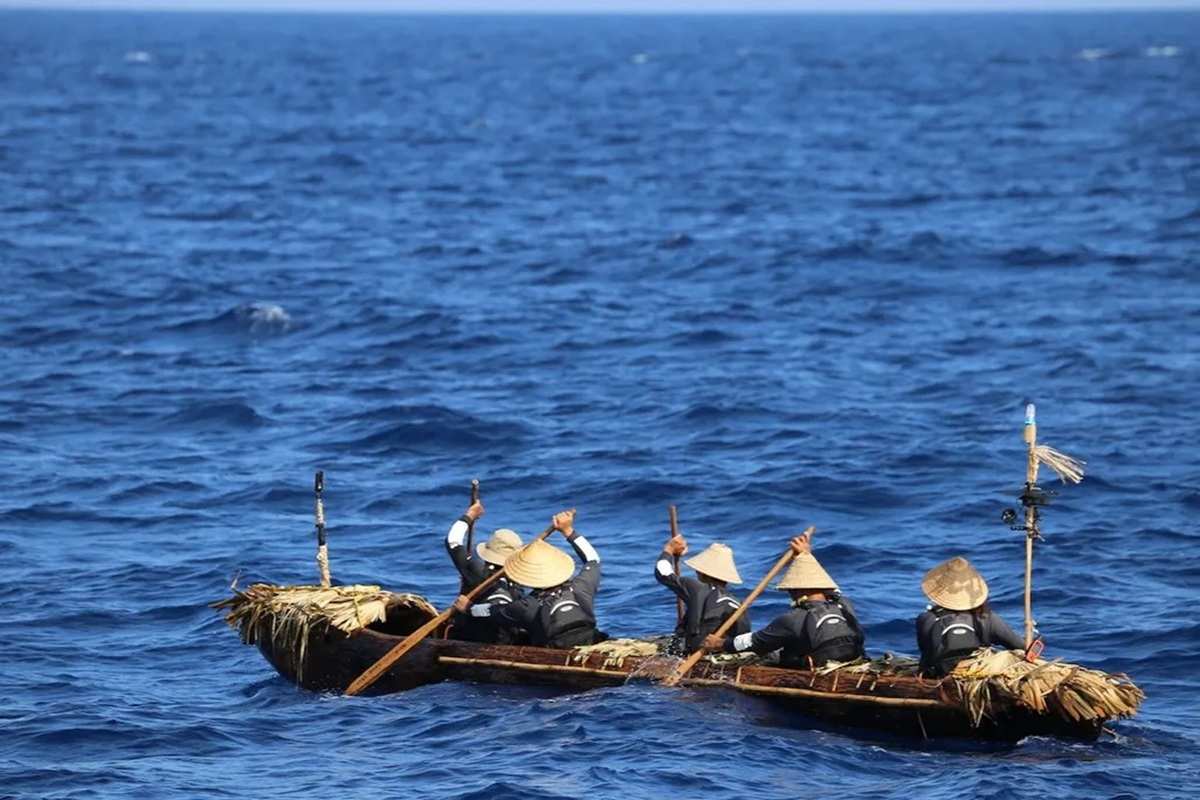

Japanese Team Rebuilds Canoe With Stone Tools And Recreates Maritime Route Of 225 Km Used By Humans 30 Thousand Years Ago.
A team of scientists decided to recreate one of humanity’s oldest maritime routes. Using only prehistoric tools, they built a canoe and sailed 225 kilometers between Taiwan and Yonaguni Island in southern Japan — the same route that the first humans took about 30 thousand years ago.
The Original Journey And Modern Doubt
At that time, humans crossed the Pacific Ocean, facing the strong Kuroshio currents. To this day, experts wondered how this was possible.
To answer the question, a group of Japanese researchers decided to redo the crossing with the same resources available in the Paleolithic period.
-
3,000-Ton, 81-Meter Attack Submarine Begins Sea Trials, Equipped with Heavy Torpedoes and Anti-Ship Missiles

-
Boat Made from 10 Tons of Plastic and 30,000 Discarded Flip-Flops Sails Along African Coast, Serving as a Floating Classroom on Ocean Pollution
-
Welder Discovers 16th-Century Diamond Ring in England After 7 Hours with Metal Detector; Gold Jewel Linked to Edward I Pattern Auctioned for £17,000
-
Former Merchant Marine Captain Invents Fuel-Free Barrier, Removes 20,000 Tons of Trash from Chennai Rivers


The Experimental Project
Led by anthropologist Yousuke Kaifu from the University of Tokyo, the scientists built a 7.6-meter canoe from a cedar log.
All construction was done using stone axes. The group did not use maps, compasses, or any modern technology. They navigated based solely on the wind, the sun, and the stars.
The boat was named Sugime. In July 2019, five crew members — four men and one woman — departed from eastern Taiwan. After 45 hours of sailing, they reached their final destination: Yonaguni Island.
Simulations And Learning
Before the expedition, the team conducted numerical simulations. The goal was to determine the type of vessel that would have the best chances of success on that route.
Initially, researchers believed that ancient humans might have used rafts. But tests showed that they were too slow to withstand the current.
The canoe carved from a log proved to be the most effective option.
The simulations also helped to identify the best season, the ideal starting point, and the methods of navigation, both under current conditions and those that existed 30 thousand years ago.
According to Kaifu, traditional archaeology cannot explain everything, as the sea often erases traces.
Therefore, the team resorted to what is called experimental archaeology, inspired by the famous Kon-Tiki expedition, carried out in 1947 by the Norwegian Thor Heyerdahl.
Challenges And Discoveries
During the journey, the crew often could not see the destination on the horizon. Even so, the boat proved to be fast and resilient.
For the scientists, this indicates that early humans already mastered sophisticated naval construction and navigation techniques.
Yu-Lin Chang from the Japan Agency for Marine-Earth Science and Technology was surprised by the results. He believed that anyone entering the Kuroshio current would be carried away aimlessly.
But tests showed that it was possible to control it — at least on the outbound trip.
However, the current likely made the return impossible, raising questions about the migration dynamics of the time.
A New View Of The Past
For archaeologist Helen Farr from the University of Southampton, who did not participate in the project, the study reveals a level of planning that is rare to find in records from the period.
According to her, actions like this bring to light not only scientific data but also human aspects that often get lost in history.
As the team concludes, only experienced rowers with advanced skills would have been able to complete the journey — even 30 thousand years ago.