






 Portuguese
  Spanish


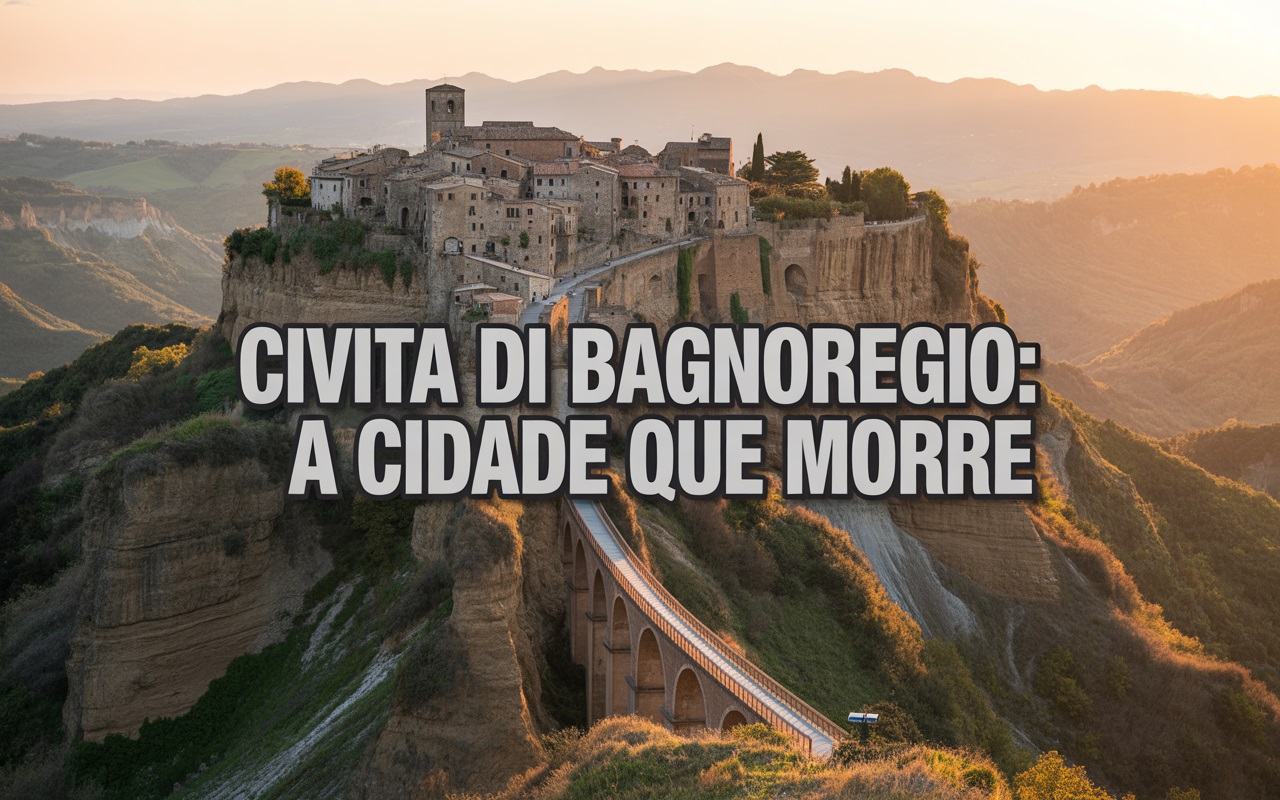


Suspended over a Cliff and Accessible Only by Footbridge, Civita di Bagnoregio Has Withstood Erosion for Centuries and Preserves One of the Most Unique Architectures in Italy.
Seen from afar, Civita di Bagnoregio appears to float in the air. The small Italian village stands isolated atop a narrow cliff of volcanic tuff, raised to approximately 443 meters above sea level, surrounded by deep valleys that advance like geological scars. Those observing it for the first time find it hard to believe that anyone could live there. Yet, for centuries, residents have withstood erosion, territorial losses, and the extreme isolation that today transforms the village into one of the most dramatic landscapes in Europe.
Entry into Civita is not through streets, roads, or ramps. Since the mid-1960s, access has been possible only on foot, via a footbridge of about 300 meters, built to replace old pathways ruined by landslides. Cars, motorcycles, or heavy vehicles are not allowed. Everything that arrives—food, furniture, construction materials—must be carried manually or transported by authorized electric carts. This limitation, which for any other city would be an obstacle, has become Civita’s trademark: a suspended place, disconnected from the modern rhythm, almost immune to time.
The Strength and Fragility of a City Built on Volcanic Tuff
The geological base that supports Civita is the reason for both its beauty and its risk. Volcanic tuff, a porous material formed from ashes and fragments expelled by ancient eruptions, allows buildings to settle relatively easily. But it is also highly sensitive to erosion. Winds, rain, temperature variations, and seismic activity slowly corrode the natural walls of the cliff, causing parts of the town to collapse over the centuries.
-
Billionaire says the most valuable skill will help overcome job elimination caused by AI, following Bill Gates’ fears

-
A Dutchman created a ‘box’ that makes trees grow in the desert almost without water and without irrigation: the invention has already brought seedlings to dozens of countries and achieves up to 90% survival where common planting did not exceed 10%.

-
Abandoned warehouse hid a giant collection of rare computers, with over 2,000 artifacts from the 1930s to the 1980s.
-
Scientists warn that melting ice is triggering an alarming chemical transformation in preserved areas, and the first signs are already concerning researchers worldwide.






Geological reports and preservation initiatives from the Italian government indicate that the village has already lost large areas since the medieval period. Entire neighborhoods have disappeared over the course of history, consumed by the instability of the hillside. This continuous cycle of loss has given rise to the melancholic nickname: “la città che muore,” the city that dies.
However, this fragility has never prevented residents and authorities from fighting for its preservation. Since the 20th century, containment measures, hillside reinforcements, structural restorations, and constant monitoring have sought to slow down erosion. The aim is not only to preserve a postcard but to protect a living historical heritage.
A Medieval Village Preserved by Isolation
Crossing the bridge, the feeling is that of entering a suspended world. Narrow streets, stone staircases, houses with low doors and asymmetrical windows compose an urban landscape that dates back centuries. The isolation imposed by geography helped preserve the medieval architecture virtually intact, without major renovations or modern interventions.
The small resident population—now reduced to a few dozen permanent inhabitants—maintains the village as a living organism, not merely as a museum piece. At certain times, particularly at dawn and dusk, Civita returns to absolute silence, interrupted only by the sound of the wind passing through the surrounding valleys.
This scenery, which could suggest abandonment, has become one of the village’s greatest attractions. Isolation brings authenticity, and authenticity attracts visitors from all over. Even before the social media tourism boom, Civita attracted the attention of documentarians, architects, and geologists. Today, it has established itself as one of the most sought-after destinations in central Italy.
The Bridge That Saved the Village from Disappearance
The footbridge built in the 1960s serves two central functions: connection and survival. Before it, old and irregular access points suffered from landslides, making it difficult for residents to stay. The new bridge stabilized mobility, allowed for essential services to arrive, and made visitations feasible.
Its light and narrow structure contrasts with the massive natural wall that supports Civita. At the same time, it serves as a visual reminder that the village depends on this link to continue existing. During severe storm periods, when fog rolls over the cliff, the bridge seems to disappear into the air—reinforcing the feeling of a town suspended between sky and earth.
The Future of a City That Tries Not to Disappear
Despite the containment works and the vast tourist attention, Civita still faces ongoing risks. Each rainy season accelerates the disintegration of the tuff in vulnerable areas. Experts and local authorities work together to map fractures, reinforce unstable segments, and restore threatened buildings.
Projects from the regional government and Italian universities use sensors and 3D scanning to meticulously monitor any movement of the hillside. The goal is simple yet ambitious: to prevent Civita from becoming just a memory.

Even so, there is an inevitable paradox. The city is celebrated precisely for its fragility. The sense that time there runs faster than in any other part of the world transforms Civita into not just a tourist destination, but a symbol of resistance.
The Poetic Strength of a City That Insists on Existing
Atop the cliff, among valleys sculpted over millions of years and natural walls slowly collapsing, Civita di Bagnoregio remains alive. Its narrow bridge is a thread that connects it to the present. Its houses carved from tuff stand as witnesses to centuries of human adaptation. And its silence—so rare in any modern city—echoes as a reminder that some places resist not from convenience, but from identity.
As long as there are residents crossing the bridge at dawn, as long as tourists traverse its streets seeking a fragment of another era, and as long as geologists fight to keep it standing, Civita will continue to be more than an isolated village. It will be a reminder that beauty sometimes arises precisely from the risk of disappearing.





Foi o lugar mais incrível que tive a oportunidade de estar, simplesmente fascinante!