






 Portuguese
  Spanish


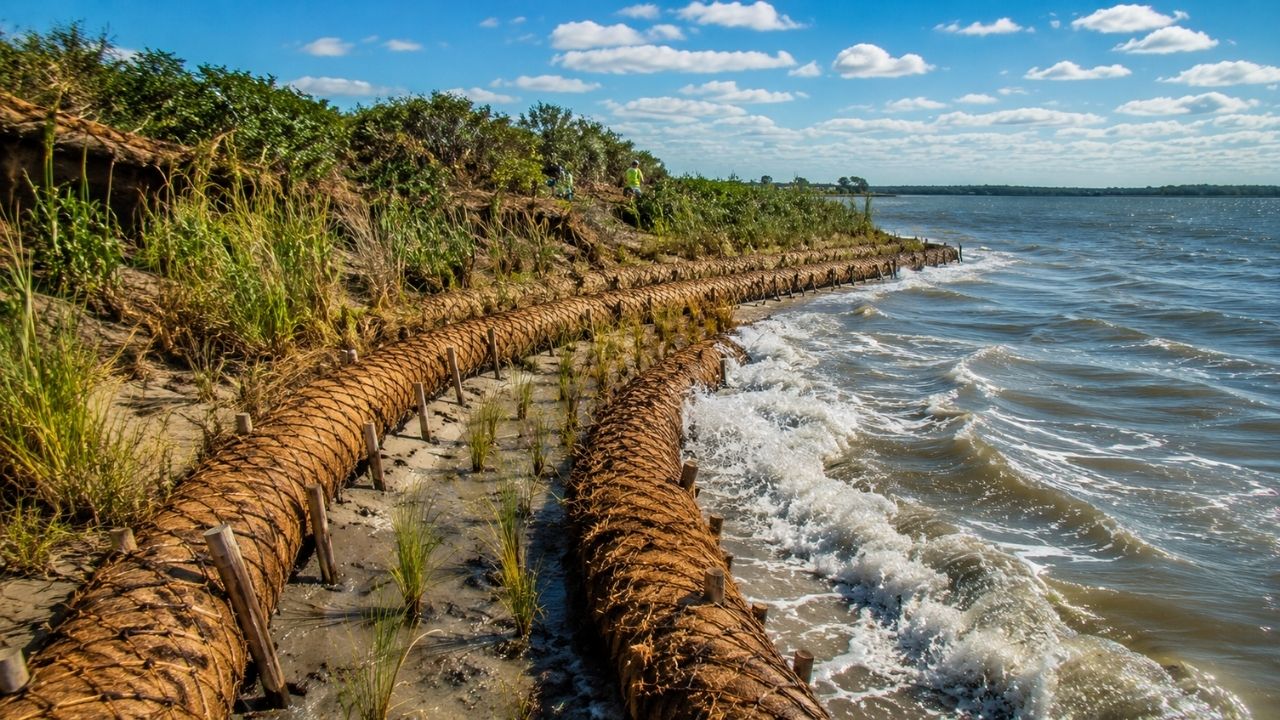

Coconut shells are being transformed into biodegradable logs used in living shorelines in the United States and other countries. The technique helps native plants to root, reduces wave force, and attempts to recover coastal stretches affected by erosion, storms, and overly rigid constructions along the coastline.
Coconut shells are being used in coastal protection projects by communities, researchers, and environmental groups seeking more natural alternatives against erosion. One case occurs in Neptune, New Jersey, in the United States, on the banks of the Shark River, where the American Littoral Society is conducting a restoration project in an area affected by Superstorm Sandy.
According to a report by the Associated Press published by Spectrum News, the initiative gained prominence in 2023, more than a decade after the storm that hit the region in 2012. The proposal is simple but noteworthy: transform coconut husk fibers into biodegradable cylinders capable of holding sediments, protecting seedlings, and giving time for native vegetation to stabilize the shoreline.
How coconut shells become natural logs against erosion

The coconut shells undergo a process to utilize the resistant fibers that surround the fruit. This material, known as coconut fiber, can be molded into mats or cylindrical logs, usually secured by nets and positioned along vulnerable shorelines.
-
Workers renovating a playground in northern England uncover 176 World War II bombs buried underground; training artifacts still contained explosives.

-
Brazilian Architect Transforms Waste into Sustainable Homes with Solar Power and Rainwater Systems for 40 Years

-
Security Guard Becomes Doctor at Louisiana Hospital Where He Once Worked, Studied Chemistry Between Shifts

-
Woman Rescued from Luxury Complex in Brazil Worked Without Pay for 55 Years, May Be Entitled to Over $300,000




The logic is not to create a permanent wall, but to provide initial support for nature to recover. The logs are installed in irregular sections of the coast, fixed with wooden stakes, and adapted to the terrain’s shape, something difficult to do with rigid structures of concrete, steel, or wood.
Over time, the material decomposes in a planned manner. Before that, it helps support typical shoreline and marsh plants, which can be placed on the logs or planted in openings made in the structure. When the roots develop, they begin to fulfill part of the stabilization function.
This point is central to understanding why coconut husks draw attention: they do not replace vegetation but function as a bridge until it strengthens. The natural barrier holds sediments, reduces part of the water’s energy, and creates conditions for the local ecosystem to reoccupy the area.
In New Jersey, solution was used in area affected by Superstorm Sandy
On the Shark River, in Neptune, New Jersey, coconut fiber logs were used in a restoration project estimated at $1.3 million. The area is about 1 mile from the ocean and had suffered severe erosion, in addition to the damage caused by Superstorm Sandy in 2012.
The project combines federal and local resources, with the involvement of the American Littoral Society, an organization focused on coastal conservation. The goal is to restore the shoreline without relying solely on hard barriers, betting on a nature-based solution to reduce wave force and protect the coastline.
At the site, sand brought by trucks mixed with sediments accumulated by the tides, visually expanding the beach strip compared to the previous condition. The presence of coconut husk logs helps keep this material in place while the vegetation establishes itself.
Besides physical protection, the project also aims to rebuild habitat. Degraded coastal areas can once again offer shelter for local species, such as crabs and organisms associated with wet margins. The defense against erosion, in this case, also becomes an attempt at environmental recovery.
Technique already appears in Boston, New York, Texas, Indonesia, and Senegal
The use of coconut husks is not limited to New Jersey. In Boston, researchers at Northeastern University are testing coconut fibers, wood chips, and other materials in floating mats designed to cushion waves and stimulate aquatic vegetation in urban waterways.
The idea is that small modules can be connected on a larger scale, forming a network capable of protecting broader areas. The appeal lies in the relatively low cost, availability of the material, and the reuse of something that could become waste.
Similar projects have also been mentioned in Rhode Island, Jamaica Bay, Cape Cod, Delaware, and Austin, Texas. In Jamaica Bay, for example, 730 meters of coastline affected by Superstorm Sandy received intervention that included coconut fiber logs.
Outside the United States, Indonesia stands out as a relevant case for being a major coconut producer. In 2021, the country produced more than 17 million metric tons of the fruit. In Senegal, residents of the island of Diogue also use natural materials, such as palm leaves, wood, and branches, to restore eroded beach sections.
Natural solution has limits and does not work on every coast

Despite the potential, coconut shells are not a universal answer for all types of erosion. In locations with very strong waves, frequent storms, or intense exposure, the material can wear out too quickly before the plants can establish themselves.
A case cited in Massachusetts shows this limitation. At the Felix Neck Wildlife Refuge in Martha’s Vineyard, the installation helped for a period but was repeatedly damaged by wave action. After a few years, the structure was not reinstalled.
Something similar occurred on Chapel Island, Nova Scotia, Canada, where coconut fiber mats and logs suffered damage caused by bad weather. These examples reinforce that living shorelines need to be planned according to wave energy, soil type, tidal regime, and local vegetation.
The solution works best when the environment allows nature to complete the service. When water destroys the structure before rooting, the project loses efficiency. Therefore, experts treat coconut fiber as an important tool, not as a miraculous promise against coastal erosion.
Why coconut shells draw attention in climate adaptation


Coastal erosion is growing as a concern in various regions of the world, especially in areas subject to storms, rising sea levels, and urban occupation near water. In this scenario, rigid solutions continue to be used, but they do not always solve the problem without creating impacts on other parts of the coast.
Living shorelines emerge as an alternative in places where it is possible to combine light engineering, native vegetation, and biodegradable materials. Instead of just blocking the water, the proposal is to rebuild a transition zone between land and sea.
Coconut husks enter this debate because they combine three factors: they are natural, moldable, and degrade over time. This allows them to be used as a temporary structure while plants and sediments take on the protective function.
For coconut-producing countries, the material can also represent a way to transform agricultural waste into an environmental resource. In wealthy regions, like parts of the United States, the fiber appears as a component of restoration projects that attempt to reduce dependence on concrete along the shores.
But the very history of these projects makes it clear that the technique needs to be well chosen. It can help a lot in some places and fail in others. Do you think natural solutions like coconut fiber logs should replace some of the concrete works on Brazilian coasts, or is rigid protection still indispensable in more vulnerable areas?


