Portuguese
  Spanish


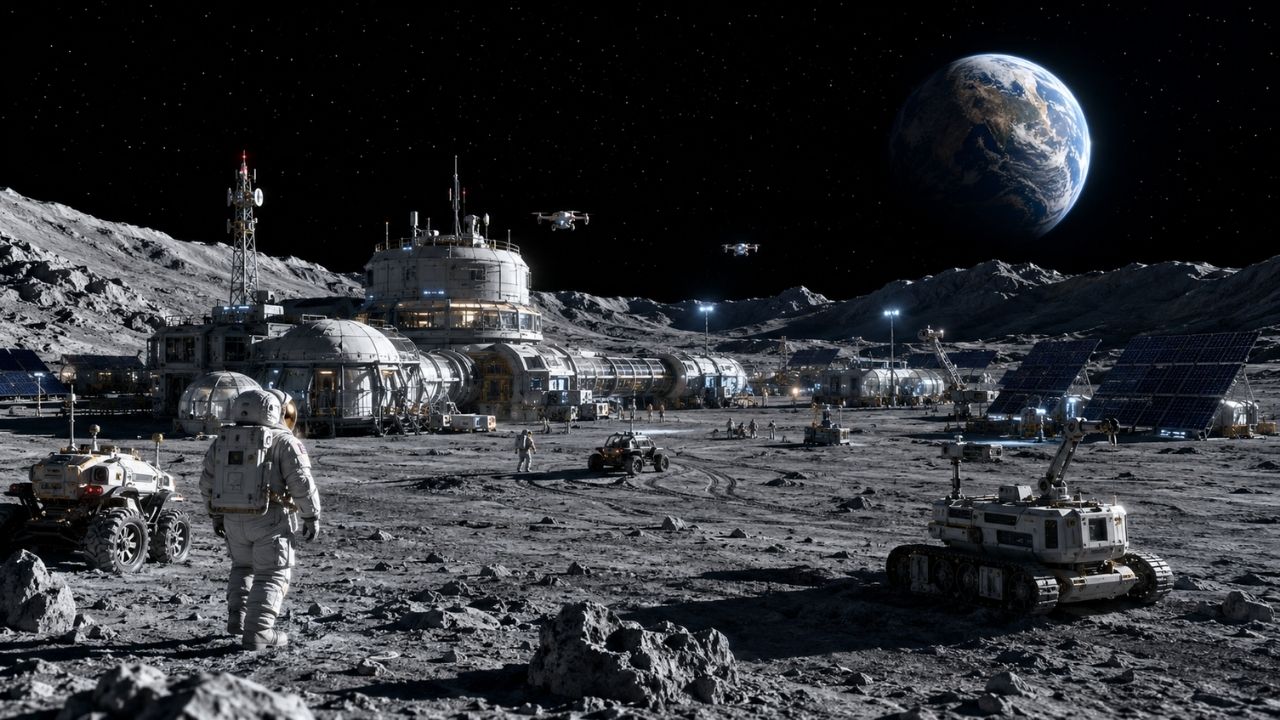

The Moon returns to the center of NASA’s strategy with a plan for a permanent base capable of occupying hundreds of square kilometers, receiving rovers, drones, landing modules, and its own energy, while Artemis prepares astronauts for long stays and brings the USA closer to Mars in the 2030s in a new race.
The Moon has returned to the center of the space race after NASA revealed an ambitious plan to establish a permanent base on the natural satellite. The structure could spread over hundreds of square kilometers and serve as a support point for astronauts on long-duration missions.
The project appears amid the intensification of a new lunar race. While the United States advances with the Artemis program, China is also working to send humans to the Moon by 2030, making permanent presence on the lunar surface a strategic, scientific, and technological priority.
NASA wants to transform the Moon into a permanent base

NASA’s proposal goes beyond a short landing and return mission. The plan aims for a permanent structure, capable of receiving equipment, vehicles, landing modules, drones, and energy infrastructure to sustain prolonged operations.
-
2,000-Year-Old Gold Rings Found with Human Bones in Thailand Reveal Rare Burial and Feature Ancient Indian Inscription

-
Lenovo Unveils Legion Y700 Tablet with RGB Backlighting, 5G, and SIM Card Support

-
World’s First Nuclear Hydrogen Unit Begins Operation: Copper-Chlorine Technology with Initial Capacity of 150 Liters per Hour, Aiming for 3,000 Liters per Hour
-
Mechanics Retrofit Old Fiat Uno with BYD Electric Motor for Silent, Low-Voltage Operation Reaching Nearly 60 km/h in Home Test



The idea is to stop visiting the Moon for just a few days and start building a continuous presence. This is the point that differentiates the new plan from the old Apollo missions, which marked lunar exploration but did not create a fixed base.
The first phase involves ordering essential systems to operate on the lunar surface. Among them are landing modules, exploration vehicles, and drones that must prepare the ground before prolonged human presence.
The stated goal is to encourage a lunar economy, expand scientific research, and lay the foundations for a future human expedition to Mars, planned for the 2030s.
Base could occupy hundreds of square kilometers
One of the most striking details of the plan is the scale. Carlos Garcia-Galan, executive of NASA’s lunar base program, envisions a base covering hundreds of square kilometers, with a perimeter marked by MoonFall drones positioned at the corners of the area.
This dimension shows that NASA is not treating the base as a small isolated outpost. The project suggests a wide operational zone, designed to accommodate habitats, rover circulation, landings, research, and support infrastructure.
The territorial demarcation would also have a diplomatic and operational function. The idea is to respect spacecraft, equipment, and structures from other countries that may be nearby, reducing conflicts in a region that tends to become more contested.
This concern shows how the Moon is beginning to be seen not just as a scientific destination, but as a territory of strategic presence, with the need for rules, boundaries, and international coordination.
Rovers and drones should arrive before the astronauts

The NASA has started ordering equipment for the lunar base, including exploratory vehicles and drones. Blue Origin, Jeff Bezos’ company, will provide two landing modules to bring lunar vehicles to the Moon’s surface, in an area near the lunar south pole.
The lunar all-terrain vehicles will be built by Astrolab and Lunar Outpost. Firefly Aerospace, which successfully landed on the Moon last year, will be responsible for delivering the first drones to the lunar surface.
These equipment should arrive before the landing of the first astronauts of the Artemis program, scheduled for 2028. The logic is to prepare the environment, test movements, map areas, and start operations before the crews arrive.
This stage is essential because a permanent base requires more than human presence. It is necessary to bring machines, energy, transportation, communication, and remote work capability before astronauts can stay for longer periods.
Artemis prepares human return to the lunar surface
The Artemis program is the backbone of the American return to the Moon. The Artemis II mission, mentioned in the source, took four astronauts to fly over the Moon, in a journey that drew attention for going further into space than the Apollo program crews.
The next step will be Artemis III, planned to test the docking of the Orion capsule in orbit around Earth with lunar landing modules developed for crews by Blue Origin and SpaceX.
The landing of astronauts on the Moon is expected to happen as early as 2028, according to the cited schedule. This mission will be a bridge between the symbolic return to the lunar surface and the construction of a more lasting presence.
With this, NASA is trying to create a sequence: first the flyover, then the docking tests, followed by the human landing, and finally the expansion to a permanent infrastructure.
Own energy will be a central piece of the second phase
The second phase of the plan, scheduled from 2029 to the early 2030s, should begin building the permanent infrastructure. Among the elements mentioned is an electrical grid, fundamental to support equipment, habitats, and scientific operations.
Without its own energy, a lunar base would be limited. Rovers, drones, communication, life support systems, and habitable modules depend on a stable source of electricity.
The construction of this infrastructure indicates that NASA wants to prepare the Moon for longer stays, not just occasional visits. Energy is the foundation to transform a lunar area into a functional station.
In the third phase, the expectation is that the station can support astronauts for extended periods, in specialized permanent habitats, at some point in the 2030s.
New lunar race gains strength with China’s advance
The American plan appears at a time of growing competition. China launched a rocket with three astronauts into space and is working to send humans to the Moon by 2030, increasing pressure on the United States.
This dispute does not exactly repeat the space race of the 20th century, but it has similar points. Whoever manages to establish a lasting presence on the Moon may gain scientific, technological, and strategic advantage.
The lunar south pole region is especially important because it concentrates interest in resources, lighting, ice, and installation possibilities. Therefore, several countries and companies are looking in the same direction.
NASA is trying to accelerate its permanent presence before international competition makes the lunar space even more contested.
Moon becomes a step to reach Mars
The lunar base is also considered as preparation for Mars. The idea is to use the Moon as a testing ground for technologies, operations, human permanence, and logistics outside Earth.
The shorter distance allows for experimenting with solutions before a Martian mission, which would require much more time, autonomy, and endurance. The Moon can function as a laboratory for human life on another world.
NASA intends to use the base for scientific research, lunar economy, and the development of systems capable of supporting more distant missions. Mars appears as the final destination of this sequence.
In this plan, building on the Moon is not the end of the journey. It is the intermediate step to learn how to operate far from Earth before sending humans to the red planet.
Permanent base changes the future of space exploration
The revelation of NASA’s plan shows that the Moon is no longer just a destination for historical return. It has come to be seen as a platform for permanence, research, space economy, and preparation for Mars.
With rovers, drones, landing modules, self-sustaining energy, and permanent habitats, the project attempts to transform hundreds of square kilometers of lunar soil into a strategic infrastructure for the coming decades.
The challenge will be to turn this ambitious plan into a real operation, within the planned deadlines and amid competition with other space powers. The race now is not just to reach the Moon, but to stay.
And you, do you think building a permanent base on the Moon is the next natural step in human exploration, or should governments prioritize Earth’s problems before investing in structures off the planet? Share your opinion.