Portuguese
  Spanish




Radia Corporation’s Colossal Aircraft Promises to Revolutionize the Transportation of Giant Cargo Such as 105-Meter Wind Turbine Blades, F-16 Fighters, and Military Equipment on Dirt Runways
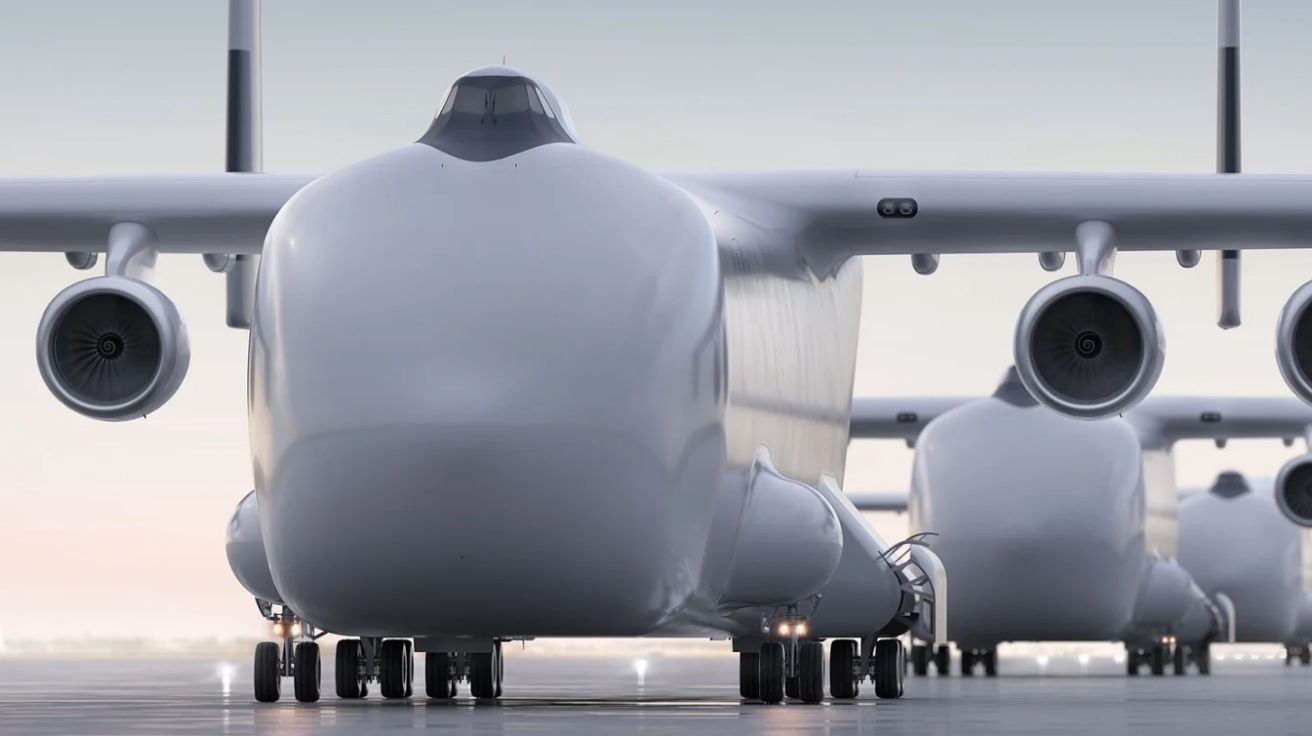
The Paris Air Show 2025 was the stage for the public presentation of the WindRunner, the largest airplane ever built in length and internal volume. With 356 meters in length, the aircraft developed by the American Radia Corporation broke all previous records, including that of the legendary Antonov An-225 Mriya, destroyed in 2022.
According to Aviation, the WindRunner was originally designed to transport 105-meter wind turbine blades, but its versatility caught the attention of sectors such as defense, aerospace, and energy. Its first prototype was unveiled at Le Bourget, France, in June, generating enormous buzz in the industry.
A Giant in The Air for Impossible Cargo
With 7,700 m³ of cargo hold capacity, the WindRunner redefines the limits of air transport. For comparison, this volume is more than three times greater than Airbus’s BelugaXL and easily surpasses all existing freighters.
-
Brazil Welcomes Spanish Wamos Air and Nigerian Air Peace, Potentially Transforming International Routes and Increasing Competition

-
Offshore air transport soars in Brazil, surpasses 2.5 million passengers, and reveals how oil has transformed Rio’s airports into key pieces of national logistics.

-
Latin America becomes the “global champion” of aviation taxes, tickets may become more expensive in Brazil, and IATA’s warning exposes risk for flights, tourism, and passengers.
-
Brazil has lost 85 air routes since 2019 and is still flying less than before the pandemic, leaving passengers with fewer destinations, fewer frequencies, and a more limited air network.




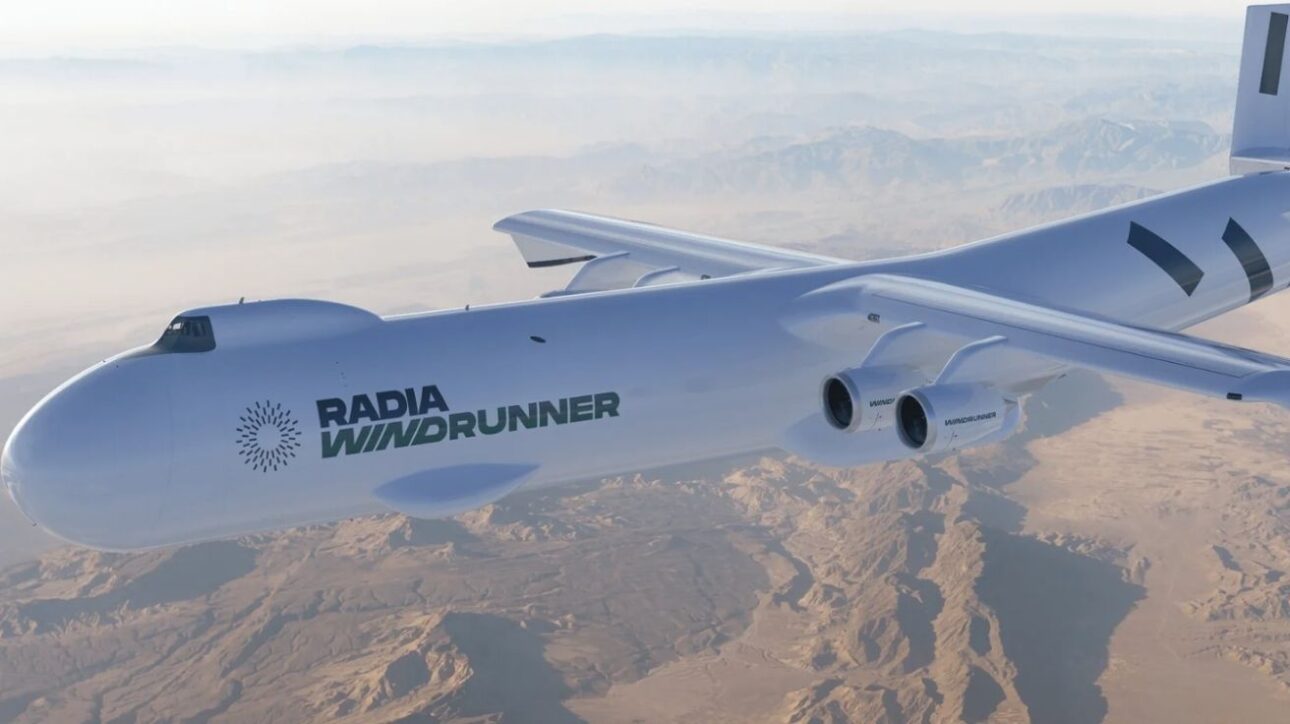
It has been specifically developed to meet the growing demand for transporting renewable components, primarily giant wind turbine blades. Today, transporting this type of cargo by land is extremely costly, time-consuming, and logistically unfeasible in many regions.
The aircraft has a 261-meter wingspan, four jet engines (models not yet disclosed), and achieves a cruise speed of Mach 0.6 (about 460 mph). Its range is 1,240 miles (2,000 km), sufficient for regional connections and tactical missions.
The Radia designed the WindRunner with the capacity to operate on unpaved runways of 1,800 meters, a straightforward solution for remote locations where wind farms, military bases, or energy facilities require rapid supplies.
Its front compartment measures 10 meters by 10 meters in cross-section, allowing it to carry anything from jet turbines to complete armored vehicles.
The aircraft can carry one 105-meter wind blade per trip, or three 80-meter blades, eliminating all the complexities of current ground logistics.
International Project with Military DNA
The WindRunner’s construction is the result of an international collaboration among five companies:
- The Spanish company Aciturri develops the tail structure;
- The Brazilian Akaer Engenharia provides the pressurization and cockpit integration systems;
- The American Astronautics Corporation handles the avionics;
- The British Element Materials manages the fuel system;
- And the Californian Ingenium Technologies creates the high-lift control systems.
The aircraft is also under evaluation by the U.S. Department of Defense. In May, USTRANSCOM signed an agreement with Radia to assess its feasibility for military logistic transport missions.
Possibilities include the transportation of entire F-16 fighters, without disassembly, and bulk loads such as oil extraction equipment and offshore platforms.
According to scientist Mark Lundstrom, founder of Radia, the WindRunner was designed to be the first large freighter capable of landing on dirt strips near energy fields and military bases.
The project also has support from veterans of Boeing, Lockheed Martin, the FAA, and former U.S. Secretary of Energy Ernest Moniz, who see the WindRunner as a milestone for energy transition.
A Direct Impact on Climate Transition
The WindRunner’s main function, according to Radia, is to accelerate the adoption of renewable energy on the planet. Quickly transporting giant turbines means reducing costs and expanding the installation of wind farms in previously inaccessible locations.
Estimates suggest that larger blades can triple the energy efficiency of turbines and reduce the cost per megawatt by up to 30%. But they only reach where they need to go with tailored transportation, such as that offered by this new giant of the skies.
The company also argues that the WindRunner can help remove dramatic amounts of CO2 from the atmosphere. “We are offering the aerospace industry a chance to participate directly in the fight against climate change,” said Paul Hanna, Vice President of Radia.
The first complete flight is expected by the end of the decade, with certification by FAA Part 25.
It is not yet known which company will provide the turbofan engines, but the project is already considered a game changer in cargo aviation.
For the defense, energy, and infrastructure sectors, the WindRunner is a concrete promise of revolutionary logistics.