






 Portuguese
  Spanish
  4 min of reading
  0 comments


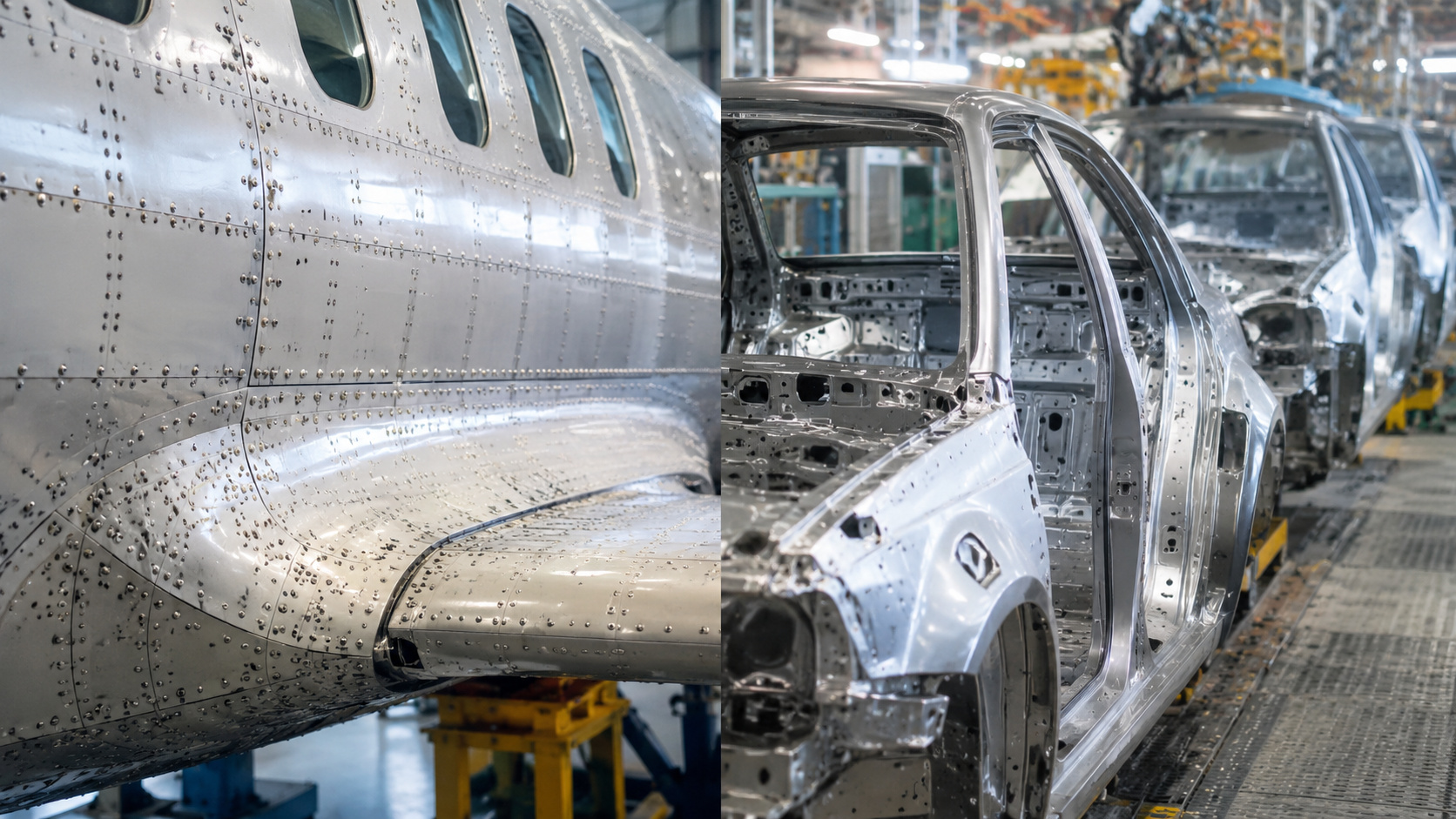
The difference between rivets and welds explains why aircraft prioritize structural strength, while cars focus on scale, finish, and industrial efficiency
A technical difference between planes and cars shows how engineering adapts each solution to the material used and the type of stress faced. Planes continue to use rivets in various parts of the structure, while cars use welds extensively in their bodies. This choice is not made out of tradition, but due to physical necessity, structural safety, and manufacturing efficiency. Aluminum, widely used in aircraft, requires different care from the stamped steel used in automobiles.
Rivets span centuries in engineering
The rivet is among the oldest metal joining methods in history and has established its presence in large structures over the centuries. This metal fastener has a rounded head and a smooth shank, which is mechanically deformed after application. As a result, two metal surfaces form a permanent and strong bond. In the 19th century, advances in engineering expanded the use of rivets in ships, railways, and metal constructions. The Eiffel Tower, completed in 1889, became one of the most well-known examples of this technology.
Titanic and railways demonstrate the strength of rivets
The Titanic, launched in 1912, used rivets extensively during its construction, reinforcing the role of this method in the naval industry of the time. Later studies raised theories about the irregular quality of some of these fasteners and brought the metallurgy of rivets into the debate about the hull’s strength. Data attributed to the manufacturer Rivetwise also indicates that, in Britain in 1900, more than 35,000 kilometers of tracks were held together by this type of fastening. This scenario shows how rivets supported an important part of modern industrial infrastructure.
-
Offshore air transport soars in Brazil, surpasses 2.5 million passengers, and reveals how oil has transformed Rio’s airports into key pieces of national logistics.

-
Latin America becomes the “global champion” of aviation taxes, tickets may become more expensive in Brazil, and IATA’s warning exposes risk for flights, tourism, and passengers.

-
Brazil has lost 85 air routes since 2019 and is still flying less than before the pandemic, leaving passengers with fewer destinations, fewer frequencies, and a more limited air network.

-
Anac and Decea are behind iFood’s drones in Barueri and explain how aerial delivery got the green light in Brazil, as orders leave the mall, cross the sky in a few minutes, and reveal the behind-the-scenes of new commercial drone deliveries in the country.






Aluminum explains the choice in aviation
Modern aviation retains rivets because aircraft face repeated cycles of pressurization, vibration, and stress during flights. The fuselage needs to withstand these forces without developing critical cracks. Aluminum, predominant in many aeronautical structures due to its lightness, does not react well to the extreme heat of welding. Welding can alter the metal’s temper and weaken sensitive points of the structure. Therefore, rivets continue to be a suitable solution for joining metal sheets in areas that require strength and reliability.
Cars follow a different industrial logic
The automotive industry works with a different need. Car bodies are mostly made of stamped steel, a material that withstands heat better and responds well to welding processes. This characteristic allowed manufacturers to adopt automated production lines, with robots capable of performing quick, repetitive, and standardized joints. Welding also eliminates the extra mass of thousands of fasteners, improves the finish, and contributes to cleaner surfaces. Thus, cars manage to combine industrial efficiency, weight reduction, and a more fluid aesthetic.
Design also influences automotive choice
Design has a direct impact on the decision of manufacturers. Cars need to present continuous, aerodynamic, and visually integrated surfaces, without apparent protrusions on the body. Welding better meets this proposal because it allows structural joining without interfering much with the external appearance. On the other hand, airplanes accept visible rivets because the priority is the integrity of the fuselage. In this case, resistance to mechanical stress comes before a clean aesthetic.

The difference reveals opposing priorities
The choice between rivets and welds depends on the material, risk, and purpose of each machine. Airplanes use aluminum, face constant vibrations, and need to withstand pressurization cycles. Cars use steel, rely on mass production, and require a more uniform visual finish. This difference shows that rivets remain in aviation due to technical necessity, while welding dominates the automotive sector for industrial efficiency.
The future of structural joints
Engineering continues to adjust its methods as new materials, new processes, and new safety requirements emerge. Even so, the central logic remains clear. Each sector chooses the technology that best responds to its usage environment. While airplanes require continuous resistance against pressure and vibration, cars need productive speed, finish, and scale.
Does it make sense to imagine airplanes and cars using the same type of structural joint?






Be the first to react!