






 Portuguese
  Spanish




Scientists at SLAC created gold hydride for the first time by subjecting hydrocarbons, hydrogen, and a gold leaf to pressures higher than those of the Earth’s mantle and heat above 1,900 °C
Gold hydride, a solid compound formed only by gold and hydrogen atoms, was created for the first time by an international team led by scientists at SLAC, in the United States, last year. The discovery happened by chance during experiments at the European XFEL in Germany, conducted to study diamond formation under extreme heat and pressure.
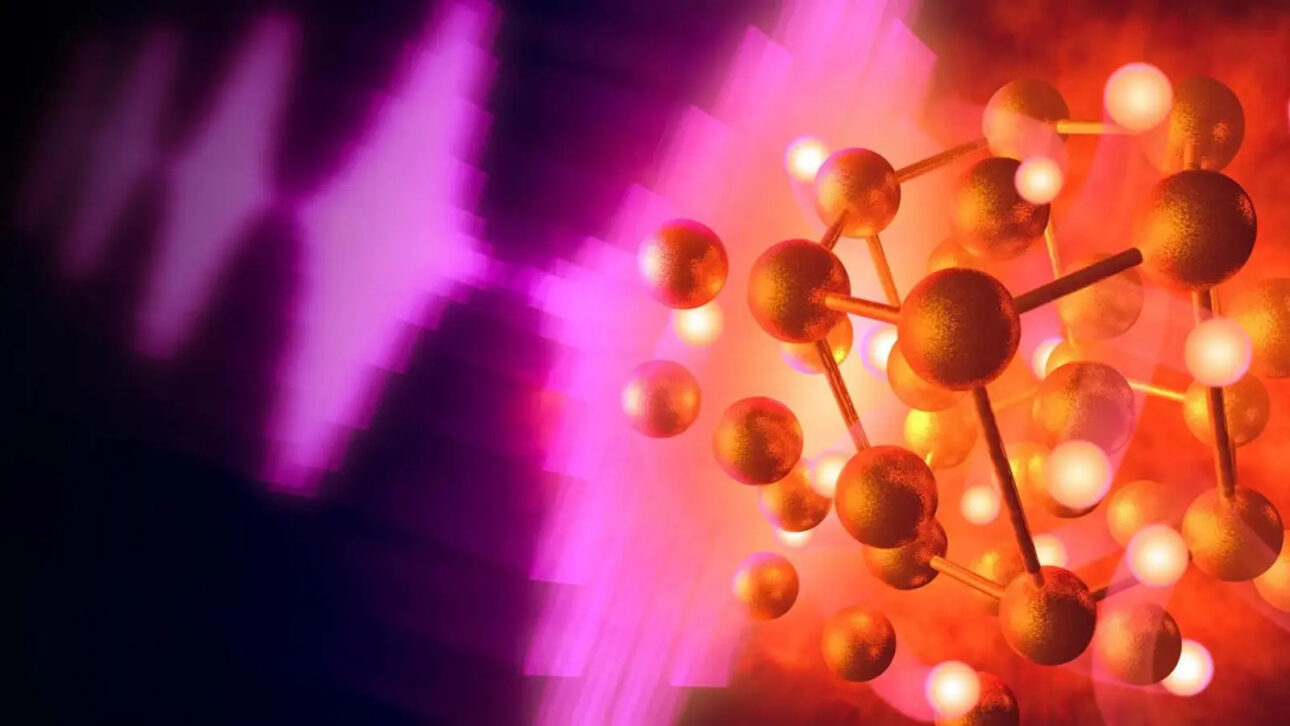
Discovery occurred during study on diamond formation
The researchers were investigating how long hydrocarbons, compounds formed by carbon and hydrogen, take to form diamonds when subjected to extremely intense conditions of temperature and pressure.
For this, the samples were compressed in a diamond anvil cell, at pressures higher than those found in the Earth’s mantle. Then, they were heated to more than 1,900 degrees Celsius with repeated pulses of X-rays from the European XFEL.
-
World’s Largest Particle Accelerator Begins Four-Year Hiatus for Magnet Overhaul, Aiming to Hunt Dark Matter by 2030

-
“Sahara Dust Turns Rain Red, Startling Residents Across Europe”
-
Stanford Scientists Develop 20-Cent Paper Centrifuge Inspired by Ancient Toy, Spins at 125,000 RPM Without Electricity, Separates Plasma in 1.5 Minutes, Aiding Diagnostics in Remote Areas

-
World’s Largest Vaccine Manufacturer, Immunizing Two-Thirds of Global Infants, Originated in a Pune Horse Farm





The gold leaf inserted into the samples had a technical function: to absorb the X-rays and help heat the hydrocarbons, which absorb this type of radiation poorly.
The expected result appeared in the records. The carbon atoms formed a diamond structure. But the scientists also identified unexpected signs of a reaction between hydrogen and gold, forming gold hydride.
Low reactivity of gold surprised scientists
The discovery drew attention because gold is known to be a metal with low reactivity. This characteristic was precisely one of the reasons it was used as an X-ray absorber in the experiment.
Mungo Frost, a scientist at SLAC who led the study, stated that the result was unexpected because gold is usually chemically “monotonous” and unreactive.
For the researchers, the finding indicates that extreme pressures and temperatures can change the behavior of known materials, paving the way for chemical reactions that do not occur under common conditions.
The results were published in the Angewandte Chemie International Edition and help to show how the rules of chemistry can change in extreme environments, similar to those found inside certain planets or in stars that perform hydrogen fusion.


Superionic hydrogen helped to reveal the compound
During the experiment, hydrogen entered a dense state called superionic. In this condition, hydrogen atoms flowed freely through the rigid atomic structure of gold.
This behavior increased the conductivity of gold hydride and allowed scientists to observe changes in how the crystalline structure of gold scattered X-rays.
Hydrogen is difficult to study with X-rays because it scatters this radiation weakly. In the experiment, however, it interacted with the much heavier gold atoms.
With this, the team was able to use the crystalline structure of gold as a kind of witness to the behavior of hydrogen. According to Frost, this structure allowed them to observe what hydrogen was doing inside the material.
Study may help to understand planets, stars, and fusion
Gold hydride offers a new way to study dense atomic hydrogen in the laboratory. This type of hydrogen is associated with environments that cannot be directly accessed in common experiments.
One of the examples cited by the researchers is the interior of certain planets, where dense hydrogen is present. Studying this material in the laboratory can help to better understand these extraterrestrial worlds.
The research can also provide information about nuclear fusion processes in stars like the Sun. Additionally, the data can contribute to studies related to the development of fusion technologies on Earth.
The compound, however, seems to exist only under extreme conditions. When the sample cools, the gold and hydrogen separate again.
Simulations conducted by the team also indicated that more hydrogen could fit into the crystalline structure of gold if higher pressures were used.
Simulations can be applied to other exotic materials
Besides the discovery of gold hydride, the study showed a route to investigate new chemistries in extreme environments.
The observed reaction suggests that temperature and pressure can compete with conventional chemistry under certain conditions.
Siegfried Glenzer, director of the High Energy Density Division and professor of photon science at SLAC, stated that producing and experimentally modeling these states is important for studying exotic materials.
According to him, the simulation tools used in the work can also be applied to the study of other properties of materials subjected to extreme conditions.
The team included researchers from SLAC, University of Rostock, DESY, European XFEL, Helmholtz-Zentrum Dresden-Rossendorf, University of Frankfurt, University of Bayreuth, University of Edinburgh, Carnegie Institution for Science, Stanford University, and SIMES.
Part of the work was funded by the U.S. Department of Energy’s Office of Science.
This article was prepared based on information from the SLAC National Accelerator Laboratory, the U.S. Department of Energy, and the study published in Angewandte Chemie International Edition, with data, numbers, and statements preserved as per the consulted material.


