






 Portuguese
  Spanish
  4 min of reading
  2 comments


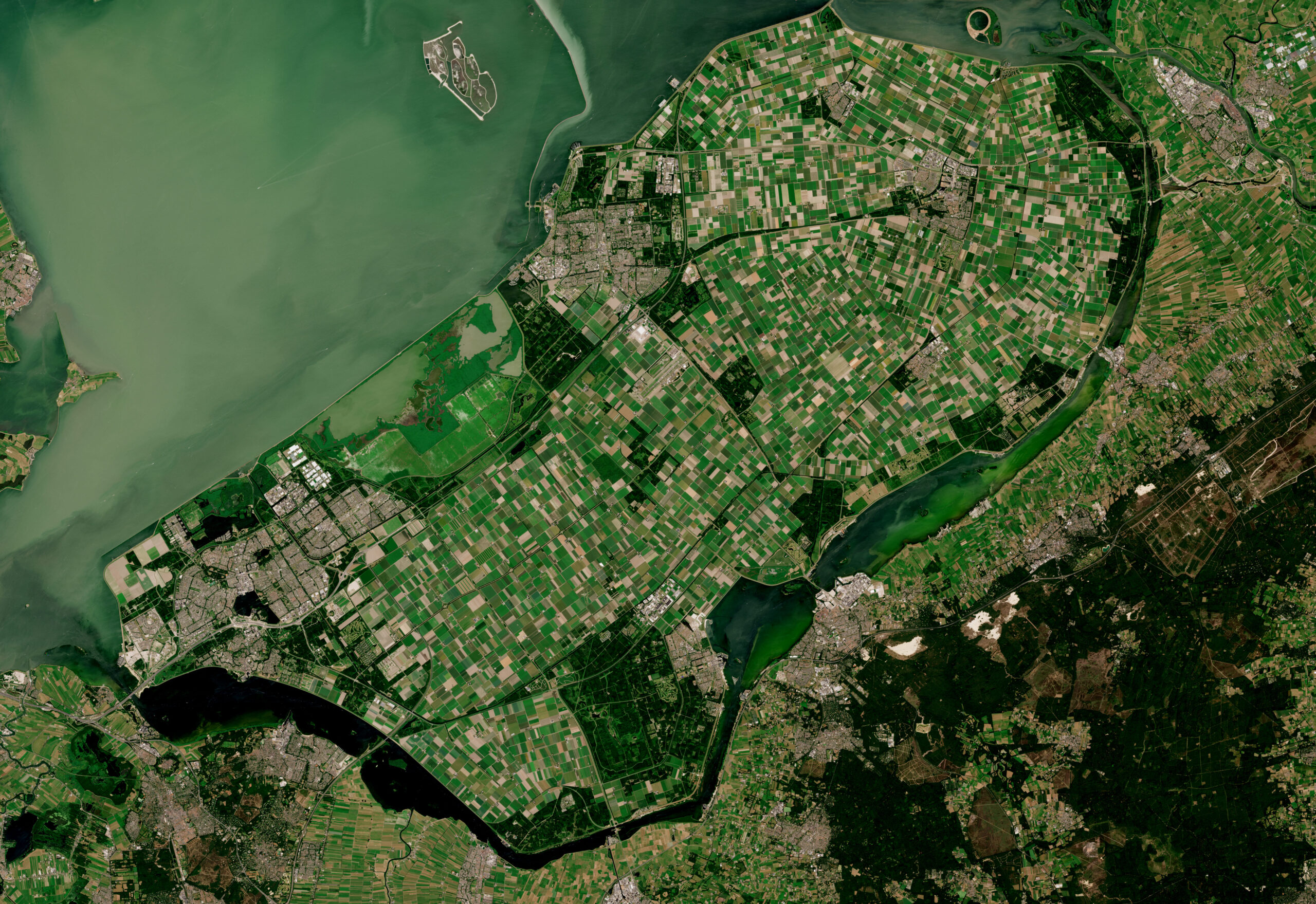


With 970 km², larger than Paris and Belo Horizonte combined, the largest artificial island in the world was created from scratch in Europe and transformed the sea into cities, roads, and farms.
Few people in the world know, but the largest artificial island ever built by humans is not in the Middle East, nor in futuristic nations like Japan or South Korea. Its location is surprising. In a region marked by centuries of struggles against the encroachment of water, a nation decided to challenge geography, tame the sea, and expand its territory in an unprecedented way in history. Thus was born an area of 970 km² completely reclaimed from the ocean, larger than Paris (105 km²) and Belo Horizonte (331 km²) combined. Its name is Flevopolder, and its existence has become an absolute landmark in global hydraulic engineering.
The story begins in the 20th century when the Netherlands, a country with a large part of its land below sea level, initiated the ambitious Delta Works and Zuiderzee Works, projects considered even today as miracles of modern engineering. There, it was not just about containing floods or building dikes. It was about creating dry land where there was once only ocean and lake. A process that required decades of planning, draining, pumping, and constructing colossal dikes until finally, in 1968, the Dutch inaugurated a new portion of continental territory, the largest hydraulic fill in the world, transformed into fertile, habitable, and economically active soil.
Engineering That Transformed the Sea into Dry Land
Transforming the sea into land requires technology, precision, and a deep understanding of water behavior. To raise the Flevopolder, teams worked for years creating systems of dams, channels, and pumps that keep the new island dry, even while being below sea level.
-
Survivor of 1966 SS Daniel J. Morrell Shipwreck in Lake Huron Recounts 38-Hour Ordeal in Extreme Cold

-
The Greatest Hoax in World Cup History? The Film That Denied Brazil’s 1958 Victory and Exposed How Fake Evidence Can Seem Convincing on TV
-
Fake South Korean Online Stores Offer Shopping Thrill Without Spending Money or Receiving Products
-
The War of Jenkins’ Ear: How a Severed Ear Sparked One of the 18th Century’s Most Unusual Conflicts


Although referred to as an island, it is, technically, a polder: an artificial area surrounded by dikes and continuously drained to remain habitable. At the heart of this project is a simple yet brutal logic: if the pumps stop, water returns, and the land disappears.
For this reason, control centers, pumping stations, and redundant systems have been installed throughout the area.
The Oostvaardersdijk dike and other hydraulic structures form gigantic barriers that withstand storms, tides, and pressures from large bodies of water. Today, this region represents a technical triumph comparable to the greatest human works, appearing alongside the Panama Canal, the Three Gorges Dam, and the NEOM Project in the select group of constructions that have changed the geography of the planet.
A City Where There Was Once Only Water: Urbanization, Roads, and Life
What stands out most about the Flevopolder is not just its scale. It is the fact that the artificial territory has become a living, active space. Today, it is home to cities like Almere and Lelystad, with modern urban infrastructure, thousands of residences, schools, industrial areas, parks, railways, and a complete road system that connects the island to the mainland.
Almere alone has surpassed 220,000 inhabitants and is one of the fastest-growing cities in the country, attracting residents seeking modern housing, urban quality, and easy access to the main Dutch metropolises.
In addition to urban use, extensive agricultural areas have been established thanks to the fertile land resulting from the drainage process. Productive fields, wind energy sources, and environmental reserves coexist side by side, demonstrating that the region is not only a construction feat, but also an economic and sustainable hub.

The Largest Hydraulic Project of the 20th Century
Flevopolder did not emerge as a display of wealth, but as a necessity. In a country where water has always been a constant threat, creating territory meant ensuring autonomy, food security, and development.
The project involved millions of cubic meters of water drained, complex networks of channels and weatherproofed pumps, and a determination that shaped generations. When completed, it became the largest hydraulic engineering work of the 20th century and remains unmatched in scale to this day, despite modern megaprojects like Dubai Palm Islands and The World.
Unlike artificial works that mainly serve for tourism or luxury, the largest artificial island in the world functions as a real city, with families, commerce, agriculture, and industries. A lasting, silent, and monumental achievement, whose human ambition allowed for the creation of an entirely new chapter in European geography.
Symbol of Resilience, Engineering, and the Future
The story of the Flevopolder is, fundamentally, a story about persistence and vision. It proves that engineering can redraw the world, that territories are not just given by nature, and that, when necessary, countries reinvent their geography to survive.
More than just fill, more than just dikes, more than just drained soil, this island is a declaration that humanity can face the impossible and win.
With the advance of climate change and rising sea levels, the Dutch model is back at the center of global discussions. Asian countries, island nations, and coastal megacities are studying the polder as a reference to protect millions of people in the future.
The largest artificial island on the planet represents not only the past of engineering. It represents the future of how entire societies may withstand the climatic transformations that the world is beginning to feel with increasing intensity.





Se fosse no Brasil não poderia fazer uma obra dessa porque os tecnocratas, políticos corruptos e meia dúzia de ambientalistas eram contra.
No nosso caso, q temos terras p/ dar, vender e emprestar, era somente tratar nossas cidades, vilas e povoados com o mínimo de drenagem e saneamento básico.
Só pra citar um exemplo: São Paulo, uma das maiores e mais ricas metrópoles do mundo, em dias de chuva parece um pântano. Isto é o retrato de nossa falta de vontade e irresponsabilidade com nossas cidades. É a demonstração de nossa incompetência.
Nossas cidades, assim como quase todo o nosso território é relativamente plano e isso baratearia e facilitariam as obras. Mas, preferem desviar bilhões e trilhões dos recursos públicos ao longo das décadas e séculos, do que investir na infraestrutura do país, como os casos dos Anões do Orçamento, Mensalão, Petrolão, Lava Jato, desvios séculares do INSS, Emendas Secretas/Pix, PEC da Blindagem, etc, etc, etc…
Este é o país do futuro e da Esperança que nunca chega!!! Até quando?
Só pra ter uma ideia, a pista de descida da Serra das Araras que, liga as duas maiores capitais do país, foi construída em 1927…