Portuguese
  Spanish




China Develops Most Complex 2D Semiconductor Chip in the World with Thickness of 1 Nanometer. Technology May Propel New Generation of Ultracompact Electronics
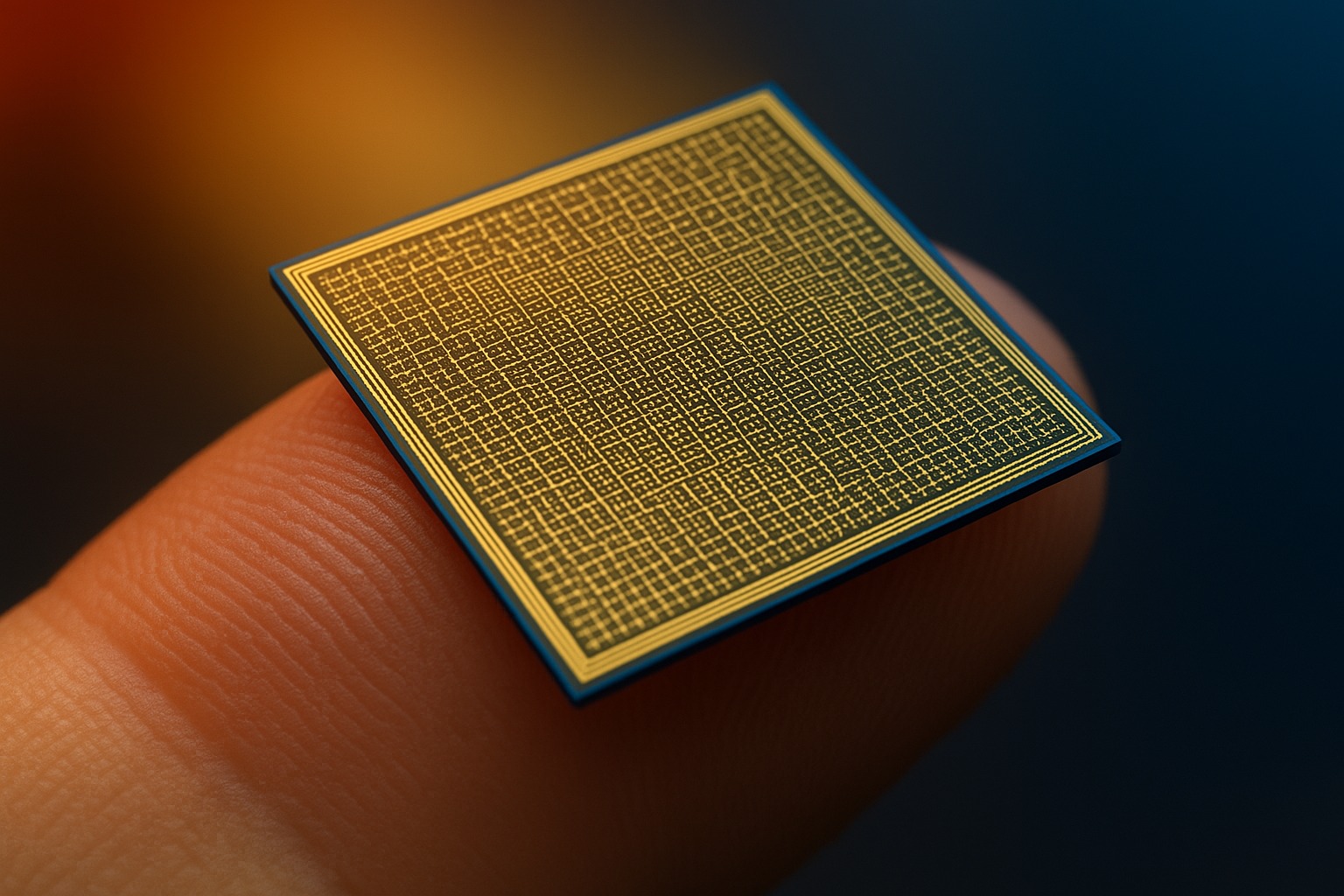
Researchers in China have developed the most complex two-dimensional semiconductor microprocessor (2D Chip) ever created, with a thickness of less than one nanometer. The innovation marks a significant advancement in the development of chips that go beyond silicon.
As traditional integrated circuits approach their physical limits, scientists around the world are betting on 2D materials, such as molybdenum disulfide (MoS2) and tungsten diselenide.
These materials have atomic thickness and offer unique physical properties that promise to revolutionize the next generation of semiconductors.
-
Harvard Researchers Develop Biological Clock to Estimate Life Expectancy, Potentially Transforming Human Aging Studies

-
Methane, natural fuel lakes, ice, and a nitrogen-rich atmosphere make Titan central to NASA’s plans for the first “space fuel station” to speed up missions beyond Mars.
-
16-Year-Old Kentucky Student Solves Long-Standing Biomedical Challenge, Wins Top Young Scientist Award at $9 Million Science Fair
-
Teen Invents Biodegradable Material from Shrimp Shells That Decomposes 1.5 Million Times Faster Than Regular Plastic




New Lingyu CPU Chip
The new Chinese 2D chip is called Lingyu CPU and was developed by the company RiVAI Technologies. It is the first RISC-V high-performance server chip entirely created by China.
This microprocessor is aimed at applications that require high-performance computing. It can also support large open-source language models like DeepSeek.
The research, published in the scientific journal Nature, shows that Chinese scientists have created a RISC-V microprocessor capable of executing standard 32-bit instructions.
It features 5,900 transistors made from MoS2 and a complete library of standard cells based on 2D semiconductor technology.
This library has 25 different types of logic units. The team of scientists also managed to optimize both the manufacturing process and the design of the 2D logic circuits, aiming to align with current advancements in silicon circuits.
Manufacturing Process and Innovation
According to researchers, the combined methodology of manufacturing and design has overcome significant challenges in wafer-scale integration of 2D circuits.
This made it possible to develop a functional prototype of a microprocessor made with MoS2. The chip demonstrates the potential of 2D integrated circuits compared to silicon.
Moreover, the chip is compatible with vector instructions and has ultra-wide vector width, meaning greater processing capability. It meets various computing demands, such as applications in machine learning.
Adoption of RISC-V
The instruction set used in the chip is RISC-V, which is open source. This allows Chinese companies to develop processors without relying on technologies controlled by other countries.
China has been investing in RISC-V as a way to circumvent restrictions imposed by trade tensions and international sanctions. These limitations hinder the country’s access to advanced chips produced abroad.
According to reports, the processor includes 5,900 transistors and implements the full 32-bit version of RISC-V. It features sophisticated circuits, such as the RISC-V instruction decoder. However, some parts of the chip have been intentionally made simply.
One example is the operation of adding two 32-bit numbers. It is executed one bit at a time, taking 32 clock cycles to complete.
Silicon Limitations and Future of Chips
In recent years, there has been an increased search for alternatives to silicon in semiconductors. This is due to technical limitations such as mobility degradation, drain-induced barrier problems, and a limited on/off current ratio.
These obstacles have driven the development of new materials. 2D semiconductors with atomic layer thickness are emerging as a possible solution.
The chip developed by Chinese scientists is a significant step in this direction. It shows how alternative materials can be used in real and complex applications, going beyond theory.
With information from Interesting Engineering.