






 Portuguese
  Spanish
  6 min of reading
  0 comments


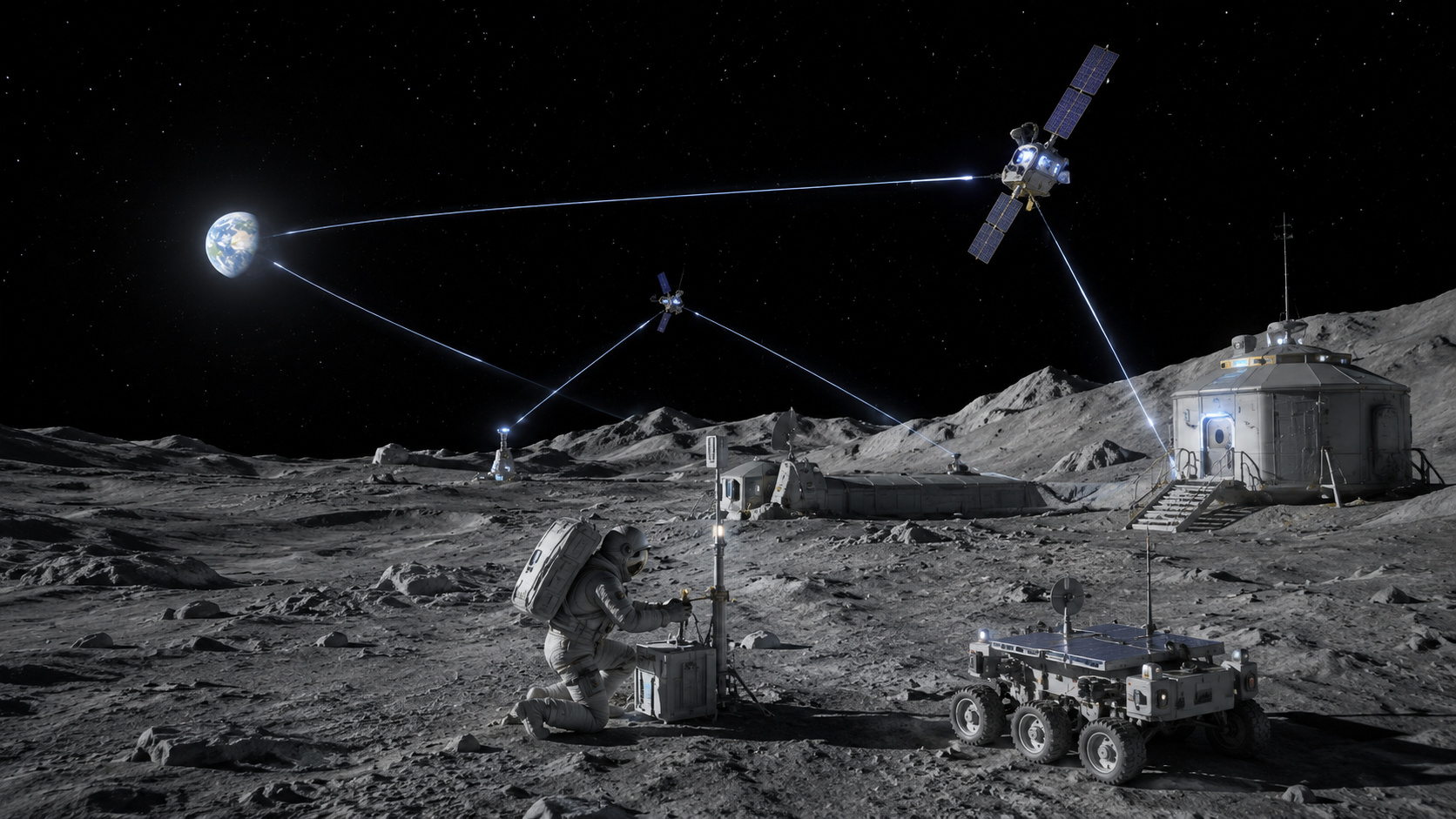
ESA prepares Moonlight network with 5 satellites to create internet, navigation, and lunar communication up to 400 thousand km from Earth.
According to ESA, the Moonlight system will consist of four navigation satellites and one satellite dedicated to high data rate communications, all integrated into a terrestrial network initially composed of three ground stations. The goal is to create a continuous data infrastructure covering a distance of up to 400 thousand kilometers between Earth and the Moon.
ESA’s Moonlight program aims to create permanent internet, navigation, and communication on the Moon
ESA describes Moonlight as the first European attempt to create a permanent commercial telecommunications and navigation infrastructure outside Earth. The agency states that the system was designed to sustain the future lunar economy and support hundreds of missions planned for the coming decades.
-
Helicopter Drops 180 Tons of Sand and Gravel on Swedish River to Revive Ecosystem Damaged by Decades of Exploitation

-
Brazilian Company Launches Retro Smartphone with 48 MP Camera, T9 Keyboard, and Privacy Features for Social Media-Free Use

-
Self-Taught Chinese Farmer Builds 5-Ton Submarine from Scrap, Launches It in Anhui River
-
Invisible Induction Technology Enables Wireless Power for Blenders, Coffee Makers, and Air Fryers, Reducing Countertop Cables





According to ESA, there are currently more than 400 lunar missions planned by space agencies and private companies for the coming years. The problem is that the Moon still does not have a continuous communication and positioning network comparable to what exists on Earth with GPS, Galileo, or satellite internet.


Today, many lunar probes rely on specific windows for direct communication with ground antennas. This limits operations, complicates autonomous landings, and increases mission complexity.
Moonlight aims to solve exactly that. According to ESA, the constellation will enable:
- continuous Earth-Moon communication
- high-speed data transfer
- orbital and surface navigation
- more precise autonomous landings
- permanent lunar operations
- support for astronauts and lunar vehicles
ESA’s lunar network will have 5 satellites connected over up to 400,000 km
The technical core of Moonlight will consist of five specialized satellites. According to ESA and the company Telespazio, an industrial partner of the program, the initial constellation will be composed of: 1 high data rate communications satellite and 4 lunar navigation satellites.
These satellites will work together to form a continuous positioning and communication network around the Moon.
ESA states that the system will create a data flow covering a distance of up to 400,000 kilometers, approximately equivalent to the average distance between Earth and the Moon.
The program also foresees at least three dedicated ground stations, responsible for maintaining constant connection between the lunar infrastructure and Earth.
Lunar satellites will function as a “GPS of the Moon”
One of the most ambitious points of Moonlight is the creation of a lunar navigation system similar to terrestrial GNSS systems, such as GPS, Galileo, and GLONASS.
According to the ESA, the four NAVSAT satellites of the constellation will allow future missions to determine position, speed, and trajectory in real-time in lunar orbit and on the Moon’s surface.
This means that future bases, lunar vehicles, and astronauts will be able to navigate the Moon with much greater precision without relying exclusively on guidance sent from Earth. ESA states that this will be essential for:

- precision autonomous landings
- operations at the lunar south pole
- rover mobility
- synchronization of lunar systems
- permanent human missions
Researchers linked to the program are also studying lunar temporal reference systems and even the creation of a specific time standard for operations on the Moon.
ESA wants to transform the Moon into a permanent space infrastructure
Moonlight was not conceived just as support for temporary scientific missions. ESA makes it clear that the ultimate goal is to enable continuous human and robotic presence on the Moon.
The logic is similar to what happened on Earth with GPS, internet, and communication satellites: create basic infrastructure to allow economic, scientific, and operational expansion.

According to ESA’s official program, Moonlight should reduce costs and simplify future lunar missions because vehicles and modules will not need to carry complete independent navigation and telecommunications systems.
In practice, ESA wants to create a kind of “permanent orbital layer” around the Moon that functions as support for:
- lunar bases
- Artemis missions
- autonomous rovers
- lunar resource extraction
- scientific research
- private commercial operations
Moonlight Program will be integrated into the international LunaNet architecture
Another important detail is that Moonlight will not be an isolated system. ESA confirmed that the project will follow the standards of LunaNet, an international initiative led by NASA and ESA to create interoperable lunar communication protocols.
LunaNet intends to function as a kind of “lunar space internet,” allowing different agencies, companies, and missions to exchange data using common standards.
This means that future American, European, Japanese, or private missions could theoretically operate on the same lunar network infrastructure.
According to ESA documents, this interoperability will be crucial because the number of lunar missions is expected to grow rapidly over the coming decades.
ESA chose special orbits to maintain permanent coverage of the Moon
The Moonlight satellites will not be in simple lunar orbits. According to technical details released by ESA and industrial partners, the satellites will use orbits known as ELFOs (Elliptical Lunar Frozen Orbits), designed to maintain long-term orbital stability around the Moon.
These orbits allow continuous coverage of regions considered strategic, especially the lunar south pole.
The south pole has become an international priority because studies indicate the presence of water ice in permanently shadowed craters, a resource considered essential for future human bases and space fuel production.
ESA states that the satellites were specifically designed to prioritize operations in this region.
Lunar Pathfinder Mission will be the precursor to the Moonlight system
Before the complete constellation, ESA will launch a precursor satellite called Lunar Pathfinder. According to official information, the Pathfinder will function as a technological demonstrator for the future Moonlight system.
The satellite is expected to operate as a lunar communication relay and validate navigation technologies in cislunar space.

The mission is scheduled for launch in 2026 and will be sent to lunar orbit by the Blue Ghost Mission 2 from Firefly Aerospace. The satellite will also carry receivers capable of capturing extremely weak signals from terrestrial GNSS systems even at great distances from Earth.
Europe wants to avoid total dependence on American space systems
Although ESA works in cooperation with NASA, the Moonlight program also has a strong European strategic component.
The project is treated by the ESA as a way to ensure European “sovereign access” to future lunar operations. This means reducing total dependence on American infrastructure in future missions.
The strategy is reminiscent of what Europe has previously done with the Galileo system to avoid relying solely on the United States’ GPS. Now, the logic is beginning to be applied to lunar orbit.
The Moon may gain its own internet infrastructure before Mars
The most impressive aspect of Moonlight might be the speed at which the lunar race is evolving. For decades, the Moon was mainly treated as an occasional scientific destination. Now, space agencies are talking about:
- lunar internet
- lunar GPS
- permanent bases
- lunar economy
- commercial orbital networks
- navigation services beyond Earth
Moonlight shows that the next stage of space exploration involves not just reaching the Moon again. It involves building permanent infrastructure around it.





Be the first to react!