






 Portuguese
  Spanish
  5 min of reading
  0 comments


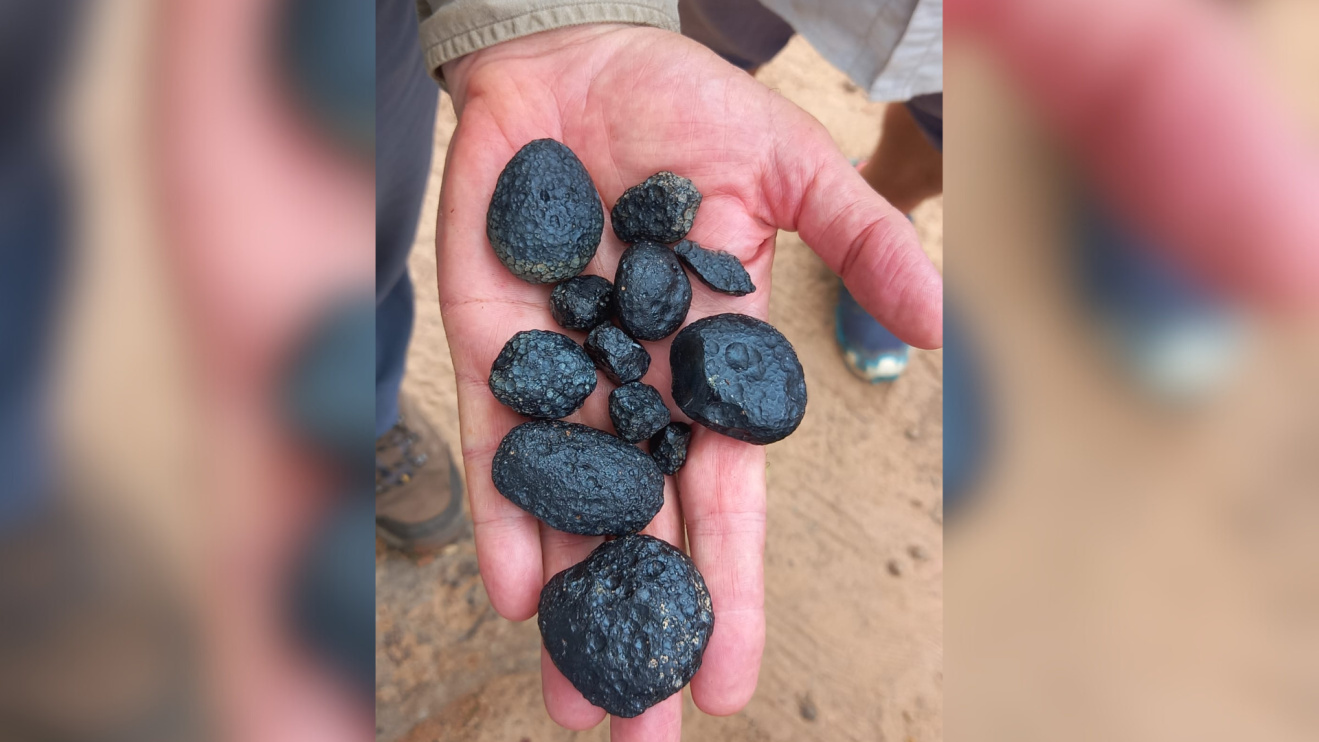
Unicamp Identifies Tektites With 6.3 Million Years In Brazil; Glass Formed By Cosmic Impact Reveals Extraterrestrial Event Without A Located Crater.
On January 16, 2026, scientific media outlets such as Agência FAPESP, Folha.com, CNN Brasil, G1 Ciência, among others, reported that research led by geologist Álvaro Penteado Crósta, from Universidade Estadual de Campinas (Unicamp), published in the scientific journal Geology, confirmed the existence of one of the planet’s rarest materials: a Brazilian tektite. This natural glass only forms when a celestial body collides with Earth at speeds greater than 11 km/s, melting soil and rock and launching the molten material over great distances before solidifying in the air. According to the publication, the event occurred approximately 6.3 million years ago, during the late Miocene, and left a signature that today occupies parts of Minas Gerais, Bahia, and Piauí.
What Are Tektites And Why Are They Called “Extraterrestrial”
Tektites are not meteorites. Meteorites are fragments of rocks that come from space. Tektites are the opposite: they are earthly rocks that have been melted, ejected, and cooled during an extraterrestrial impact.
The term “extraterrestrial” arises not because the material comes from outside, but because they only form due to cosmic events, with energies that do not exist in conventional terrestrial phenomena.
-
Helicopter Drops 180 Tons of Sand and Gravel on Swedish River to Revive Ecosystem Damaged by Decades of Exploitation

-
Brazilian Company Launches Retro Smartphone with 48 MP Camera, T9 Keyboard, and Privacy Features for Social Media-Free Use

-
Self-Taught Chinese Farmer Builds 5-Ton Submarine from Scrap, Launches It in Anhui River
-
Invisible Induction Technology Enables Wireless Power for Blenders, Coffee Makers, and Air Fryers, Reducing Countertop Cables






Therefore, tektites serve as a kind of geological signature of the shock, an indirect evidence that something much larger usually occurred, such as an asteroid or comet fragment that released energy equivalent to thousands of nuclear bombs.
In Brazil, the fragments have been nicknamed “geralsitos”, a reference to northern Minas Gerais, where they were collected over the last decades by locals and geologists who, until recently, did not know exactly what they were carrying.
The Discovery That Changed Geological Maps
According to Agência FAPESP (January 16, 2026), the tektites were initially recognized as impact glass after laboratory analyses using electron microscopy, spectrometry, and isotopic analysis, confirming typical characteristics of ultrafast melting and cooling in flight. These signatures include:
- absence of crystals (amorphous glass)
- trapped gas bubbles
- flow microstructures
- chemical composition depleted in volatile elements

These factors indicate a material that melted above 1,700°C, a temperature capable of turning rock into liquid in fractions of a second — a phenomenon that only occurs in high-energy impacts.
Brazil had not been on the global map of tektites until now. Prior to this discovery, only four main fields were recognized worldwide:
- North America
- Central Europe and Southeast Asia
- Ivory Coast
- Australia and Tasmania

The inclusion of the Brazilian field, according to Crósta, represents a complete revision of the geological view of South America in the context of cosmic impacts.
Where The “Geralsitos” Were Found
The already identified fragments are spread over a large territorial area encompassing:
- Northern Minas Gerais
- Southern Bahia
- Western Piauí
The material appears mainly in areas of plateaus, hilltops, and rocky fields, places where erosion exposes ancient layers and facilitates access to sediments older than the superficial soils.
This spatial distribution suggests that the field could reach hundreds of kilometers in length, placing Brazil in a select group of regions with documented impact through tektite dispersion.
The Mystery Of The Missing Crater
One of the most fascinating points that intrigues geologists worldwide — is that the impact crater has not yet been found. This is extremely unusual, as tektite fields are usually associated with known structures, such as:
- Ries (Germany) — European field
- Chesapeake (USA) — North American field
- Ivory Coast — African field
- Australasian — megadispersed field of Asia-Oceania
There are some hypotheses for the Brazilian case:
- The crater may have been eroded over millions of years.
- The crater may be buried under thick sediments.
- The crater may be submerged, possibly associated with ancient coastal regions.
- The impact may have occurred before major tectonic events that deformed the surface.
According to the research published in Geology, based on argon-argon dating (⁴⁰Ar/³⁹Ar), the event occurred 6.3 ± 0.2 million years ago, a period that coincides with significant climatic and geomorphological transformations in South America.
Why Is The Discovery So Important
There are three main reasons:
1. It Rewrites The Geological History Of Brazil
The country now enters the global map of high-impact cosmic events — something that was previously thought to be extremely rare here.
2. It Opens The Chance To Locate An Unprecedented Crater
Finding this structure means studying:
- impact dynamics
- local extinctions
- environmental changes
- sediment deposition
Discoveries of this kind often become international scientific heritage.
3. It Expands Research On The Risk Of Future Impacts
Understanding ancient impacts helps to:
- understand frequency
- estimate energy needed for lethal impacts
- improve planetary defense models
This is a topic discussed by organizations such as NASA, ESA, and UN, especially after the detection of potentially hazardous asteroids such as Apophis and Bennu.
Brazil Is Now Part Of Impact Geology
Researchers point out that, although not widely publicized, Brazil has impact-associated structures already mapped, such as:
- Araguainha (MT/GO) — largest crater in South America, ~40 km in diameter
- Vargeão (SC)
- Colônia (SP) — currently an urban area
- Vista Alegre (PR)
The existence of tektites adds a new layer to the story, because it is not just a crater — it is a field of dispersal, which implies an even larger event.
What Happens Now
Groups of geologists from Unicamp and international institutions plan to:
- map more samples
- estimate the ejection trajectory
- model the dispersion axis
- search for the original crater
If the crater is located, Brazil could host one of the most important sites on the planet for cosmic impact studies, similar to the Chicxulub crater in Mexico, responsible for the extinction of the dinosaurs.
The discovery of the “Brazilian tektites” is a rare combination of cutting-edge science, geology, astronautics, and natural history. While revealing the deep past of the country, it opens space for new questions:
- Where exactly did the celestial body hit Brazil?
- What was the size of the object?
- What effects did it cause on the climate and biota of the time?
- Does the crater still exist or has it already disappeared?
These are questions that will make the next years one of the most exciting periods for Brazilian geoscience.





-

1 person reacted to this.