






 Portuguese
  Spanish


3D Printed Skin With Living Cells Could Replace Animal Testing. Technology Advances As An Ethical And Accurate Solution In The Cosmetics Industry
A realistic human skin model printed in 3D with living cells could change cosmetic testing worldwide. The innovation was developed by scientists at Graz University of Technology (TU Graz) in Austria, in collaboration with Vellore Institute of Technology (VIT) in India.
The research began following the establishment of Directive 2010/63/EU, which imposed stricter rules on the use of animals in cosmetic testing within the European Union.
The regulation increased the pursuit of safer and more ethical methods for testing the toxicity and absorption of nanoparticles, such as those found in sunscreens.
-
China Develops Custom 140-Ton Electric Mining Truck with 770 kWh Swappable Battery, Deploys 290 Units in Xinjiang’s Largest Zinc Mine

-
Meta to Launch Arena, a New Prediction App Targeting 3.56 Billion Users, Competing with Polymarket and Kalshi

-
Scientist Challenges Famous Human Evolution Theory, Argues Homo Sapiens Evolved Gradually Over Thousands of Years
-
15-Year-Old American Builds Ocean Generator with PVC Pipe and 3D-Printed Propeller for $12, Wins National Prize, Presents at White House, and Makes Forbes 30 Under 30 List




The solution was to create artificial human skin in the laboratory. This model accurately reproduces the structure of real human skin, with three layers and similar functions.
To achieve this, the scientists used special formulations of hydrogel and living cells. The result is a platform that allows for ethical, safe, and effective cosmetic testing.
Hydrogels Are The Foundation Of Artificial Skin
The hydrogels used in this artificial skin are essential. They function as a medium to keep the living cells alive. “The hydrogels must be able to interact with the living cells of the skin,” explained Professor Karin Stana Kleinschek from TU Graz. “These cells not only need to survive, but they also need to be able to grow and multiply.”
According to her, the starting point was hydrogel formulations developed at the university itself. These materials have a high water content, which promotes cell growth.
However, this characteristic also makes them unstable. Therefore, the scientists are working on mechanical and chemical techniques to make these structures more firm and secure.
The team from Austria is dedicated to stabilizing the structures. They are seeking gentle methods without toxic chemicals. This ensures the process is as natural as possible. Once the 3D printed skin is stabilized, the team from India will conduct tests to evaluate its durability and possible side effects.
Focus On Testing With Nanoparticles
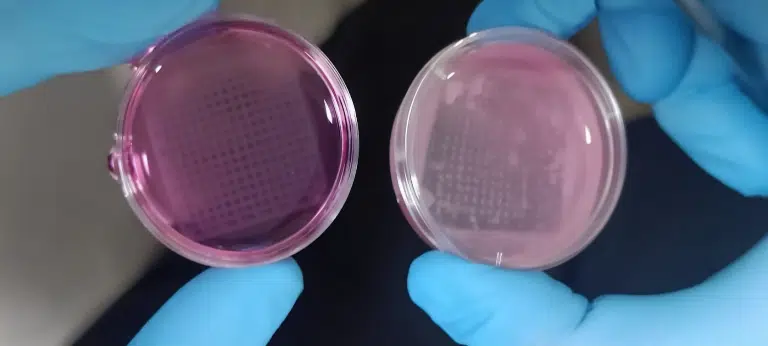
The initial tests of the artificial human skin showed that the 3D printed hydrogels are stable and do not harm the cells. This is an important step.
However, for the artificial skin to be used effectively, the skin cells need to survive for at least two to three weeks in the laboratory. Only then can they form real tissue.
This criterion is essential. Only after this period is it possible to conduct tests with cosmetic products. The idea is for the nanoparticles from cosmetics, especially sunscreens, to be applied to this artificial human skin.
This way, the scientists can observe how these substances react in a tissue very similar to human skin.
Artificial Human Skin: A New Phase For The Industry
According to Professor Kleinschek, this stage marks an important advancement for research. “In the next phase, the 3D printed models will be used to test nanoparticles,” she stated. She considers the result a joint success of both institutions.
The collaboration of expertise was crucial. On one side, TU Graz brought experience in materials for tissue mimicry. On the other, VIT contributed knowledge in molecular and cellular biology.
Together, the teams are now focused on further improving the hydrogel formulations and proving that they function as real substitutes for animal testing.
The expectation is that this model will be widely used in the future. It can replace traditional testing, providing more safety and respect for animal life.
In the meantime, studies continue at a rapid pace. The next goal is to definitively prove the effectiveness of the 3D human skin in cosmetic testing.
With information from Interesting Engineering.





