






 Portuguese
  Spanish
 5 min of reading
  0 comments


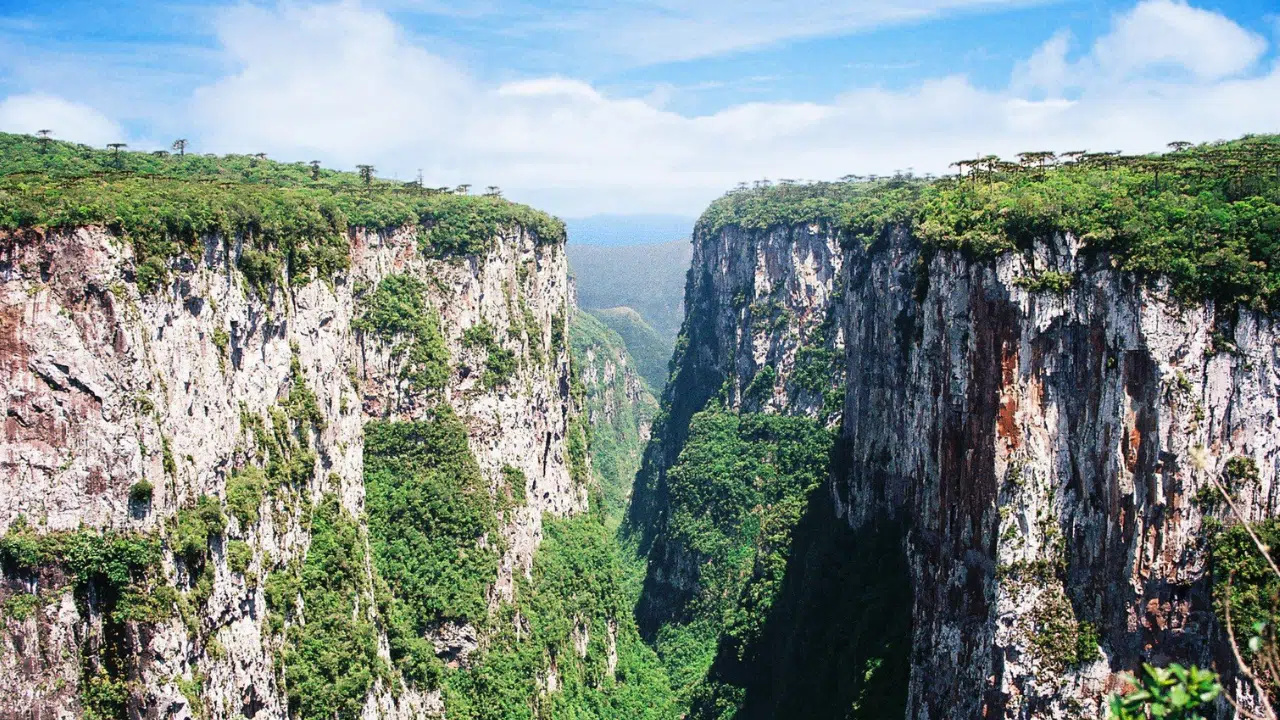
Southern City in Aparados da Serra Records Up to −7°C and Monumental Canyons, Earning the Nickname “Brazilian Norway” in the Heart of Brazil.
Among the rolling fields of Campos de Cima da Serra, in the northeast corner of Rio Grande do Sul, there is a small municipality of just over 6,300 inhabitants (IBGE) that has drawn the attention of Brazilians and foreigners for an unexpected reason: the harsh cold and monumental geography. This is Cambará do Sul, located about 190 km from Porto Alegre, one of the coldest places in the country and the gateway to the Aparados da Serra and Serra Geral National Parks.
Not by coincidence, the city has gained nicknames like “Brazilian Norway” and “Land of Canyons”, as it combines negative temperatures, mountainous landscapes, deep geological cavities, and a sense of isolation that resembles Nordic regions. Comparisons to Scandinavia arose not from culture but from the climatic and geological landscape, something rare in Brazilian territory.
Mountain Landscape and the Fascination of Isolation
What surprises most those who arrive in Cambará do Sul is not only the canyons, although they are the major postcard attraction, but the silent vastness that dominates the local biome.
-
Survivor of 1966 SS Daniel J. Morrell Shipwreck in Lake Huron Recounts 38-Hour Ordeal in Extreme Cold

-
The Greatest Hoax in World Cup History? The Film That Denied Brazil’s 1958 Victory and Exposed How Fake Evidence Can Seem Convincing on TV
-
Fake South Korean Online Stores Offer Shopping Thrill Without Spending Money or Receiving Products
-
The War of Jenkins’ Ear: How a Severed Ear Sparked One of the 18th Century’s Most Unusual Conflicts


The southern Brazilian plateau in this region is marked by high-altitude fields, century-old araucarias, and a mosaic of Atlantic Forest and native fields, preserved historically due to difficult access and low population density.
This natural isolation has shaped not only the landscape but also the visitor’s experience. Instead of bustling urban centers, Cambará offers dirt roads, isolated cabins, inns with fireplaces, glass cabins, and a routine marked by fog, cold winds, and silence. In certain areas, visibility opens up to kilometers of fields and rock formations — a sense of expanse that is hard to find in a tropical country.

Local tourism has been organized to take advantage of this atmosphere: sensory experiences, such as waking up to the sound of wind in the fields and watching the fog slowly descend from the canyons, have become the true tourist asset of the region.
Economy in Transition: From Timber to Ecotourism
Cambará do Sul was, until a few decades ago, a municipality predominantly focused on agro-forest industries, with sawmills and the exploitation of forest resources. The change began when the first ecotourism groups discovered the Itaimbezinho and Fortaleza Canyons, and when national conservation policies established the parks that now protect these areas.
Over the years, the service sector has grown continuously. The presence of professional guides, boutique hotels, structured campgrounds, regional restaurants, and high-end establishments like the Parador Cambará do Sul has helped reposition the municipality as a nature tourism hub.
The result of this movement is evident: the economy has increasingly revolved around hospitality, gastronomy, specialized guiding, horses, trails, 4×4 rides, receiving companies, and a growing chain of services that now supports a good part of the population.
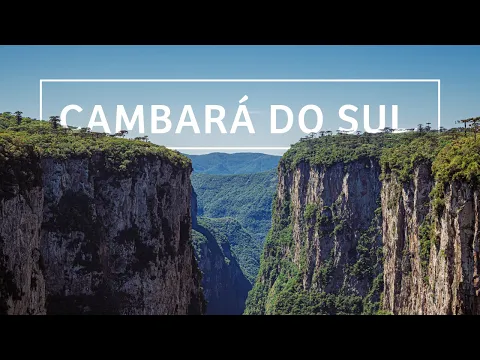

The Monumental Landscapes of the Canyons
Visiting Cambará do Sul is primarily about contemplating the canyons. They are not recent volcanic formations, nor are common valleys but deep structures featuring vertical sandstone cliffs, covered with native vegetation and sculpted over millions of years by the slow work of water and time.
Two of them are widely known:
Itaimbezinho: the most famous. It features cliffs up to 720 meters high, trails with developed viewpoints, and an impressive natural amphitheater.
Fortaleza: larger and wilder, with 360° views at the top and cliffs reaching 900 meters deep, on clear days allowing views of the Santa Catarina coastline.
These canyons are part of the Aparados da Serra, one of the most unique geological regions in the country, connecting high-altitude fields with humid valleys and Atlantic forest.
The climate, at this point, plays a decisive role. The famous “viração”, a name given by locals to the rapid fog, can cover the canyon in minutes, creating a cinematic and unpredictable scene, reinforcing the idea that nature dictates the pace there.
When the Cold Transforms the Mountain
Although Cambará do Sul welcomes visitors year-round, it is in winter that the city fully embraces its “Nordic” fame. The altitudes above 1,000 meters allow temperatures to drop to negative values, generating constant frosts and, in some years, snow.
According to climatic records compiled by meteorological services and regional outlets, the municipality has already reached −7 °C, one of the lowest values recorded in Brazil. This causes, on the coldest mornings, the fields to awaken completely white, covered by a layer of ice formed overnight.
This phenomenon, extremely rare across most of the country, produces landscapes that inspired the nickname “Brazilian Norway”: silent valleys, frozen fields, low-lying fog, and cold winds cutting through the araucarias.
Why Does This Place Stir the Imagination?
There are three main factors:
Uncommon Climate in Brazil — negative temperatures, frosts, and the possibility of snow.
Monumental Geology — canyons with dimensions comparable to the great valleys of the Northern Hemisphere.
Silence and Isolation — the feeling of low human density and geographic scale.
This combination results in an experience that approaches what many Brazilians imagine when thinking of Scandinavia: raw nature, cold, and expansiveness.
A Destination that Connects Simplicity and Natural Grandeur
Cambará do Sul is not a place for those seeking urban parks or large avenues. It is a destination for those who wish to observe land, sky, and stone, for those who find value in the cold wind, the fire of the fireplace, the silence, the chimarrão, and the traditional hospitality.
And perhaps that is what best defines the so-called “Brazilian Norway”: not the attempt to imitate a distant country, but the ability to offer something rare in contemporary Brazil, grand landscapes, true winters, and an intimate relationship with the territory.
On the edge of the canyons, as the viração rises and the cold wind cuts across the face, the visitor realizes they are in the presence of a geographical power that requires no exaggeration. The scene speaks for itself: there, Brazil shows a face that few know — cold, monumental, and silent.





-

2 people reacted to this.