






 Portuguese
  Spanish


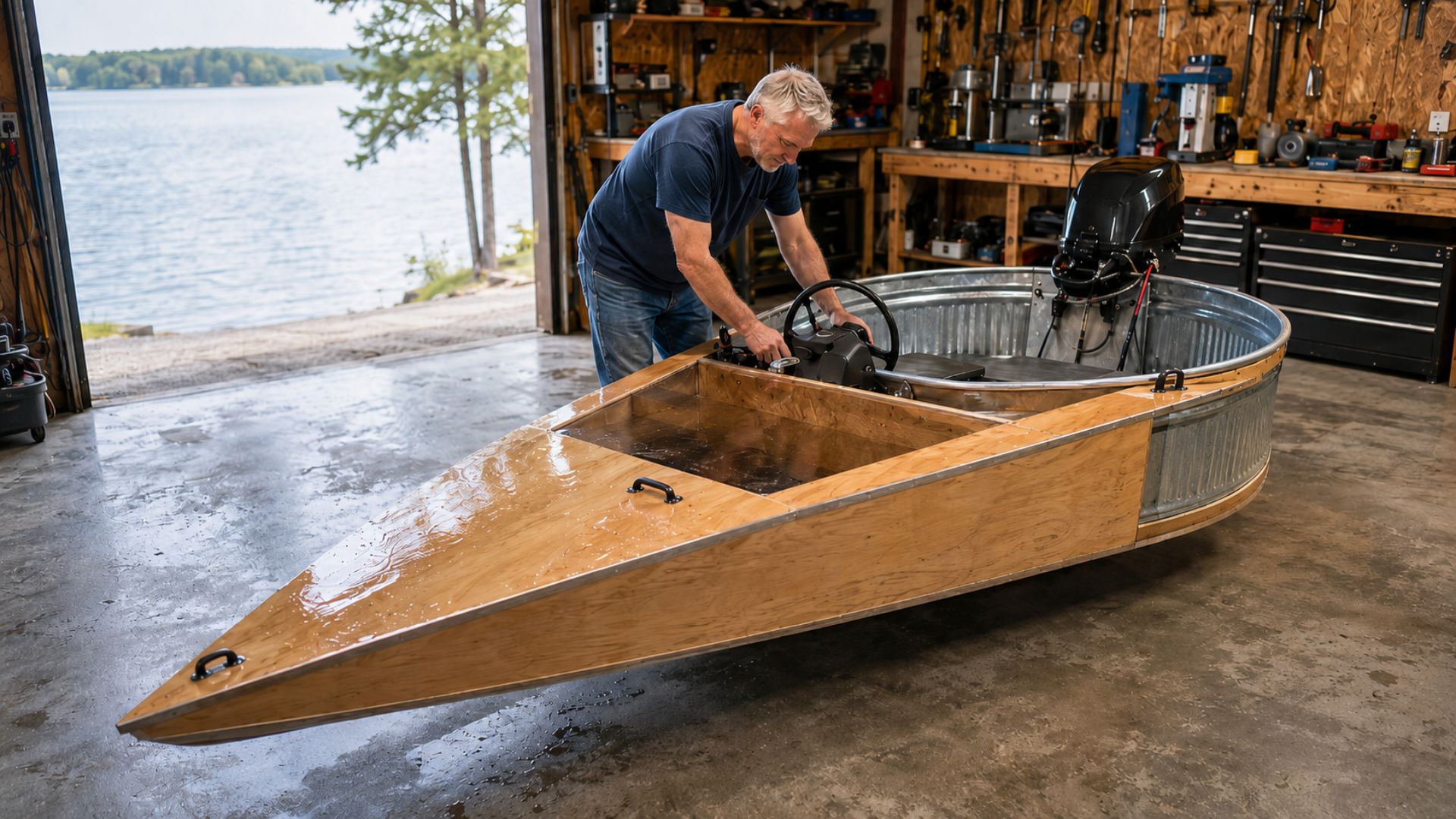


The American Jason Hibbs, from the Bourbon Moth Woodworking channel, transformed a cattle trough into a motorized boat. He reinforced the tank with plywood, sealed everything with epoxy, and installed an outboard motor. Named Milk Dud, the homemade vessel really floated and glided on the water.
What was supposed to be just a cattle trough from a farm turned into a real motorized boat. The feat is by the American Jason Hibbs, owner of the Bourbon Moth Woodworking channel, who documented in video, step by step, how he transformed the metal tank into a small homemade boat capable of gliding through the water.
The idea seemed ridiculous on paper: take a cattle waterer and make it float with people inside. But, with plywood, a lot of epoxy, and an outboard motor, the project proved that even the most unlikely construction can succeed when the craftsmanship is meticulous. Named Milk Dud, the boat was even christened with milk instead of champagne.
From cattle trough to boat: how it all began

The inspiration came from a Midwest United States tradition, where it is common to float down rivers inside farm troughs. Jason wanted to turn this unexciting scene into something real and decided to convert a cattle trough into a motorized vessel. On paper, the proposal sounded like a joke, but in the hands of an experienced woodworker, it became a serious project.
-
At 17, she hand-painted her first watercolor design for school uniforms; her brand grew without investors, sold 135,000 pieces, and aims for $3 million in revenue by 2026.

-
At 61, Former Homeless Wheelchair User Receives Key to Container Home in Brazil, Declares Independence

-
São Paulo Highway to Receive Over $260 Million in Upgrades, Including 90 Kilometers of Service Roads and New Infrastructure, by 2027
-
Shell Discovers Intact Early 19th-Century Wooden Shipwreck in the Gulf of Mexico at Over 1,300 Meters Deep




The work began with narrow strips of plywood attached to both sides of the tank, forming the first outline of the hull. The pieces were first joined with tape to test the shape and then permanently fixed. Gradually, the old cattle trough began to take on the silhouette of a boat, with upper and lower contours connected by diagonal supports.
Plywood and epoxy: building the hull

The structure took shape with a wedge-shaped piece at the bow and a series of cross boards screwed in, which transformed the hull into a ribbed and sturdy frame. To follow the curves of the tank, Jason made notches in the plywood, allowing it to bend without breaking. Each joint received a generous layer of epoxy, applied at all contact points to ensure firmness and sealing.
After covering the entire structure with panels, the hull was turned over to close the bottom, also in plywood, with the edges sanded to glide better in the water. To gain buoyancy, the builder injected expanding polyurethane foam into the internal cavities. Then, he sealed the bottom with epoxy resin, sealing screw holes and joints, because, in a boat, even the smallest gap can become a problem.
Painting, cockpit, and the outboard motor

With the hull ready, came the aesthetic refinement. Jason reinforced the external seams with wooden strips, plugged the screw holes with small plugs, and sanded everything until the finish was smooth. The painting followed a classic boat scheme: white top, navy blue bottom, and a red stripe marking the waterline, a separation that also protects the part most exposed to water.
The interior received a complete cockpit. Seats with semicircular bases were installed, upholstered in blue synthetic leather, flooring that mimics wood, and even a storage space hidden under the benches. Finally, the missing piece: a Mercury Pro Kicker outboard motor, firmly screwed to the back. With the outboard motor locked in place, the former cattle trough was officially ready to face the water.
The water test: does the Milk Dud boat float?

The moment of truth arrived. The boat, now named Milk Dud, was taken on a trailer to the water and received an unconventional christening: instead of champagne, a bottle of milk, a humorous tribute to its cattle trough origin.


According to the channel TechFreeze, which followed the process, the answer was yes. The Milk Dud not only floated but also glided across the surface with surprising lightness, cutting through the water with ease. After so much doubt and so many seemingly crazy decisions, the project proved its worth: a simple farm water trough, combined with plywood, epoxy, and an outboard motor, turned into a beautiful and functional boat.
The transformation of the cattle trough into a real boat shows that creativity and care can work miracles even with the most unlikely scrap.
Tell us in the comments if you would dare to sail on the Milk Dud and what is the most unusual object you have ever seen turned into a boat.


