Portuguese
  Spanish


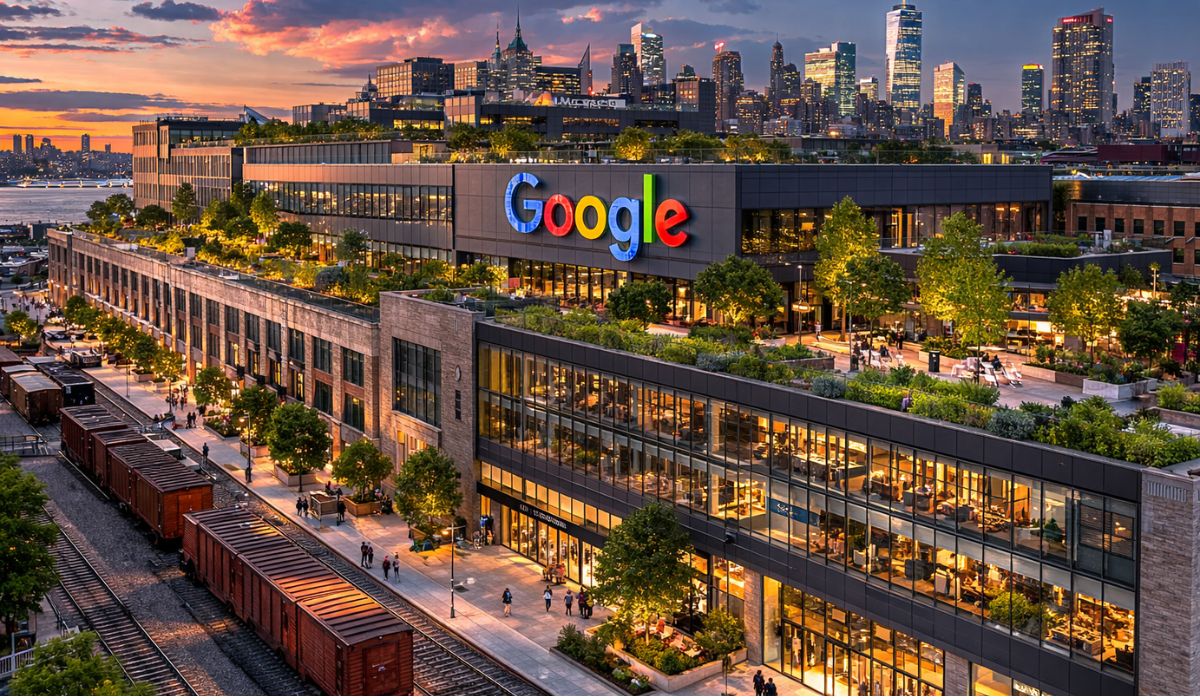


Urban Redevelopment, Billion-Dollar Investment, and New Corporate Office Model Mark the Transformation of St. John’s Terminal in Manhattan into a Project That Combines Industrial Heritage, Sustainability, and Google’s Expansion in New York.
The St. John’s Terminal, in Hudson Square, expanded Google’s presence in New York by combining the redevelopment of historic infrastructure, a billion-dollar investment, and a collaborative office model.
The property, purchased by the company for around US$ 2.1 billion and inaugurated as Google’s office on February 26, 2024, occupies the former freight terminal of the area and now houses the American operations of the Global Business Organization, a division related to sales, partnerships, and client relationships.
Originally built in the 1930s, the terminal was adapted rather than demolished.
-
A metal detector led a prospector to a rock that resisted a saw, acid, drill, and sledgehammer; years later, scientists cut the block with diamond and discovered a 17 kg meteorite from the beginning of the Solar System.

-
Just one message on WhatsApp: Belém launches “Plante Aqui” and plants a tree for free at your doorstep within 15 days, with a goal of 5,000 seedlings by the end of 2026 in the capital of Pará.

-
The most ‘stingy’ millionaire in Canada? Bill Holland saved money to retire at 32, led the management company that now manages $140 billion, and still takes public transportation, in the same club as Warren Buffett and Elon Musk.
-
At 79 years old, the businessman who led Burger King’s arrival in Brazil announces an investment of R$ 380 million to create a “Gaucho Tuscany” on 370 hectares, with private vineyards, olive groves, a luxury hotel, and its own wine and olive oil production, along with about 200 properties.




The architectural solution preserved the historical base of the building and added new floors over the existing structure, forming a large-scale horizontal volume in a city characterized by vertical towers.
The result was a 12-story building with about 1.3 million square feet, designed to accommodate more than 3,000 employees and integrate Google’s campus into the surrounding Hudson Square area.
Google in New York Redevelops Historic Freight Terminal
The transformation of St. John’s Terminal has been treated by Google and the offices involved in the project as part of the strategy to occupy buildings already integrated into the urban fabric of New York, rather than reproducing the isolated campus model of the Silicon Valley.
The former terminal served as the endpoint of the freight railway line connected to what is now the High Line.
During the renovation, part of the structure that extended over Houston Street was removed, reopening the visual and physical connection between the neighborhood and the banks of the Hudson River.
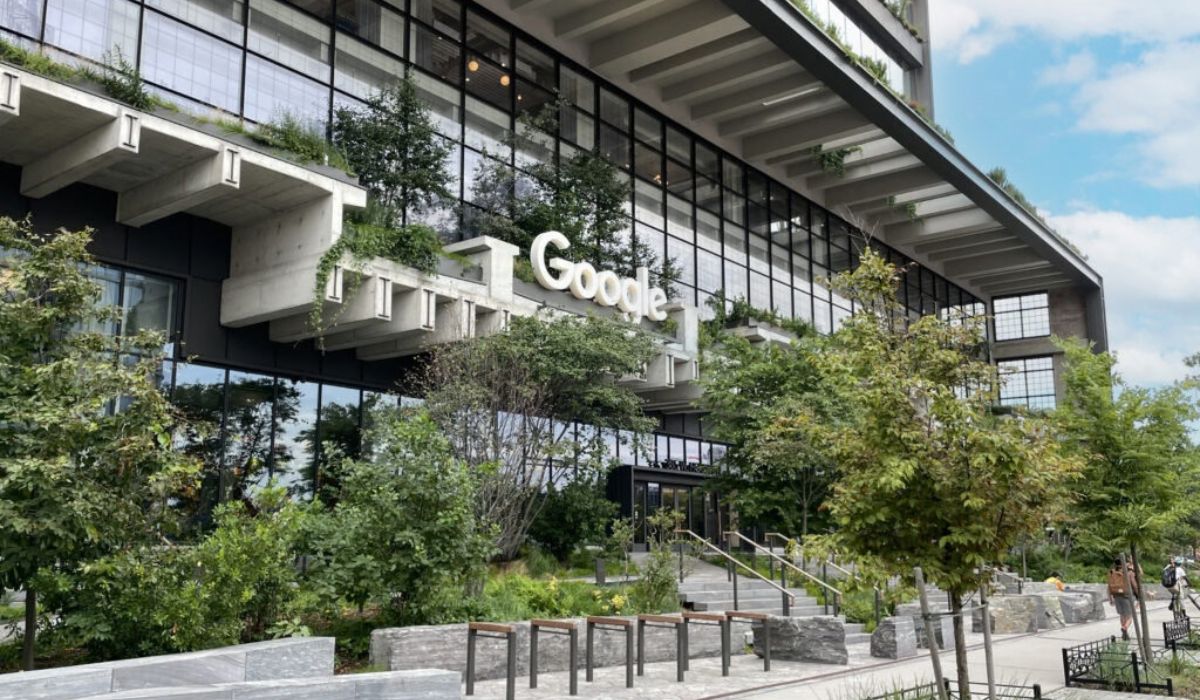
As a result, the intervention altered not only the building but also its relationship with the city.
Instead of erecting a tower closed off from itself, the architects opted for a lower and more extensive set, described in specialized publications as a “groundscraper”.
This choice preserved industrial characteristics of the property and maintained the reference to the logistical past of the area, now incorporated into contemporary corporate use.
Hybrid Work Model at St. John’s Terminal
The project was conceived for an office that is less rigid than the fixed station standard.
Instead of traditional rows of permanently assigned desks, Google adopted a “shared neighborhood seating” system in the building, where teams work in shared neighborhood areas and circulate between spaces designed for different tasks throughout the day.
The proposal includes areas for meetings with clients and partners, collaborative environments, and alternative work zones.
In practice, this means that the building was organized to respond to hybrid work without relying on a single configuration.
Meeting rooms, collaboration areas, and support spaces were designed to receive quick adjustments, according to the size of the group or the type of activity.
According to the official project materials, the focus is less on the individual desk and more on the circulation between environments aimed at exchanging ideas, concentration, and face-to-face meetings with teams and clients.
Green Spaces, Natural Light, and Well-Being at Google’s Office
One of the most publicized aspects of St. John’s Terminal is the incorporation of green spaces into the work environment.
The building features 1.5 acres of vegetation distributed at street level, gardens in the former railway beds, terraces, and other external areas.
According to Google, over 95% of the outdoor plants are native to the state of New York, and the complex has become a habitat for over 40 species of birds observed in partnership with NYC Audubon.


In addition to the landscaping, the project also features terraces with views of Manhattan and the Hudson River, as well as indoor environments designed to receive natural light and accommodate different usage profiles.
This proposal follows a trend observed in the office market, which seeks to combine productivity, flexibility, and well-being in corporate areas located in dense regions of the city.
Sustainability and Environmental Certification of the Project
The repurposing of the base of the old terminal has been presented by Google and the COOKFOX office as one of the main environmental gains of the project.
According to the two institutions, preserving a substantial part of the existing structure is expected to avoid approximately 78,400 metric tons of CO2 equivalent emissions compared to constructing a new structural foundation.
The building also incorporates solar panels, rainwater retention, and reclaimed wood from the Coney Island boardwalk after the damage caused by Hurricane Sandy.

In terms of certifications, the project has been associated with the LEED Platinum standard.
Sources linked to the development and design of the building indicate LEED v4 Platinum certification for the core and shell, as well as LEED v4 Platinum for the interiors.
The complex has also been described as a candidate for ILFI Zero Carbon certification, a fact mentioned by the project leaders as part of the project’s environmental strategy.
Impact of Google’s Investment in Hudson Square
The opening of St. John’s Terminal also had an impact on Hudson Square, an old industrial area that has been repositioned over the past few decades as a creative, technological, and corporate hub.
By installing an operation of this scale there, Google has reinforced the role of the neighborhood in its presence in the city and has expanded a movement already initiated with other company assets, such as Chelsea Market, Pier 57, and 111 Eighth Avenue.
New York was already, before the building’s inauguration, the second largest base of Google employees after Mountain View.
In 2024, the company reported surpassing 14,000 full-time employees in the city.
The St. John’s Terminal does not house all these professionals, but it has taken a central position in the company’s real estate strategy, which maintains offices distributed throughout Manhattan.