Portuguese
  Spanish


SpaceX conducted a Falcon 9 launch that generated a bright plume in the shape of a space jellyfish, visible in the night sky when exhaust gases expanded at high altitude and were illuminated by the Sun, creating vibrant colors that caught the attention of observers and photographers during a routine mission.
SpaceX launched a Falcon 9 rocket on July 9, 2026, at 5:25 AM Eastern Time, from the Cape Canaveral Space Force Station in Florida. During the Starlink 10-42 mission, the Sun-illuminated exhaust plume formed an image in the night sky resembling a giant jellyfish.
The information was published by the Daily Galaxy on July 10, 2026. According to the report, the effect occurred because the Falcon 9 ascended to a region still illuminated by sunlight while ground observers were already in darkness, creating a rare combination of space launch, atmosphere, and light geometry.
Falcon 9 created a space jellyfish in the sky
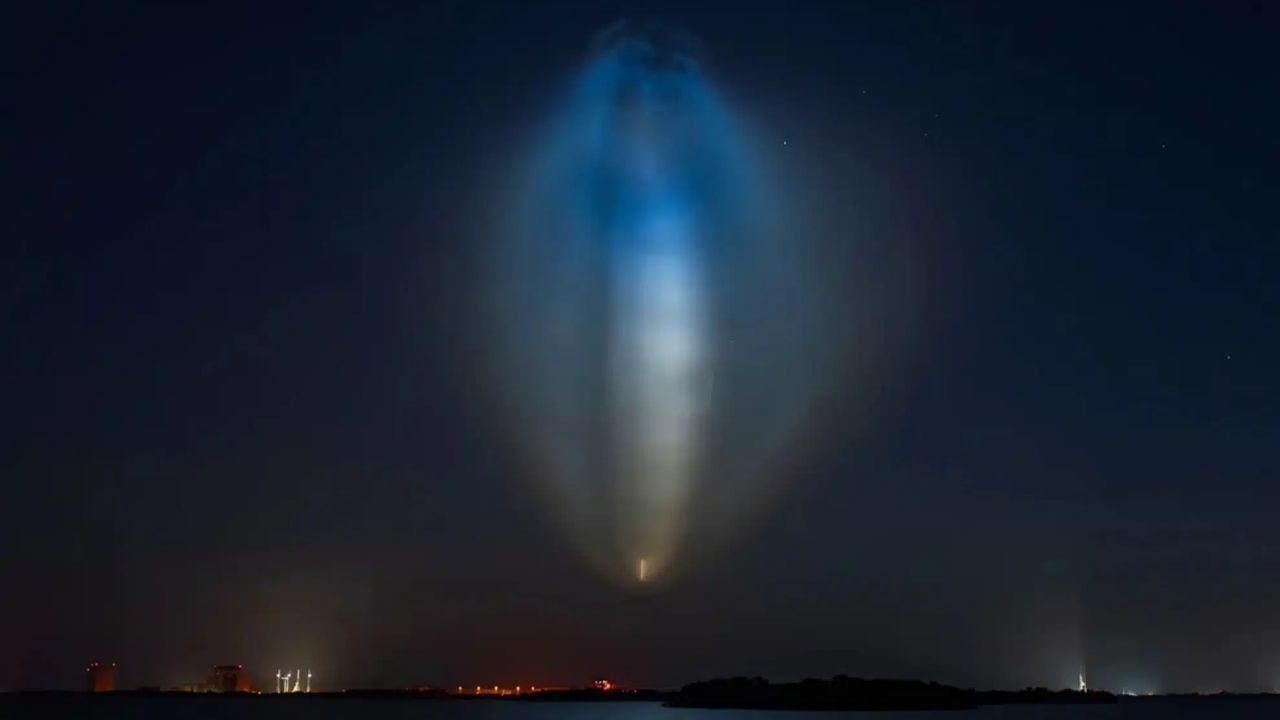
The SpaceX launch caught attention because it did not just produce the usual rocket trail. As the Falcon 9 ascended through the atmosphere, the gases released by the engines spread in the rarefied air and formed a wide, bright, and translucent structure, resembling a jellyfish.
-
Spain places 9 bison in a fenced area of 400 hectares to test a new barrier against fire, but scientists warn that, although they control the underbrush, there is no evidence that the animals can reduce large fires.

-
YOU LOOK AT SUGAR EVERY DAY, BUT THERE IS A BAN ON IT THAT ALMOST NO ONE KNOWS; UNDERSTAND WHY MAKING IT AT HOME IS NOT ALLOWED IN BRAZIL

-
Advancement in science: a new plastic developed by researchers in the USA combines structural strength and thermal blocking in a single technology, opening new possibilities for construction, transportation, electronics, and sustainable solutions with a direct impact on global energy efficiency.
-
Arrival of the São Francisco River waters in Rio Grande do Norte marks a historic chapter, boosts development, and symbolizes social justice for millions of Northeasterners.




The image stood out for its bell shape and elongated trails, which resembled tentacles in the night sky. What seemed like a mysterious scene to many observers was, in practice, a known physical effect, caused by the interaction between exhaust gases, high altitude, and solar illumination.
Colorful plume appeared because of the Sun’s light
A colorful plume appeared because the rocket’s exhaust gases expanded in a very high region of the atmosphere. At this altitude, the air is thinner, allowing the material released by the Falcon 9 to spread more widely than it would near the ground.
Even with the night already formed for those observing from Earth, the highest part of the trajectory was still receiving sunlight. When the Sun illuminated the expanding plume, the gases reflected and scattered the light, creating shades of blue, white, pink, and orange in the sky.
Phenomenon depends on a rare combination of conditions
Rocket launches happen frequently, but not all produce this type of visual spectacle. For the so-called space jellyfish to appear, the rocket needs to reach a great altitude during twilight, when the ground is already dark, but the upper region of the atmosphere remains illuminated.
This time window is narrow and depends on the position of the Sun, the rocket’s trajectory, atmospheric conditions, and the launch time. Therefore, a flight considered routine by SpaceX can turn into a rare phenomenon for those watching from the ground.
Observers mistake the trail for something unusual
The appearance of the plume can confuse those who do not follow space launches. Due to its size, brightness, and unusual shape, many people associate the phenomenon with rare meteorological events, unknown objects, or even scenes too artificial to seem real.
In fact, the explanation lies in atmospheric physics. The rocket releases gases at high speed, these gases expand in the thin air, and sunlight creates the visual effect. The result may seem strange, but it does not indicate failure, explosion, or an event out of the mission’s control.
Plume changes shape as it spreads
Unlike a star, planet, or fixed object in the sky, the Falcon 9’s plume quickly changes appearance. As high-altitude winds act on the gases, the trail elongates, opens up, and gradually loses definition.
This transformation makes the phenomenon even more striking for photographers and observers. The initial bright core can spread into translucent layers, creating a dynamic image for a few minutes before disappearing. Each launch produces a different visual signature, depending on the route, altitude, and lighting.
Space engineering becomes atmospheric spectacle
The case shows how a technical mission can generate a visual effect capable of reaching people who weren’t even following the launch. SpaceX conducts frequent missions with the Falcon 9, but some of them end up gaining attention precisely because of the images created in the atmosphere.
This type of scene connects engineering and nature in the same event. The rocket fulfills its orbital mission, while the atmosphere transforms the passage of gases into a luminous spectacle. The public sees beauty, but behind the image, there is a precise combination of propulsion, altitude, and sunlight.
Falcon 9 continues as a recurring vehicle for SpaceX
The Falcon 9 is used by SpaceX in commercial, governmental, and scientific missions. The rocket has become known for the reuse of boosters and the high frequency of launches, transporting payloads, satellites, and equipment to different orbits.
Although the main focus of these missions is operational, launches carried out at dawn or dusk have a higher chance of creating striking visual effects. When the timing coincides with ideal lighting, a common mission can generate images that quickly circulate on social media.
Photos and videos increase curiosity about space
Images of bright plumes tend to spread easily because they spark immediate curiosity. The unusual shape, strong colors, and scale of the cloud make many people stop to try to understand what appeared in the sky.
This interest can bring the public closer to space science. People who do not follow SpaceX launches end up discovering, through photos and videos, how atmospheric physics affects the appearance of flights. The visual impact becomes a gateway to understanding rockets, orbits, and solar illumination.
Night sky shows that space routine still surprises
The launch showed that an operation considered normal for SpaceX can turn into a rare spectacle for those observing from Earth. The combination of Falcon 9, exhaust plume, high altitude, and sunlight created an image that seemed more artistic than technical.
The scene also reinforces how space phenomena can be misinterpreted when they appear unexpectedly in the sky. Would you think it was just the trail of a rocket or would you also be in doubt upon seeing a giant “jellyfish” glowing in the night sky? Share your opinion.