






 Portuguese
  Spanish


Indicator Shows Recovery After Historic Decline
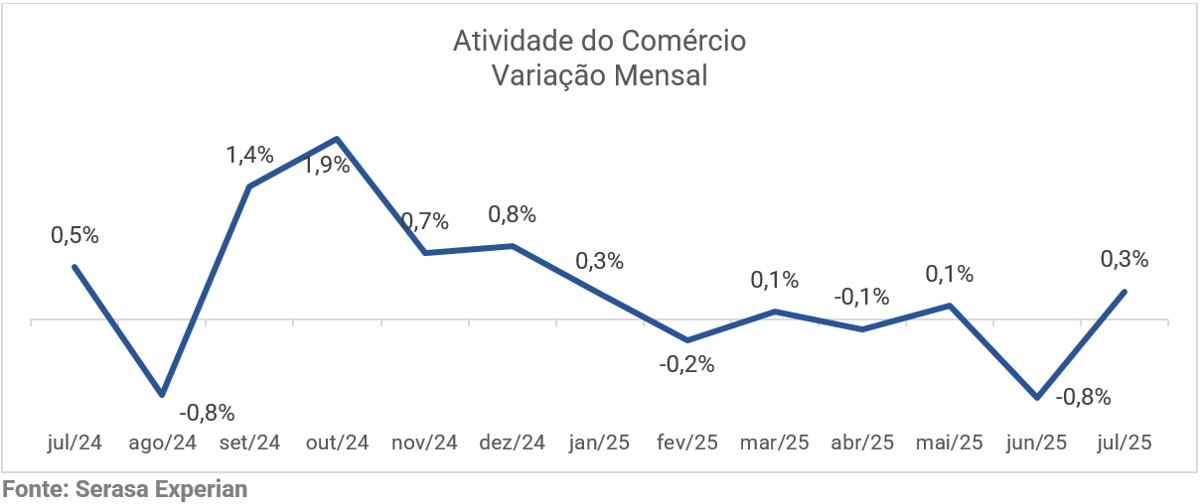
The Brazilian retail sector recorded growth in July 2025, according to Serasa Experian.
The index indicated an increase of 0.3% compared to June.
The movement halted the previous decline and revealed signs of recovery in specific sectors.
Recovery Driven by Vehicles and Supermarkets
According to data released on August 21, 2025, the Vehicles, Motorcycles, and Parts sector recorded an increase of 1.2%.
Supermarkets, Hypermarkets, Food and Beverages rose by 0.6%.
However, segments like Fuels and Lubricants experienced a decline of 0.4%.
Meanwhile, Textiles, Clothing, Footwear, and Accessories fell by 1.6%.
Camila Abdelmalack, an economist at Serasa Experian, highlighted that high interest rates still influence the scenario.
This factor complicates credit and affects sectors reliant on financing.
-
Controversial 6-day Workweek Elimination in Brazil Faces Economic Criticism Over Productivity Claims

-
Itaú to Refund Customers After 14 Years of Unauthorized Credit Card Charges; Agreement Includes No Interest or Adjustments, Deadline by 2028, with Potential Impact of Up to $6.5 Billion

-
Brazilian Company Grows from Bartering Soap for Food to Producing 30 Million Units Monthly, Challenges Global Giants with $100 Million Revenue and Expands into Premium Cosmetics
-
Petrobras and Engeko’s New Investment Plan Promises Billions and Thousands of Jobs, Capturing Market Attention


- Vehicles, Motorcycles, and Parts: +1.2%
- Supermarkets, Hypermarkets, Food and Beverages: +0.6%
- Fuels and Lubricants: -0.4%
- Textiles, Clothing, Footwear, and Accessories: -1.6%
Annual Comparison Confirms Consistent Advance
In the comparison between July 2024 and July 2025, physical retail activity rose by 3.4%.
The highlight was for Textiles, Clothing, Footwear, and Accessories, which grew by 5.3%.
This result represented the second best performance of the year.
Furthermore, all segments showed positive results:
- Construction Materials: +5.0%
- Fuels and Lubricants: +4.3%
- Furniture, Appliances, and Electronics: +4.2%
- Supermarkets, Hypermarkets, Food and Beverages: +2.6%
- Vehicles, Motorcycles, and Parts: +2.5%
Consumption Shows Signs of Deceleration
The analysis by Serasa Experian reinforces that, although the results are positive, there are indications of gradual deceleration.
In the second half of 2025, a slower growth rate is expected.
This scenario is likely to impact sectors more dependent on credit.
Nonetheless, basic consumption continues to be supported by a strong labor market.
Additionally, real wage gains maintain retail stability.
This combination ensures balance, even in the face of high interest pressure.
Methodology and Relevance of the Data
The Serasa Experian Retail Activity Indicator is calculated based on credit inquiries made across various sectors of the national retail.
A total of about 6,000 commercial establishments participate in the statistical base, ensuring broad representation across six different retail segments.
Moreover, all information is statistically processed, following a methodology compatible with the Monthly Retail Survey of IBGE.
Serasa Experian was founded in 1968, reinforcing its tradition in the data and credit analysis market.
Since 2007, the company has been part of the international group Experian, expanding its reach and technology.
Today, it is considered the largest datatech in Brazil, conducting over 6.5 million inquiries per day in its system.
Thus, the numbers presented highlight Serasa Experian’s role as a national reference in economic trends.
Similarly, the company stands out for its in-depth analysis of consumption behavior in the country, providing strategic data for various sectors.





Be the first to react!