






 Portuguese
  Spanish


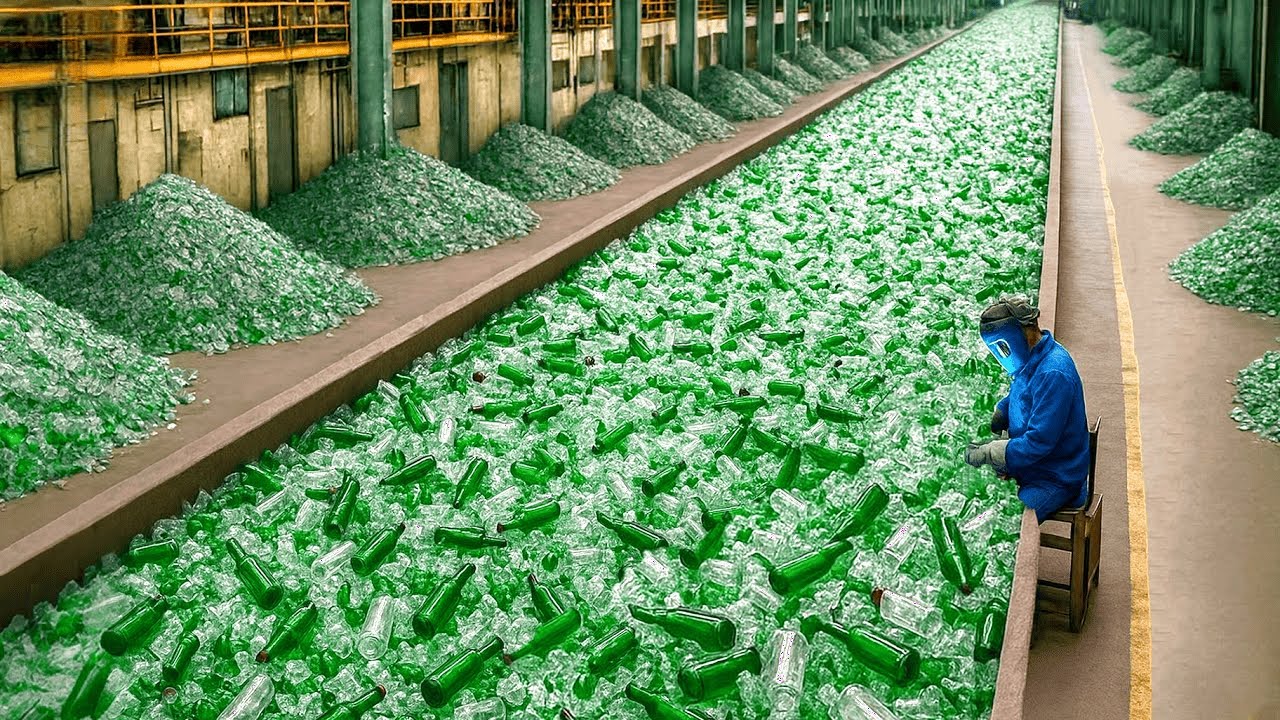


From Collection to Melting at 1,250 °C, Understand How Glass Is Recycled Indefinitely, Saving Up to 40% Energy, and Returning to Shelves as New Bottles.
In glass recycling industrial facilities spread across Europe and Brazil, a standardized and highly automated process transforms tens of millions of tons of broken bottles into new containers every year. According to data consolidated by entities such as FEVE (European Container Glass Federation) and ABIVIDRO (Brazilian Glass Industry Association), the world recycles about 130 million tons of glass per year, utilizing a material that can be reprocessed indefinitely without loss of quality. These numbers are updated annually by sector reports published between 2022 and 2024.
A Global Waste Problem That Glass Can Solve
Humanity produces today over 2 billion tons of solid waste per year, according to data from the World Bank.
Glass accounts for approximately 20% of this volume, especially in beverage and food packaging. The challenge is that a single discarded bottle can last over 1 million years in a landfill without decomposing.
-
Couple buys 1905 colonial house, plans to tear down walls to unite three rooms, but finds hidden service staircase and rethinks the entire renovation to preserve details that have survived for over a century.

-
Couple receives a quote of $50,000 to install a built-in refrigerator, decides to do the work themselves, spends $6,000, and claims to have saved over $100,000 by renovating the house.
-
At 77 years old, an elderly woman lives alone in an almost ghost village in the French Alps, at an altitude of 1,000 meters, where there is a town hall, a mayor, and an entrance sign, but only she lives there every day in a place destroyed by a landslide and almost erased from the map.

-
India excavates a 28 km artificial lake in the Thar Desert, lines the bottom with a giant plastic sheet to prevent 1.41 million tons of water from disappearing into the sand, and attempts to supply 5 million people throughout the year.


This is where glass stands out. Unlike plastic or paper, it does not lose chemical or structural properties when recycled. This allows the same material to pass through the industrial cycle countless times, reducing sand, limestone extraction, and energy consumption.
Collection Begins Before the Factory
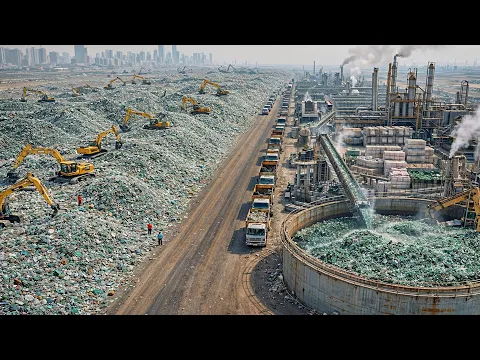

The industrial process only works because there is a constant flow of used bottles. In countries like Germany, the Netherlands, and Nordic countries, systems of deposit return systems have been operating since the 20th century. Machines installed in supermarkets and urban areas receive empty bottles, identify the material, and refund consumers between 10 and 20 cents euro per unit, according to data from the European Commission.
This system reduces glass contamination and ensures cleaner raw materials for factories. In Brazil, although the model is less widespread, cooperatives and reverse logistics companies collect thousands of tons per month, mainly in metropolitan areas.
From Truck to Industrial Yard
After collection, specialized trucks transport the bottles to the plants. A standard truck can carry 20 to 30 thousand bottles per trip, equivalent to 10 to 12 tons of glass. Upon arrival at the plant, the load is unloaded into large yards, forming mountains of clear, green, and brown glass, the three most used colors in the beverage industry.
These piles are not waste. They are strategic stockpiles of raw material, monitored to maintain a continuous flow of production.
Initial Sorting and Heavy Cleaning
The glass then proceeds to the heart of the plant. Loaders feed conveyors that take the shards to vibrating screens, responsible for removing dust, sand, and very fine particles. Next, workers manually remove larger contaminants, such as plastics and papers.
Metal caps are eliminated using high-power magnetic separators, capable of removing almost all the steel present. By the end of this stage, the material already reaches about 80% purity, a level sufficient to advance to fine processing.
Grinding: Transforming Bottles into “Glass Sand”
The clean glass enters hammer mills, industrial machines that break the shards until achieving controlled granularity. Large fragments automatically return to the mill, ensuring total uniformity.
The result is glass cullet, a granular material resembling artificial sand. This form is crucial because it melts faster, reducing time and energy consumption in the furnaces. Studies by the Glass Packaging Institute indicate energy savings of up to 40% energy when using recycled cullet instead of virgin raw materials.
Optical Sorting by Color
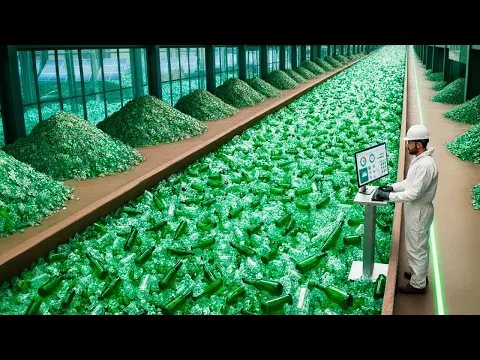
Before becoming new glass, the cullet must be perfectly sorted by color. Optical systems with laser sensors and high-speed cameras analyze tens of thousands of fragments per minute. Compressed air jets divert each piece to the correct flow: clear, green, or amber.
This precision is vital. A small mix of colors compromises the quality of the final product, making the glass unusable for beverages and food.
The Recipe for New Glass
The cullet does not enter the furnace alone. It is mixed with basic ingredients: silica sand, sodium carbonate, and limestone. Depending on the formula, the cullet can represent 20% to 70% of the total mixture. Each increase of 10% in cullet usage reduces energy consumption by about 3% and decreases CO₂ emissions, according to the FEVE.
The mixture goes to gas furnaces that operate at around 1,250 degrees Celsius. The material remains molten for up to 24 hours, the time needed to eliminate bubbles and gases. The resulting liquid glass is homogeneous, dense, and extremely pure.
High-Precision Molding
The molten glass is shaped by processes such as blow-blowing, widely used for bottles. Droplets of glass at around 1,000 °C fall into steel molds designed in CAD software. Compressed air jets form the interior of the bottle with millimeter precision.
Each line can produce hundreds of thousands of units per day, all practically identical.
After molding, the bottles pass through controlled cooling tunnels to avoid internal cracks. Cameras and sensors check for bubbles, cracks, and dimensions. Approved pieces are palletized by robots and packaged for transport.
From Oven to Shelf
Before receiving beverages, the bottles are cleaned with hot water and steam, sterilized, and checked again. Only then do they proceed to bottling lines of companies such as Coca-Cola, Ambev and other multinational beverage sector companies, following global quality standards.
In the end, the bottle that returns to the shelves may have been recycled dozens of times over decades. That’s why glass is considered one of the most sustainable materials ever produced by modern industry.
In a world that generates billions of tons of waste every year, glass demonstrates that technology, logistics, and engineering can transform practically eternal waste into a continuous, efficient, and economically viable production cycle.





Muito bom isso
Para o meio ambiente então é um luxo
So precisa de mais pontos de coleta de vidros
Onde moro não tem
Gostaria de saber uma empresa perto onde recolhe o vidro