






 Portuguese
  Spanish


The Journey of National Engineering That Overcame Monumental Geological Challenges to Extract a Submarine Treasure and Consolidate the Country as One of the Giants of Global Energy.
The discovery of vast reserves of oil and gas beneath a salt layer 2,000 meters thick triggered a technological and economic revolution in Brazil. Overcoming unprecedented engineering barriers up to 7 kilometers from the sea surface, the country not only achieved self-sufficiency but established itself as a true global oil power, in a saga of innovation, ambition, and complex challenges.
The Origin of Oil Beneath the Salt Layer
The story of the pre-salt began more than 100 million years ago, with the separation of the South American and African continents. This geological event formed large depressions that became shallow lakes and seas. In these environments, an immense amount of organic matter was deposited on the seabed.
Over time, seawater flooded these basins. Intense evaporation formed a colossal layer of salt, up to 2 kilometers thick, which covered all the organic matter. This salt layer acted as a perfect geological seal, trapping hydrocarbons. Under extreme pressure and heat, the organic matter transformed into oil and high-quality gas.
-
Woman Claims to Have Spotted a Technical Pattern in Recent FIFA Tournaments, Predicts Possible World Cup Winner

-
Chevrolet Offers Chance to Win a 2026 Sonic RS for Free via WhatsApp
-
Earthquake vs. Tsunami: Which Causes More Destruction and Why One Can Be Even More Dangerous
-
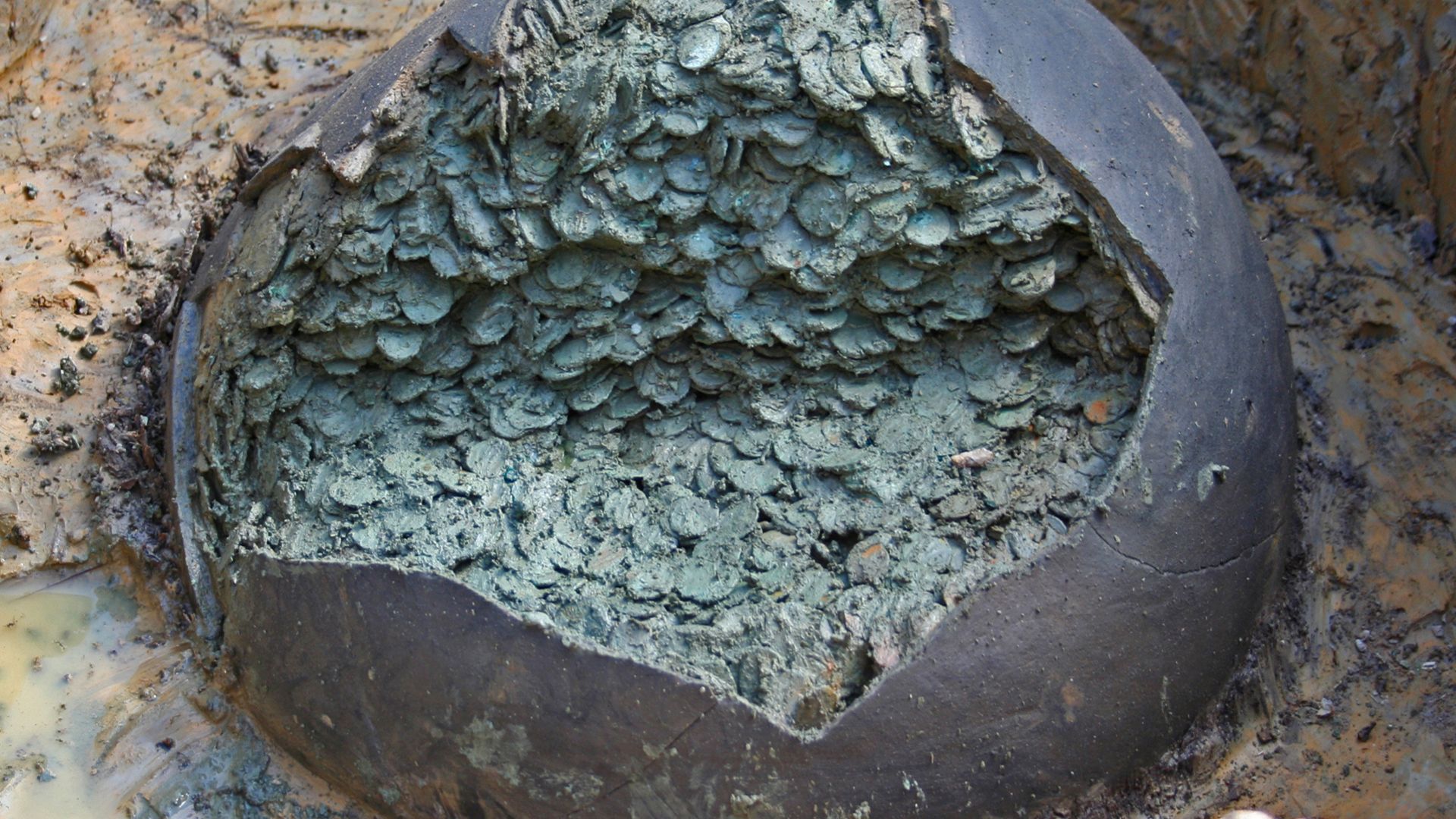
Hospital Cook Discovers 1,700-Year-Old Pot of 52,503 Roman Coins Using Metal Detector in Field


Salt, therefore, is both a blessing and the greatest challenge of the pre-salt. It allowed the formation of this treasure, but its plastic nature and hardness make drilling an extraordinarily complex task. The oil found is light, with low sulfur content, making it more valuable in the market and cheaper to refine, generating high-value derivatives like diesel and gasoline.
Overcoming Extreme Challenges on the Seafloor
Exploring the pre-salt has taken offshore engineering to a new level. Operations occur in ultra-deep waters, over 2,200 meters deep and up to 300 kilometers from the coast, creating a logistical nightmare. The main obstacle, however, is the 2,000-meter salt layer. Under pressure, the salt flows like a viscous mass, threatening to crush the well during drilling.
Moreover, the reservoirs present high pressure and temperature conditions, requiring special metal alloys. The associated natural gas is rich in CO₂, a highly corrosive contaminant. To overcome these challenges, an arsenal of innovations has been created. Advanced seismic algorithms allowed us to “see” through the salt, reducing risks.
The backbone of production is the floating platforms (FPSOs), true industrial plants offshore. Perhaps the most emblematic innovation is the management of CO₂. Instead of releasing it, the technology separates it and re-injects it into the reservoir. This prevents emissions of greenhouse gases and helps to “push” more oil into the producing wells, transforming an environmental problem into an economic advantage.
The Rise of Brazil in the Global Energy Scenario
Pre-salt exploration reconfigured the Brazilian economy. Production soared exponentially, transforming Brazil from a country seeking self-sufficiency to one of the largest producers and exporters of oil in the world. By March 2025, pre-salt production already represented 79.8% of the national total.
This volume directly impacted the Gross Domestic Product (GDP). In 2023, federal revenues associated with the oil and gas sector totaled 1.65% of GDP, with projections for growth. The flow of resources strengthened the balance of payments and the energy security of the country, consolidating its position as an oil power. The demand for specialized services also boosted the generation of qualified jobs and the development of a sophisticated national supply industry.
Brazil’s Strategic Bet in a World of Decarbonization
In a scenario of global energy transition, Brazil adopts a dual strategy: to consolidate itself as a leader in renewable energies while maximizing the production of its pre-salt oil. The rationale is based on the high quality and lower carbon intensity of Brazilian oil. Thanks to CO₂ reinjection technology, production emits less greenhouse gases per barrel than the global average.
The thesis is that, with the gradual decline in global demand, cheaper and less polluting oils, like those from the pre-salt, will be the “last barrels standing”. The goal is to use the massive revenues from oil exports to finance Brazil’s energy transition, investing in wind, solar, and green hydrogen energy. It’s a bold bet to reverse the “resource curse,” using a fossil asset as a bridge to become a green energy superpower.


Só espero que o Brasil não não caia na **** do Petróleo, como Venezuela, Iram, Iraque..etc. ou seja, usam o dinheiro para uma minoria e o povo é usado para apoia-los.