






 Portuguese
  Spanish


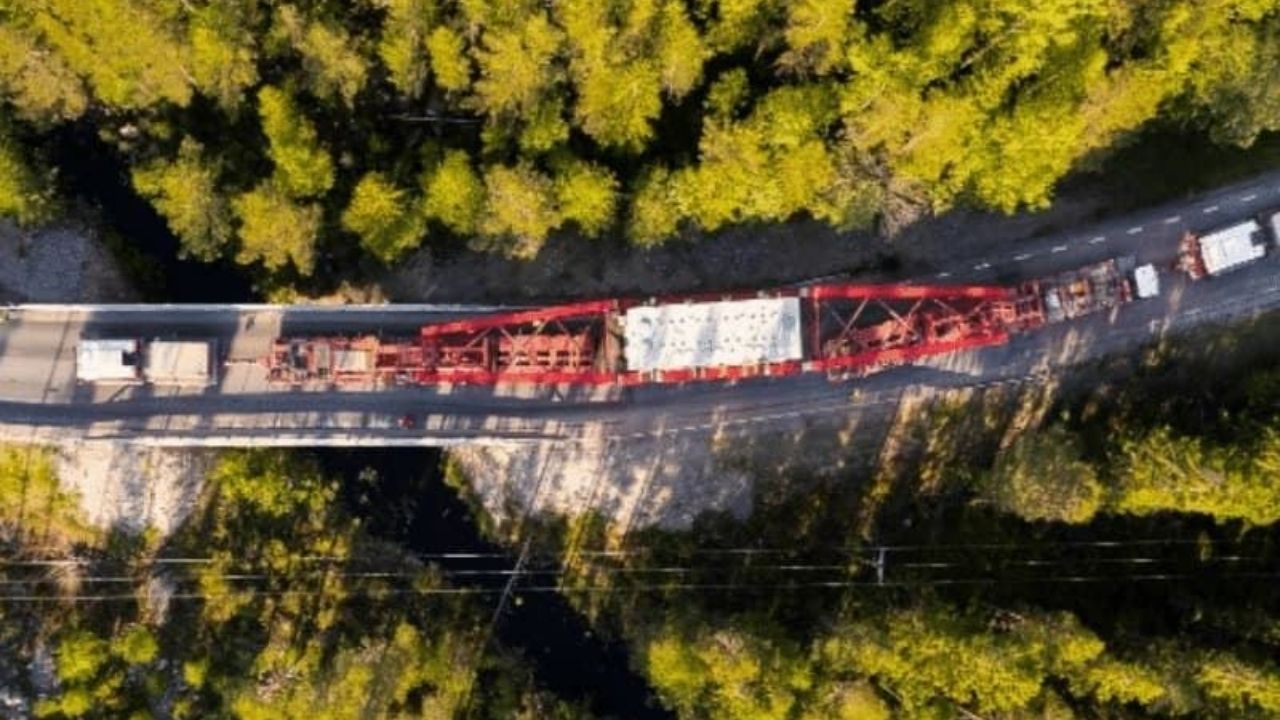


A 390-ton and 750 MVA transformer was transported 270 kilometers in Sweden with special trucks from Mammoet, railway crossings, reinforced bridges, and adapted sections to serve one of the largest wind power hubs in the country, in Ljusdal, without delaying the installation planned in the Swedish national renewable energy transition project.
The 390-ton transformer transported by Mammoet in Sweden required a rare operation even by special load standards. The piece, with a capacity of 750 MVA, needed to traverse a total route of 270 kilometers to reach Tovåsen, in the municipality of Ljusdal, where it would serve a large wind energy hub.
The company responsible Mammoet states that this was the heaviest road transport ever conducted on Swedish roads. To make the movement possible, the operation involved special trucks, route studies, bridge reinforcement, removal of 400 mm of road under some passages, railway crossings, and journeys conducted only at night.
A 390-ton load to deliver energy to a remote wind power hub
The transport of the transformer was part of an essential stage for Sweden’s energy infrastructure. The equipment would be used in a project linked to the expansion of wind energy, in a remote and mountainous region of the country, where road access already represents a natural challenge.
-
New Smart Radar Begins Issuing Fines to Solo Drivers in Carpool Lanes, Uses Cameras to Count Occupants, Changing Traffic Enforcement Rules on Busy European Roads

-
Why can the crane operator only obey the correct signalman on the construction site: among dozens of workers, a hand raised by the wrong person can confuse the maneuver and turn a load of tons into an immediate risk.
-
What changes with the new public transportation rules that can reduce pressure on fares and pave the way for zero fare in Brazil?
-
Argentina confirms Belgian giant to lead strategic Paraná River waterway and promises to reduce logistical costs on one of South America’s most important routes


Ellevio, the energy company involved in the project, needed to deliver the equipment to Ljusdal, an area identified as the future site of one of the largest wind energy clusters in the country. Without the transformer, the necessary infrastructure to connect wind generation to the grid would be incomplete.
The challenge was not only in the weight of the load. The equipment had dimensions and mass sufficient to require integrated planning from the factory to the final foundation. Therefore, Mammoet worked together with Martin Bencher to organize the land transport, the maritime stage, and the final placement of the equipment.
The operation began at the Hitachi Energy unit in Ludvika. From there, the transformer traveled 125 kilometers by road over two nights to Köping, where Martin Bencher took over the maritime stage to Iggesund. After that, there were 145 kilometers left by land, precisely the most difficult stretch.
A 270-kilometer route needed to be studied before the journey

Before any truck set out, the team needed to understand if Swedish roads would support such an extreme load. The source points out that most of the country’s roads are not normally designed for such heavy transports, making route studies indispensable.
Mammoet used its own route survey tool to identify obstacles, weak points, and sections that would require intervention. The goal was to know in advance where the road needed to be reinforced, cleared, lowered, or adjusted to allow the safe passage of the transformer.
This preparation included technical assessments of road and bridge strength, carried out in partnership with Martin Bencher. In several places, studies showed that reinforcements would be necessary to better distribute the weight and avoid structural risks during the crossing.
In other sections, the problem was height. Under some bridges, it was necessary to remove 400 mm of road to create enough space for the passage of the assembly. This type of adaptation shows that the operation was not just transport: it was engineering applied in motion.
Bridges, railways, and permits created a precision operation
The path to Tovåsen included sensitive passages. The route crossed railway lines on four occasions, which required strict windows for the assembly to cross without interfering with rail traffic. Each crossing needed to be authorized and synchronized precisely.
Additionally, five smaller bridges required the use of eight additional axle lines under the transformer. The measure served to better spread the load and reduce the concentrated pressure on more sensitive structures along the way.
The permits also played a decisive role. An operation of this magnitude depends on permissions from local authorities, police, and infrastructure agencies. Without institutional coordination, a 390-ton load cannot simply occupy roads, intersections, and railways.
The journey could only take place at night, which increased logistical complexity. After the maritime stage, another six nights were needed to complete the final stretch to Tovåsen. Nighttime movement reduced traffic interference but required greater security control and planning.
Special trucks and a 400-ton structure moved the load

To move the transformer, Mammoet assembled specialized equipment from its European inventory. The operation was pulled by a main mechanical horse and supported by two 700 hp Trojan trucks, developed by the company itself to transport extreme loads.
According to the source, these trucks are capable of pulling 500 tons on a 7% incline. This performance was important because part of the route crossed remote and mountainous terrain, where the weight of the load and road conditions increased the degree of difficulty.
The transformer was transported on an AL500 structure, with a capacity of 400 tons. This beam system, unique to Mammoet, was designed to offer greater steering capacity, reducing the need to remove urban furniture and obstacles along the route.
The structure was supported on two 16-axle trailers. At specific points, especially on smaller bridges, another eight axle lines were added. With each section change, the set needed to balance weight, stability, height, width, and turning radius.
The final stretch was the most difficult part of the operation
Although the total route added up to 270 kilometers, the final stretch of 145 kilometers, between Iggesund and Tovåsen, was considered the most challenging. The region was less developed, with smaller roads and more limited conditions for an exceptionally sized load.
It was in this part that the railway crossings and bridges that required additional axles were concentrated. The operation needed to advance within specific windows, respecting traffic, safety, and infrastructure limits.
The transformer arrived at the destination as scheduled. After the journey, a second specialized Mammoet team took over the jacking and skidding stage, a process used to lift, laterally move, and position the piece on its foundation.
This final stage was as critical as the journey. Bringing the load to the site was not enough; it had to be placed exactly where it would be installed and commissioned. The precision in positioning allowed the subsequent stages of the wind farm to continue without delay.
Operation shows little-seen behind-the-scenes of the energy transition


Large renewable energy projects are often remembered for turbines, towers, and wind blades. But Sweden’s case shows that the energy transition also depends on heavy equipment, prepared routes, specialized logistics, and works invisible to most of the population.
The 390-ton transformer was a critical piece for the network infrastructure. Without such equipment, the energy generated by wind farms does not efficiently reach the electrical system. Therefore, transporting the load was a fundamental part of the project’s progress.
The operation also reveals a little-discussed point: regions with high wind potential are not always close to easy roads, accessible ports, or ready infrastructure. Often, bringing equipment to remote areas requires adaptations as complex as building the park itself.
In this case, logistics engineering was as important as energy engineering. The load only reached its destination because there was route study, structural reinforcement, dedicated equipment, and cooperation between Mammoet, Martin Bencher, Hitachi Energy, and Ellevio.
The heaviest transport in Sweden became an engineering milestone
Mammoet classified the operation as the heaviest road transport ever carried out on Swedish roads. The feat combines three high-impact elements: record weight, long distance, and a route with unusual technical barriers.
The number of 270 kilometers draws attention, but the real difficulty was in the details. Bridges needed to be evaluated and reinforced, roads were lowered, railway crossings were coordinated, and nighttime transport required continuous operation control.
The transformer arrived on site within the deadline, allowing installation and commissioning work to proceed. This result reinforces the importance of prior planning in projects where any delay can affect energy works, industrial schedules, and associated investments.
In the end, the journey of the load shows that the expansion of wind energy does not depend solely on the wind. It also requires prepared roads, special equipment, and logistical decisions capable of moving giant pieces through regions where almost nothing was designed for this type of transport.
And you, do you think operations like this show the true scale of the energy transition, or does the public still underestimate the engineering needed to bring renewable energy to the grid? Share your opinion.







This is a very tough engineer feat as described in the commentary.
The project involved the pulling of resources and coordination of expertise from other engineering discipline. Such as structural engineers, transportation engineers, extra heavy duty riggers, heavy duty cargo drivers,soil testing expertise etc. Infact all engineering discipline are needed to undertake such a daunting feat. Don’t underestimate any engineering discipline.