Portuguese
  Spanish


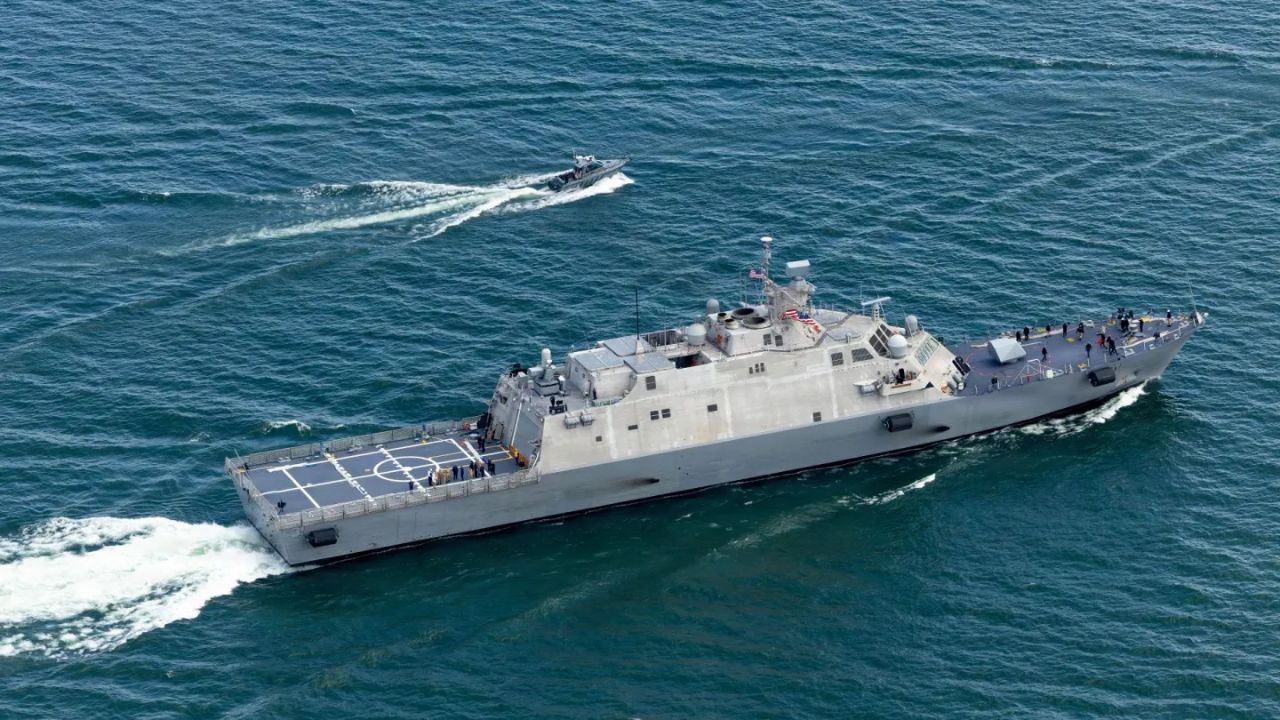

The USS Cleveland was commissioned on May 16, 2026, in Ohio. It is the last ship of the LCS Freedom class and marks a new chapter for the U.S. Navy.
With a ceremony held on May 16, 2026 in the city of Cleveland, Ohio, the United States Navy officially incorporated into its fleet the USS Cleveland (LCS-31) — the 16th and final littoral combat ship of the Freedom variant to be delivered to active service. The event marked both the ship’s entry into operation and the closure of an entire production line, built over years by Lockheed Martin in partnership with Fincantieri Marinette Marine, in the state of Wisconsin. From now on, the USS Cleveland will have its home port at Naval Station Mayport, in Florida.
A historic milestone for the state of Ohio
In addition to ending the production of the Freedom class, the ceremony had a special significance for Ohio. According to the USS Cleveland Legacy Foundation and the local press, it was the first time in 250 years that a U.S. Navy warship was commissioned in the state.
The USS Cleveland is the fourth U.S. Navy ship to bear the city’s name. The ship’s sponsor, Robyn Modly — a native of Cleveland and wife of former Navy Secretary Thomas Modly — was present at the celebration. In the week leading up to the commissioning, the crew participated in community activities in the city, strengthening the bond between the sailors and the honored community.
-
U.S. Military Intervention Risk in Brazil Raises Alarm, Highlights National Sovereignty Amid Tensions Over Washington’s Terrorist Designation of PCC and Comando Vermelho

-
Brazilian Air Force’s Sole KC-30 Aircraft Completes Strategic Mission to Spain for 105mm Anti-Tank Ammunition for Leopard 1A5 Tanks

-
Brazilian Air Force Seeks to Acquire More Gripen Fighter Jets
-
U.S. Air Force Launches Air-to-Air Missile Project with Range of Up to 1,850 km for Indo-Pacific Operations




Acting Navy Secretary Hung Cao spoke during the event and dedicated the moment to the crew: “Today we celebrate the sailors who bring this ship to life. To the officers and crew of the USS Cleveland, today is your day”, he stated, according to an official U.S. Navy statement.

What are LCS class ships and why were they created
The Littoral Combat Ships — literally translated as “littoral combat ships” — were designed to operate in coastal regions, where larger vessels like destroyers and cruisers are not the most efficient choice. Fast, agile, and with modular architecture, they can be reconfigured for different types of missions.
The U.S. Navy itself defines them as small surface combatants capable of operating autonomously or integrated with a networked naval force, alongside larger vessels. Among the capabilities planned for these ships are:
- Patrol and presence in coastal zones
- Surface warfare
- Submarine mine countermeasures
- Maritime interdiction
- Support for operations in littoral environments
- Integration with unmanned systems
The Freedom variant — to which the USS Cleveland belongs — has a steel hull with an aluminum superstructure, combined diesel and gas turbine propulsion, and a speed exceeding 40 knots. For reference, 40 knots is approximately 74 km/h at sea.
Controversial program: criticisms, cuts, and adaptations
Despite the technical capabilities, the LCS program has accumulated criticisms over the years. The two variants developed — Freedom, by Lockheed Martin/Fincantieri, and Independence, by Austal USA — faced questions about reliability failures, high maintenance costs, successive changes in the employment concept, and limitations in onboard weaponry.
As a consequence, the U.S. Navy opted to prematurely retire some of the older ships of the class. On the other hand, part of the fleet received the Naval Strike Missile (NSM) anti-ship missile, which increased the offensive capability of these vessels in surface combat.

Even amidst the controversies, the LCS continues to have relevant functions: patrol, operations with drones and unmanned vehicles, and action in regions where the deployment of large combat ships is not justified.
USS Cleveland and the future of the American fleet
The commissioning of the LCS-31 occurs at a moment of strategic transition for the U.S. Navy. The end of the Freedom line symbolizes the end of a phase and opens space for the so-called Fleet of the Future — a concept that combines high-value ships, small combatants, unmanned platforms, and logistical means to sustain distributed operations in different theaters.
Among the programs that stand out in this new scenario are next-generation frigates, modernized destroyers, and future unmanned ships. The USS Cleveland, therefore, enters service as a symbol of an era that ends — and as an active part of a navy that is already projecting what comes next.
Source: Naval Power