Portuguese
  Spanish


Recent Studies Reveal Alarming Impacts of Anchoring in Sensitive Areas of the Antarctic Seafloor
Ship traffic in Antarctic waters has increased significantly in recent decades.
Since 1990, the region has received not only scientific research vessels but also tourist ships, fishing boats, and private yachts.
Although this constant presence has boosted the polar economy and contributed to the advancement of scientific knowledge, the environmental impacts resulting from maritime operations have raised serious concerns.
Primarily, the recurring practice of anchoring in ecologically fragile areas has been identified as one of the main threats to the region’s marine ecosystems.
According to the International Maritime Organization (IMO), the body responsible for regulating safety and environmental protection of global maritime transport, it is essential to implement specific standards to reduce these damages.
Existing guidelines, while important, have proved insufficient in light of the ongoing increase in traffic in the region.
Images Reveal Degradation of the Seafloor Caused by Anchors
During the austral summer of 2023, an international team of researchers captured unprecedented images of the effects of anchoring on the Antarctic seabed.
The material, released in January 2025, highlighted profound changes in the substrate and an alarming decline in local biodiversity.
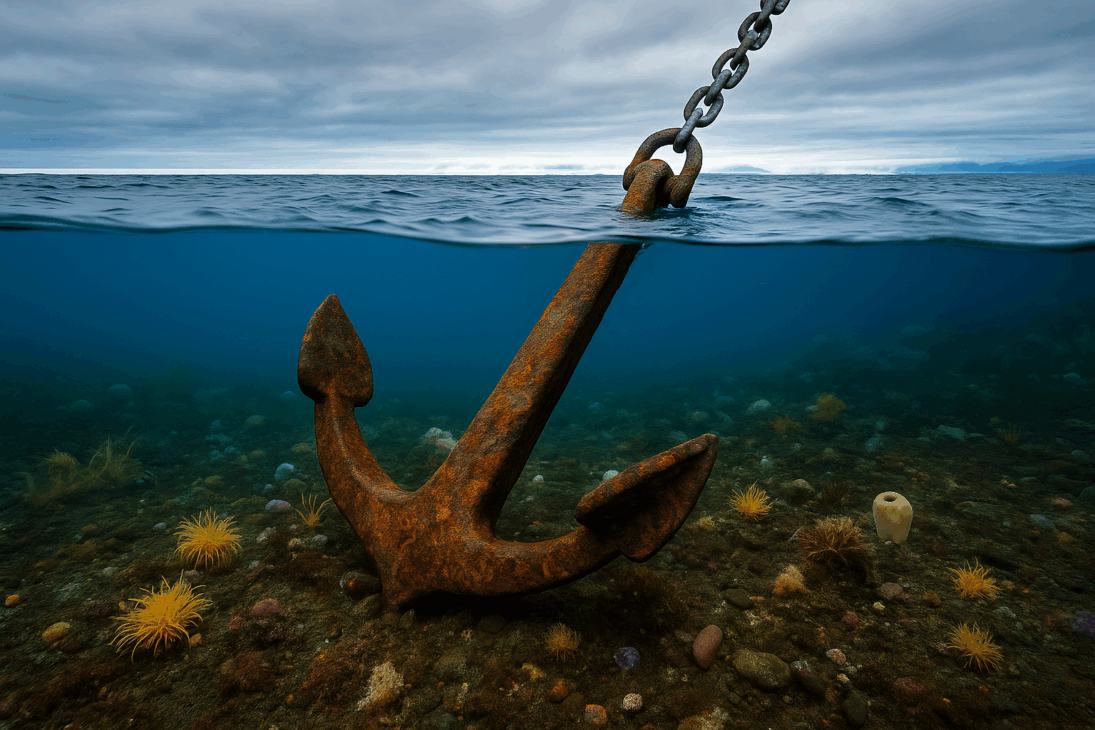
Anchors, when deployed and retrieved, create furrows and displace sediments, as well as crushing organisms such as corals and giant sponges.
-
Brazilian Port Expands Ship Capacity to 9.5 Meters, Boosting Cargo Transport and Reducing Logistics Costs

-
Three Chinese companies manufacture more than 96% of the world’s dry cargo containers and 100% of refrigerated ones, in a dominance built over 40 years that has made it almost impossible for the West to compete in this market.

-
The Panama Canal stores water in Gatún and Alhajuela lakes to maintain 38 daily crossings and prevent a drought linked to El Niño from once again stalling ships, raising freight rates, and putting pressure on global supply chains as occurred in 2023 and 2024.
-
While the US Navy still relied for decades on the subsonic Harpoon and Tomahawk missiles for naval combat, the US Air Force reactivated the AGM-183A ARRW program on May 12, 2026, in an anti-ship version capable of making a Nimitz-class aircraft carrier disappear in minutes.


Furthermore, the holding chains of the anchors widen the impact area as they are dragged laterally, which destroys essential marine habitats.
Such damage directly affects slow-growing species with a geographic distribution restricted to Antarctica.
Among them, sponge colonies stand out, which, in addition to serving as natural water filters, provide shelter for numerous microorganisms and fish.
Slow Growth and Fragility Hinder Ecosystem Regeneration
Unlike tropical regions, the marine ecosystem of Antarctica presents extreme conditions. Low temperatures, nutrient scarcity, and the presence of sessile organisms, which cannot move, make the recovery of degraded areas extremely slow.
Species such as Antarctic sponges and corals can live for thousands of years, but their development occurs very gradually.
Therefore, areas impacted by anchors may take decades to regenerate or, in many cases, may never fully recover.
Biological vulnerability, combined with a low growth rate, exacerbates the risks of environmental imbalance.
Recovery also depends on factors such as the type of sediment and the intensity of the disturbance caused by anchoring.
Preventive Measures and International Cooperation Are Essential
In light of the severity of the situation, experts have proposed urgent actions.
Among the alternatives are the establishment of exclusion zones, where anchoring would be strictly prohibited, and the use of technologies such as floating anchoring systems that prevent direct contact with the seafloor.
Other measures under discussion include:
- Mapping vulnerable regions to guide navigation;
- Continuous monitoring of vessels and ecological impacts;
- Development of specific international rules for Antarctic traffic;
- Strengthening cooperation among countries signatory to the Antarctic Treaty, environmental NGOs, and regulatory bodies such as the IMO.
These strategies, however, require political will, financial resources, and, above all, international commitment to polar marine conservation.
The transparent sharing of scientific data and continuous review of regulations are also fundamental steps.
Madrid Protocol and New Studies Reinforce the Urgency of Preservation
The Madrid Protocol, which came into effect in 1998, already establishes strict environmental protection standards for Antarctica.
It prohibits any mineral exploitation (except for scientific purposes), requires environmental impact assessments for all activities including tourism, and defines Antarctica as a natural reserve dedicated to peace and science.
The treaty remains in effect until at least 2048, binding all signatory nations.
However, despite these legal advances, studies published in February 2025 reaffirm that unregulated anchoring remains one of the most destructive factors in the current polar maritime scenario.
Recent audiovisual documentation, captured by underwater robots and drones, proves that existing protocols have not been sufficient to curb ongoing degradation.
In light of this, the balance between scientific exploration, tourism, and environmental preservation becomes one of the greatest geopolitical challenges of our time.
The future of Antarctic marine biodiversity will depend on coordinated, evidence-based actions with decisions that take into account both environmental urgency and the strategic importance of the region for the planet.