






 Portuguese
  Spanish


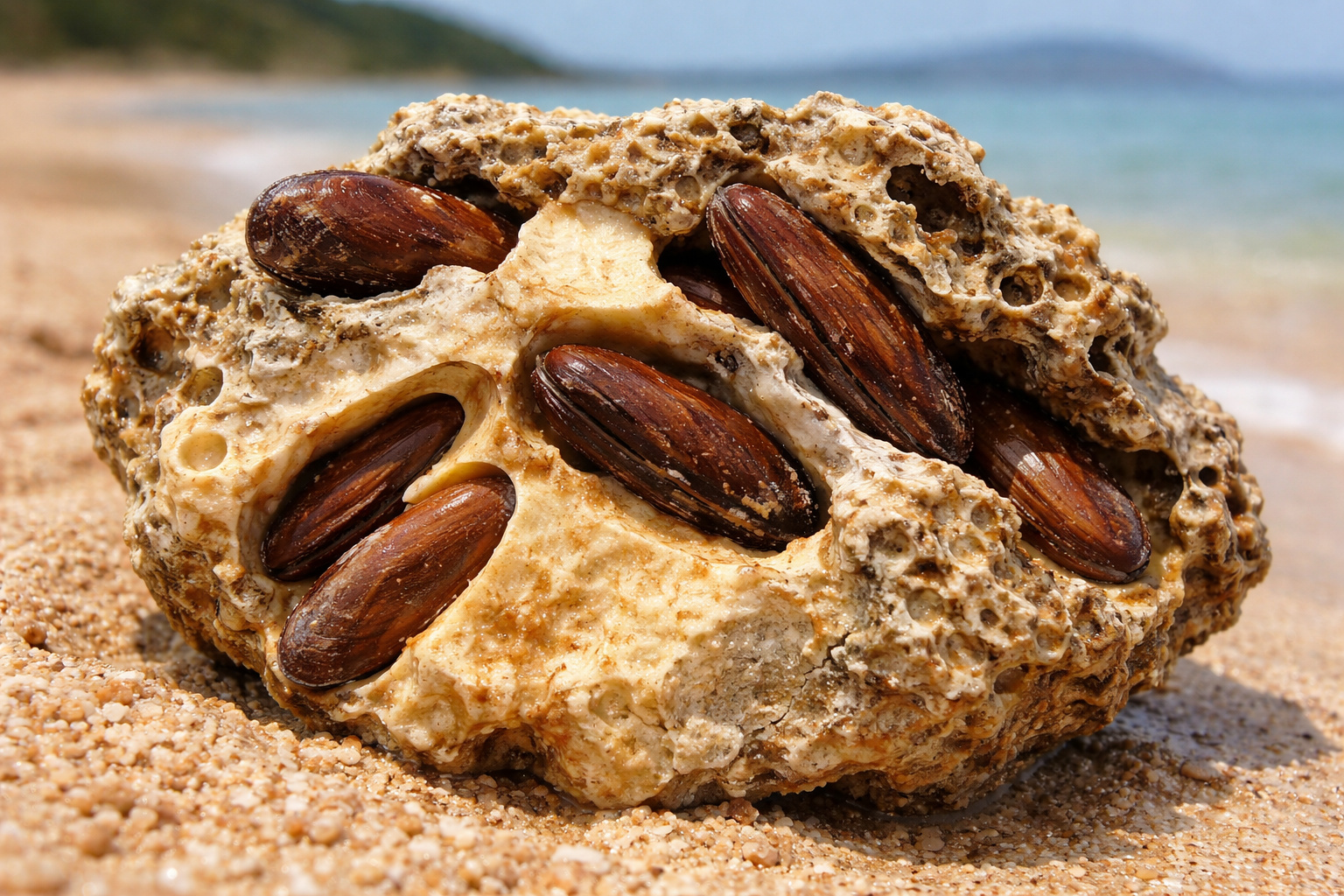


With Biological Acid Capable of Piercing Rocks, Lithophaga Lithophaga (Sea Date) Burrows into Coasts, Creates Submerged Labyrinths and Led Countries to Ban Fishing to Avoid Coastal Collapses.
When divers returned from the water with completely hollowed limestone blocks, many thought it was a case of common erosion. Only later did researchers confirm: it wasn’t the tide’s doing, but a bivalve mollusk called sea date (Lithophaga lithophaga), capable of boring into entire rocks using biological chemistry.
Discreet, rarely seen alive and protected by its own underwater architecture, the sea date has become one of the most impressive organisms in the Mediterranean — not for its size, but for its ability to reshape ecosystems over decades.
How the “Biological Acid” That Erodes Rocks Works
The sea date lives within limestone rocks (calcium carbonate), mainly in Mediterranean coasts. To excavate its tunnel, it secretes acidic substances that progressively dissolve the carbonate, making room for the animal’s growth. Sources such as NOAA, IUCN, Marine Biology and Mediterranean institutes describe the process as a combination of:
-
China Develops Custom 140-Ton Electric Mining Truck with 770 kWh Swappable Battery, Deploys 290 Units in Xinjiang’s Largest Zinc Mine

-
Meta to Launch Arena, a New Prediction App Targeting 3.56 Billion Users, Competing with Polymarket and Kalshi

-
Scientist Challenges Famous Human Evolution Theory, Argues Homo Sapiens Evolved Gradually Over Thousands of Years
-
15-Year-Old American Builds Ocean Generator with PVC Pipe and 3D-Printed Propeller for $12, Wins National Prize, Presents at White House, and Makes Forbes 30 Under 30 List




- Acid Secretion for Chemical Dissolution
- Mechanical Micro-abrasion (scraping) to enlarge the tunnel
- Permanently Fixed, as it does not leave the hole where it grows

The result is walls filled with cylindrical holes that, when exposed, resemble honeycombs — only in rock.
In many sections of the Croatian, Greek, and Italian coast, the ongoing work of these mollusks over decades to centuries transforms cliffs into highly perforated structures, altering coastal roughness and hydrodynamics.
Ecological Impacts: When Bioengineering Becomes a Problem
The transformation of the rocky substrate is not neutral. In marine biology, substrate determines fate: who lives there depends on texture, hardness, and water exchange. Perforated coasts accumulate sediments, change nutrient circulation, increase micro-habitats for certain species, and expel organisms that rely on smooth surfaces.
This process can favor species adapted to cryptic environments, reduce calcareous macroalgae and others that need solid bases, and even alter local trophic chains. It is a slow adjustment and difficult to reverse — and the problem is amplified by human fishing.
Why Sea Date Fishing Is So Destructive
To collect the sea date, you do not scrape the rock: you destroy the rock. Traditionally, Mediterranean fishermen would break cliffs with hammers, pulling out entire blocks and exposing colonies that took decades or centuries to form.

The result: accelerated erosion, loss of biodiversity, coastal disfigurement, and decreased primary producers, as algae and soft corals depend on intact rock.
Italian and Croatian studies show that one square meter of destroyed rock can take more than 50 years to recover biological coverage, and geological re-composition is essentially irreversible on a human scale.
The Coastal Collapse Led Countries to Ban Consumption
In light of the evident damage, several Mediterranean governments have banned fishing and trading of the sea date:
- Italy — banned since Law No. 963/1965 and reinforced by subsequent regulations;
- Croatia — consumption and extraction criminalized;
- Spain — protected in Mediterranean waters, with coastal enforcement;
- Greece — extraction considered destructive and illegal.
In some places, selling or serving sea date in restaurants can lead to hefty fines, closure of establishments, and even environmental lawsuits. The European Union also classifies it as a species of conservation interest, given the vulnerability of Mediterranean limestone coasts.
The Role of Science: The Mediterranean as a Bioengineering Laboratory
Italian, Croatian, Spanish, and Marine Biology Journal research analyze the sea date as a model of chemical bioerosion, rock-organism interaction, and long-term ecological engineering.

Marine zoology and geology laboratories treat the mollusk as an ecosystem engineer, in the same conceptual category as beavers, leafcutter ants, and tube-building amphipods — with the difference that this engineer works with acid.
The Paradox of the Sea Date
- Biologically, it is an evolutionary masterpiece: a mollusk capable of living hidden, protected and stable for decades;
- Ecologically, it is a transformational agent: cuts substrates, creates micro-habitats, and alters submerged landscapes;
- Culturally, it has become a delicacy that destroys the environment when collected.
This paradox — fascinating biology + destructive human impact — has made the sea date an environmental symbol in Mediterranean countries.







Não tem como criar em laboratórios ou fazendas marinhas como se faz com mexilhões?