






 Portuguese
  Spanish
  4 min of reading
  0 comments


Family business created in a rural stand in Jundiaí grew with cassava dough coxinhas, earned R$ 7 million in 2025, and now bets on franchises to expand presence in the São Paulo countryside and the capital.
Kiosque Roseira, a family business created from a fruit stand at the gate of a farm in Jundiaí, in the São Paulo countryside, reached four units, earned R$ 7 million in 2025, and started aiming for opening franchises by the end of 2026.
Leading the expansion is Mônica Leonardi Schincariol, who left a 29-year career in the financial market to take over the operation started by her parents, Jayr Leonardi and Laurinda.
According to UOL, the brand intends to open six franchised units, initially focusing on the São Paulo countryside and the capital, before advancing to more distant markets.
-
Farmers in the USA refuse millions to not give up lands that carry a lifetime of work, while the data center rush targets farms in Australia and turns AI into a new pressure force on areas that still produce food.

-
Son of a farmer from a remote village who barely spoke English scores 98.2%, earns a full scholarship to Cornell, and moves India

-
The richest man on the planet has already sent cheese into space: SpaceX placed a wheel of Le Brouère inside the Dragon capsule, kept the cargo a secret, and turned a NASA test into one of the most unusual missions in history.
-
After almost 40 years, the cable that helped build the modern internet begins to be removed from the ocean




The strategy starts in Jundiaí, where the company consolidated the sale of coxinhas, fruits, juices, and products linked to the family’s rural history.
Origin of Kiosque Roseira in Jundiaí
The origin of the business dates back to January 1987, when Laurinda and Jayr started selling grapes at the corner of the farm where they lived and cultivated the fruit, in the Caxambu neighborhood, in Jundiaí.
The first structure was improvised, made with canvas and bamboo, and served to protect the family from the sun during direct sales to the consumer.
At that time, the family sold part of the grapes that did not go to the São Paulo warehouses, as a simple alternative to better utilize the farm’s production.
Gradually, the stand also began to offer fruits from neighboring properties, such as strawberries, persimmons, peaches, and tangerines, increasing customer traffic in the area.
The rural stand took on a new format when Laurinda and Jayr began freezing fruits to prepare natural juices, maintaining business even outside the harvest season.
Then came the pastries and, later, the coxinhas, which changed the scale of the business and gave the old stand its own gastronomic identity.
Mônica left the financial market for the family business
The trajectory changed after Jayr’s death in 2005, when Laurinda maintained the operation with the help of her grandchildren.
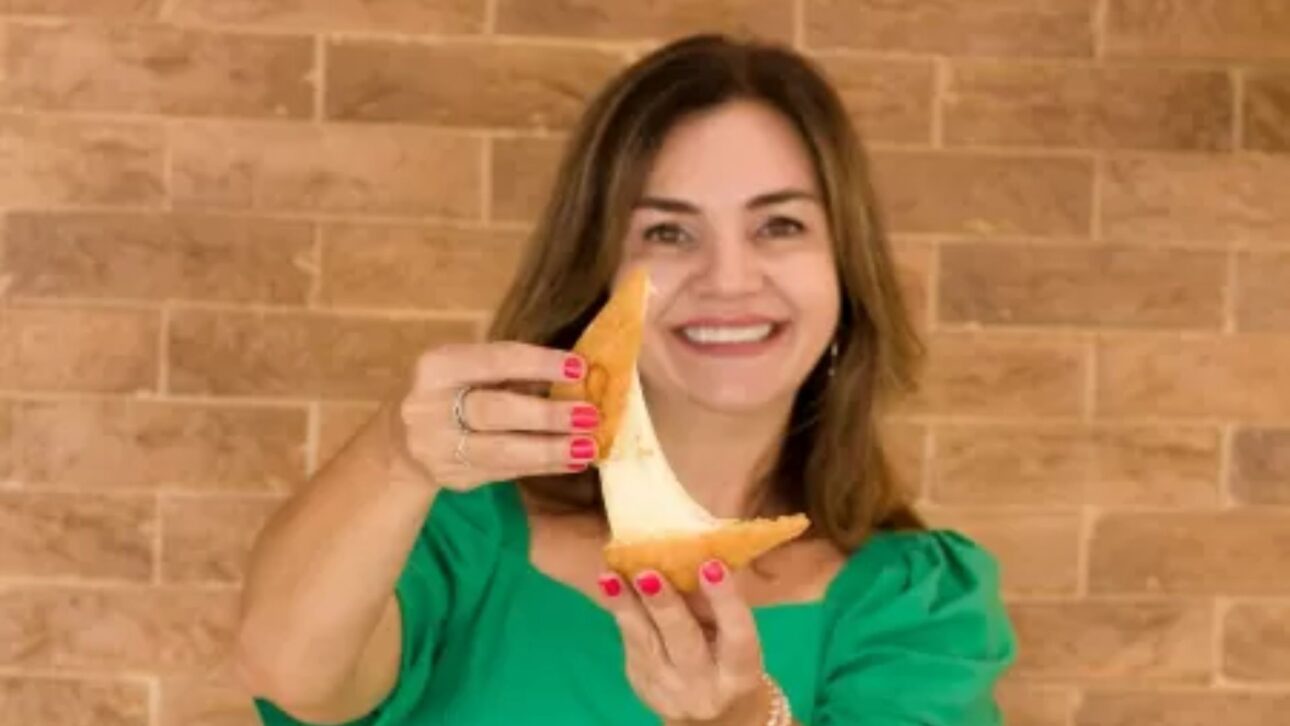
Ten years later, with her mother already elderly, Mônica decided to leave the financial market and take over the family business, a move that paved the way for the brand’s professionalization.
Trained in finance, Mônica worked in an area far from the routine of cooking, customer service, and large-scale production of snacks.
She told UOL: “I was already wanting to leave the financial market and change fields,” explaining her decision to continue the family legacy.
On January 6, 2017, the family business was inaugurated under the name Kiosque Roseira, at the same location where the old fruit stand operated.
Mônica’s nephew, César Leonardi Oliveira, joined the business as a partner and CEO, keeping the family’s presence in the operation’s leadership.
Cheese coxinha became the brand’s symbol
The product that projected the brand was the cheese coxinha with cassava dough, created by Laurinda in 2012.
The recipe gained strength in Jundiaí, a city where the cheese coxinha has cultural recognition and was declared an intangible heritage in 2018.
Following this recognition, Kiosque Roseira began to accumulate awards in the contest “The Best Cheese Coxinha in Jundiaí.”
According to UOL, the snack won the competition in 2019, 2020, and 2021, and Mônica became part of the technical jury of the competition in 2022.
The company also created a sweet variation connected to the family’s agricultural production: the grape coxinha.
The item combines cassava dough, whole grape juice, and a filling of artisanal Niagara grape jelly, and was launched in 2020 during the 37th Grape Festival and 8th Wine Expo in Jundiaí.
Menu has 20 flavors of coxinha
The menu includes 20 flavors of coxinha, among savory and sweet options.
Among the fillings mentioned by UOL are cheese, chicken, chicken with catupiry, rib with cheese, salmon, pork with provolone, grape, Nutella, and dulce de leche.
The 175-gram coxinha is sold, on average, for R$ 14, while a portion with 15 mini coxinhas costs between R$ 18 and R$ 20.
The monthly volume reported by the brand reaches about 50,000 traditional coxinhas and 250,000 mini coxinhas.
Kiosque Roseira Franchises Start Near Jundiaí
Kiosque Roseira has four units in operation, located in Jundiaí and Várzea Paulista.
The Várzea Paulista store operates as a pilot project of the franchise model, which will be offered in two formats: street store and shopping mall store.
The initial investment forecast ranges from R$ 215,000 to R$ 240,000, with an estimated average monthly revenue of R$ 100,000 and projected profit between 12% and 15%.
The expansion, according to Mônica, will follow a regional logic: “To facilitate logistics, the expansion will be in a spiral form.”
The proposal is to expand the area of operation without losing operational control, starting with cities close to Jundiaí and the capital of São Paulo.
The plan preserves elements that have sustained the brand so far: family origin, regional product, emotional memory, and professional management applied to an operation that was born outside the traditional business environment.
The old canvas and bamboo stall, created to sell grapes directly to the consumer, became the foundation of a company that uses the coxinha as its main scale product.
The growth shows how a rural business, when commercially structured, can gain regional presence without completely breaking with the history that originated it.




Be the first to react!