






 Portuguese
  Spanish


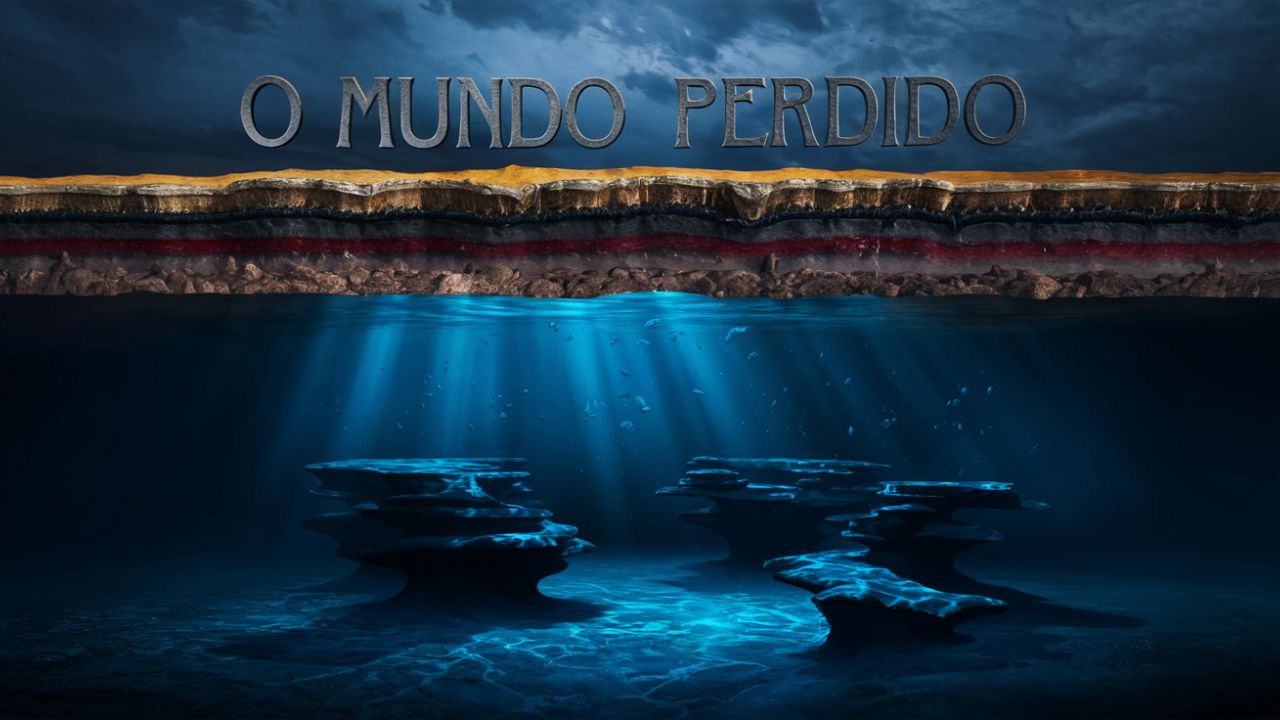


Mysterious Formations Found in the Earth’s Mantle Below the Pacific Ocean, Challenging Tectonic Plate Theories and Raising Hypotheses About 4 Billion-Year-Old Materials.
Something that contradicts everything we thought we knew. That’s exactly what happened when scientists discovered mysterious structures on the floor of the Pacific Ocean. This discovery not only shook the foundations of geology but also left a sense that there is much more to learn about our planet.
The Discovery That Challenged the Rules of Geology
In the middle of the Earth’s mantle, in an area where none of this should exist, geophysicists from ETH Zurich found formations that do not make sense to current science. Using high-resolution modeling techniques, they detected materials that may be remnants of subducted tectonic plates. The detail? According to our theories, these plates should not be there.
These formations are made up of materials that intrigue even the most experienced scientists. Some theories suggest they may be remnants of ancient tectonic plates, while others indicate that the discovery is deposits of iron-rich rocks. The most curious thing is that these zones defy conventional subduction models, as if they were pieces of a puzzle that do not fit together.
-
China Develops Custom 140-Ton Electric Mining Truck with 770 kWh Swappable Battery, Deploys 290 Units in Xinjiang’s Largest Zinc Mine

-
Meta to Launch Arena, a New Prediction App Targeting 3.56 Billion Users, Competing with Polymarket and Kalshi

-
Scientist Challenges Famous Human Evolution Theory, Argues Homo Sapiens Evolved Gradually Over Thousands of Years
-
15-Year-Old American Builds Ocean Generator with PVC Pipe and 3D-Printed Propeller for $12, Wins National Prize, Presents at White House, and Makes Forbes 30 Under 30 List




Thanks to high-resolution seismic models, it was possible to map the behavior of waves within the Earth. Imagine using a giant ultrasound to see what is underneath the ground – that’s more or less what happened. However, instead of confirming what they expected, scientists encountered something completely unexpected.
Advanced Technology and the Impact on Geology With the Discovery

The discovery was only possible due to high-resolution modeling technology, which allows for visualizing structures that previously went unnoticed. This advancement is like swapping an old magnifying glass for a super-powerful microscope.
With this new technology, researchers managed to detail the interior of the Earth’s mantle in a way never seen before. They observed anomalies that indicate unusual materials spread across deep regions of the planet.
By studying the behavior of seismic waves, they noticed that they deviated in unexpected ways. This suggested that the interior of the Earth is far more complex than we imagined – and full of secrets yet to be uncovered.
Theories About the Origins of the Formations
With so many unanswered questions, some hypotheses emerged to explain these enigmatic structures. Do they hold clues about the planet’s beginnings?
One theory is that these formations are made of very old materials, perhaps even from the beginning of the formation of the mantle, 4 billion years ago. Another possibility is that they are zones where iron-rich rocks have accumulated over time due to movements in the Earth’s mantle.
These discoveries could rewrite the history of our planet’s formation. They indicate that the processes that shaped the Earth may be more varied and complex than anyone imagined.
Future of Science
If confirmed, these discoveries could drastically change the way we understand the Earth. After all, what else is hidden beneath our feet, waiting to be discovered?
Scientists have already begun to rethink theories about tectonic plates and the Earth’s mantle. It’s as if a new page is being written in the great book of geology.
These formations remind us that, even with all available technology, we still know very little about the Earth. Each new discovery is a step toward the unknown – and an opportunity to learn more about ourselves.







Devem ser resquícios da terra primordial, que depois foi acrescida com resíduos espaciais das estrelas, cometas, asteroides, de teia e outros astros.
Nada e nem ninguém será capaz de desvendar nada sobre a terra.. o homem e muito incompetente demais para tal coisa,sem dizer que os nO temos essa sabedoria e muito menos sabemos nada do nosso criador. O planeta está em plena mudança e nada que façamos irá mudar isso. a cada milhares de anos haverá mudanças sobre a face da terra!!
“A vida é breve; a arte, longa.” – Hipócrates