Portuguese
  Spanish


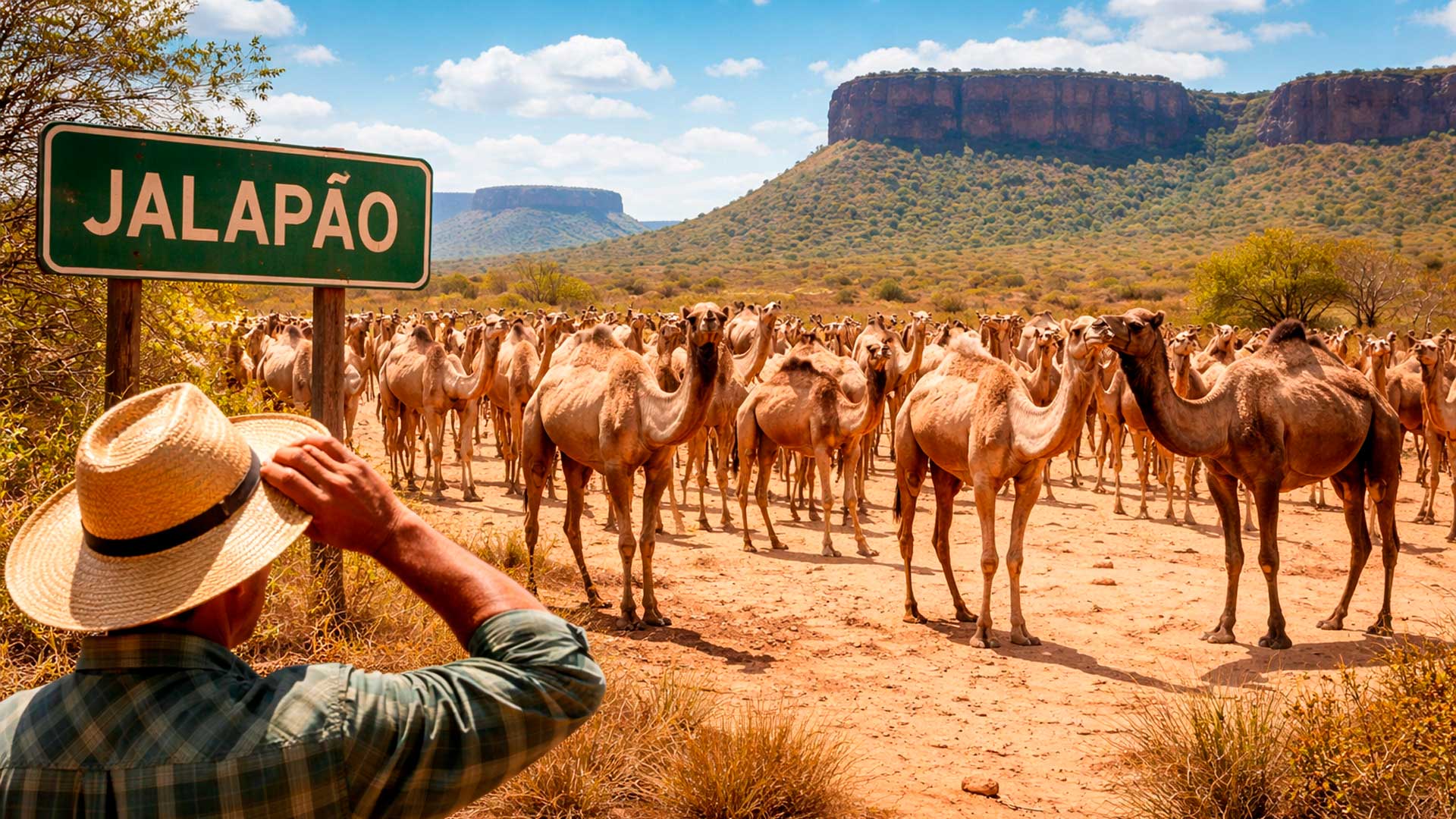


Dromedaries Seen in Rio Sono Attracted Attention for Looking Like They Came from the Desert, but They Arrived in 2024 and Are in Compliance with Health and Transportation Documentation, According to Local Authorities
The scene looked like it was from another continent. Animals called “camels” were filmed resting on a farm in the Jalapão region of Tocantins, and the question spread quickly: how did they appear there overnight.
The most straightforward answer is that there was no sudden “appearance,” but rather logistics. The Tocantins Agricultural Defense Agency (Adapec) reported that the animals arrived in the state in April 2024 and that the health and transportation documentation is regular, with verification of Animal Transit Guide (GTA) and other mandatory documents.
The shock, however, makes sense. Jalapão is known for its plateaus, sand, and dry climate, which reinforces the mental association with “camel habitat.” A local resident who captured the images summed up the astonishment in a few words by saying “It’s different. Even camel is here”, echoing what many thought when they saw the video.
-
How to Prevent Brown Recluse Spider Bites: Common Hiding Spots and Free Tips to Reduce Risks

-
Natto: The Unusual Japanese Superfood Gaining Popularity on Social Media and Driving Record Exports
-
Brazilian Mayor Goes Undercover as Homeless for 24 Hours to Assess Public Services

-
15-Year-Old Entrepreneur Malu Lira Publishes 20 Children’s Books on Financial Education, Earns $500,000, and Expands Her Project to the Amazon Rainforest




Behind this relocation, there is a little-remembered Brazilian context. For decades, dromedaries were used as a tourist attraction in the dunes of Genipabu, in Rio Grande do Norte, and the operation was closed in 2024, with plans to send the animals to a sanctuary in Tocantins.
What Really Appeared in the Cerrado of Tocantins


The term “camel” often becomes a catch-all for similar species. Technically, the dromedary is the “one-humped camel,” while the bactrian camel is the two-humped one.
This helps to understand why the scene confuses even those living in rural areas. In Brazil, these animals are not part of the native fauna and rely on management, feeding, and monitoring to thrive, which turns any unusual appearance into a topic of public debate.
From the Sand of Genipabu to the Interior of Tocantins: The Route That Explains the Surprise
Genipabu has been synonymous with a unique outing for many years. The company Dromedunas operated for 26 years with dromedaries on the sands of Genipabu Beach, in Extremoz, Greater Natal, until announcing the closure of activities on May 15, 2024.
The text of the announcement and local coverage indicated low demand as the central reason, following a period of difficulties and changes in the format of the service. The operation had already reduced tours and maintained, for a time, only photos with animals in a private area.
At its peak, in the early 2000s, the business offered 120 tours per day and maintained 20 dromedaries, according to the report.
At the closure, the relevant information for the history of Jalapão is the destination. Coverage recorded that the animals would go to a sanctuary in Tocantins, where a project related to camelid reproduction would continue.
Here comes the connection that makes the story “close” in the minds of those following the case. The arrival in April 2024 confirmed by Adapec in Rio Sono coincides with the period of demobilization of tourism in Genipabu, making it plausible that some of the animals seen in Tocantins came from this transfer, although not all publications mention the origin by name.
What the Oversight Says and Why This Doesn’t Lead to an Invasion of Wild Species
Besides the curiosity aspect, there was a practical concern. When an animal appears unexpectedly, doubts arise about escape, sanitary risk, and environmental impact, especially in ecotourism areas.
At this point, the most important information is about control. Adapec stated that the situation is regular and that the verification included GTA and mandatory documents, highlighting that, from a sanitary point of view, there would be no irregularity.
On the federal side, there is a detail that almost no one knows. In an official list from Ibama of species considered domestic for operational purposes, both Camelus bactrianus identified as camel and Camelus dromedarius identified as dromedary appear.
This does not mean “free rein” to raise any exotic animal under any conditions. It means that, when there is breeding and transportation, the debate revolves around documentation, health, welfare, and oversight, not a supposed natural presence in the Cerrado.
Why the Case Draws So Much Attention and What It Reveals About Camelid Farming Worldwide
The Brazilian surprise also stems from the imagination. Dromedaries are associated with North Africa and the Middle East, and reference sources describe the dromedary as the camel with one hump, adapted to arid regions.
However, globally, camelids are not just “desert animals in films.” There are established production chains in several countries, focusing on milk, meat, work, and sport. Scientific reviews describe dromedary milk as a valued product and report average daily productions that vary according to management and region, with numbers often in the range of a few liters per day.
When this reality meets Brazil, the reaction tends to oscillate between fascination and discomfort. Fascination for the improbable image in Jalapão and discomfort because part of the collective memory associates these animals with tourist use, reopening discussions about limits, care, and transparency.
In the end, the story of the “camels of Jalapão” is neither a supernatural mystery nor a sudden invasion. It’s a combination of economic change in tourism, animal transfer, and a visual shock amplified by social media.
In your view, should dromedaries be used in tourist attractions in Brazil or should this be banned altogether? Comment on what you think and where you would draw the line between tourist tradition, animal welfare, and oversight.