






 Portuguese
  Spanish


A microhouse village in the United States draws attention for combining compact housing, reduced rent, and social support in a project aimed at seniors facing housing insecurity.
A community of nine microhouses for low-income seniors facing housing insecurity was inaugurated on May 1, 2026, in Pensacola, Florida, by the Catholic Diocese of Pensacola-Tallahassee.
Called Trinity Village, the project occupies land owned by the diocese on West Garden Street and offers compact housing with rent of $500 per month, which includes basic bills, according to the institution and the local press.
The initiative was created to assist seniors living on a fixed income who struggle to maintain housing amid rising costs such as rent, taxes, insurance, and property maintenance.
-
Mother from Brazil’s Maranhão Creates Lactose-Free Cookie for Daughter with Cerebral Palsy, Now Producing 10 Tons Annually and Exporting to Mexico

-
Brazilian Student Turns Electric Shower Repair into Thriving Industry with 3,600 Jobs and Over $1 Billion in Revenue, Aiming to Become the “Next WEG”

-
German Ship Concludes 40-Year Maritime Career with Final Mission in Brazil, Departing Recife with Floating Labs to Study Atlantic Currents
-
Artisanal Well Transforms 4 Hectares in Brazil’s Semi-Arid Region into Productive Farmland with Drip Irrigation


According to the diocese, this group is among the most vulnerable to housing insecurity in the Pensacola area.
In Trinity Village, each house is just under 300 square feet, equivalent to almost 28 m².
The units feature a bedroom, bathroom, compact kitchen, and living area in an individual space, structured to provide permanent housing for low-income seniors seeking housing stability.
Microhouses for Seniors in Pensacola
Trinity Village was inaugurated almost two years after the project began.
EWTN News reported that the diocese held the groundbreaking ceremony in September 2024, on a lot located behind the institution’s pastoral center.
The official handover of the houses took place in May 2026.
The community was developed by Trinity House LLC, linked to the Catholic Diocese of Pensacola-Tallahassee, with funding from private donations.
According to the institution’s official page, the goal is to expand housing access for low-income seniors facing housing insecurity.
The diocese states that the project received support from donors, families, foundations, and local partners.
Among the contributions cited by the institution is a donation of $300,000 from the Chadbourne-DeMaria Foundation.
Local coverage also reported that the total cost of the construction was just over $1 million.
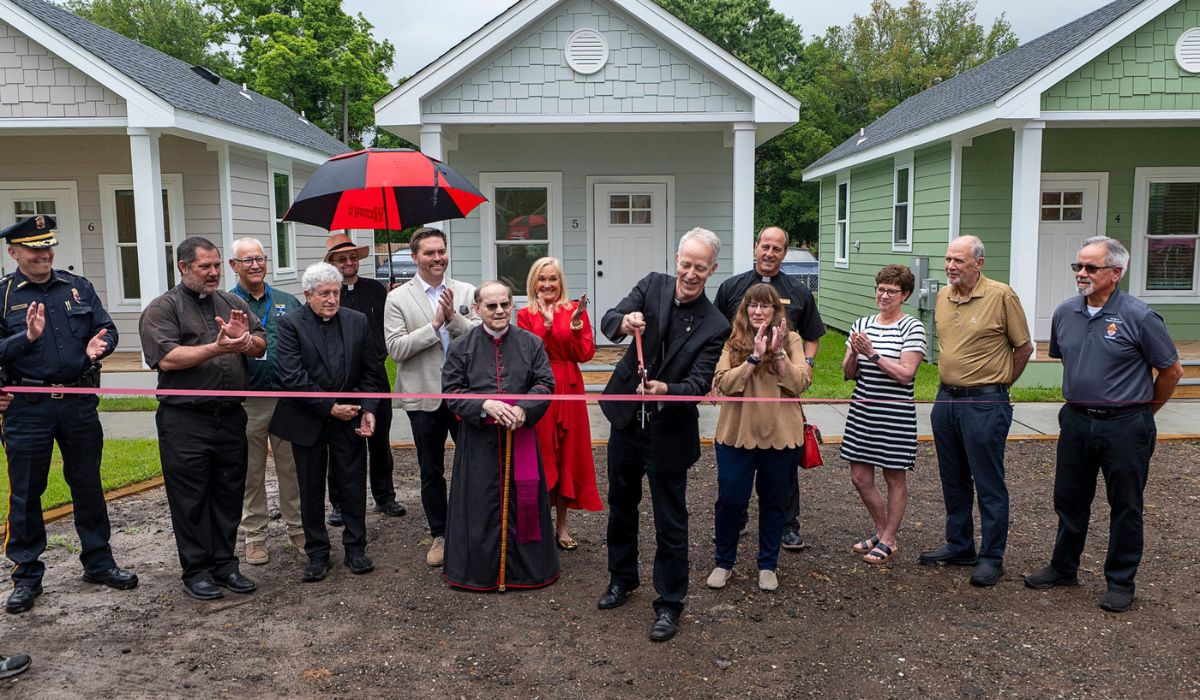
Compact Housing with Individual Structure
The micro-houses draw attention for using a reduced area to concentrate basic housing functions.
The proposal of Trinity Village is not to operate as a collective shelter, but to offer individual units, with a bathroom, kitchen, and private sleeping space.
This difference was highlighted by the diocese itself when presenting the project as a stable housing alternative for the elderly.
Instead of temporary stays in shelters or emergency solutions, the units were structured to function as permanent residences, with monthly rent and social support.
The format also allows each resident to maintain their own routine.
The Diocese of Pensacola-Tallahassee states that the project includes case management and mentoring services, with support for access to documents, social benefits, food, and other services aimed at the elderly.
The reduced size of the houses was treated by the diocese as part of the housing model.
In an interview with WUWF, Deacon Ray Aguado stated that the units are just under 300 square feet, with a 10-foot ceiling and natural light entry.
He used the description to explain the attempt to avoid making the spaces seem too enclosed.
Rent of $500 with Bills Included
The monthly rent was set at $500, with basic bills included, according to broadcaster WEAR and EWTN News.
For residents with fixed income, cost predictability is one of the central points of the project, as variable expenses can compromise the monthly budget.
Bishop William Wack, of the Diocese of Pensacola-Tallahassee, told the local press that the community was designed for people pressured by choices between paying for housing, buying food, or maintaining medical treatments.
The statement was made during the coverage of the opening of Trinity Village.
Deacon Ray Aguado also told the press that he was surprised to notice the presence of many people over 60 among the homeless population.
According to him, part of this group faces difficulty finding rent compatible with available income.
Among those interested in one of the units was David Sanford, who told the local broadcaster he hoped to secure a spot.
He said that the space would allow him to move around with the chair, take a shower, cook, and live more independently if he was approved in the selection process.


Social support for low-income seniors
In addition to housing, Trinity Village provides support for the residents.
The official page of Trinity House states that residents can receive support in case management, mentoring, and referrals to public and community services.
The assistance may include help in obtaining identification documents, driver’s license, Social Security card, social benefits, and food programs.
These services were mentioned by the diocese itself as part of the support structure for the seniors living there.
In the context of the project, the housing serves as a starting point to organize other aspects of daily life.
Without a stable address, seniors may face obstacles in receiving official mail, keeping documents updated, accessing benefits, and attending health appointments.
The diocese reported that it intends to use other owned lands in Pensacola to build new units in the future.
The expansion, according to the institution, will depend on the continuation of partnerships and private donations to enable new stages of affordable housing.
Church land and affordable housing
The use of land belonging to a religious institution is one of the characteristics of Trinity Village.
The community was established in an area of the Catholic Diocese of Pensacola-Tallahassee, which reduced the need to acquire new land for the first phase of the project.
The WUWF report pointed out that local leaders are discussing ways to expand microhouse communities in Escambia County.

The theme involves land use regulations, building codes, and the possibility for churches to use their own properties in affordable housing projects.
At the opening ceremony, the Diocese of Pensacola-Tallahassee cited the participation of partners such as Catholic Charities of Northwest Florida, architects, engineers, construction companies, and donors.
The city of Pensacola was also represented at the event, with the presence of Mayor D.C. Reeves, according to the institution.
With nine units, Trinity Village has a limited scale but presents a specific model of urban land use for low-income senior housing.
The project brings together compact houses, rent below usual market values for new units, and social support services, according to the information released by the diocese.


